Villagers Seek Restoration of Neglected 700-Year-Old Temple

To protect their cultural legacy, the villagers voluntarily removed the overgrowth and cleaned the temple premises.
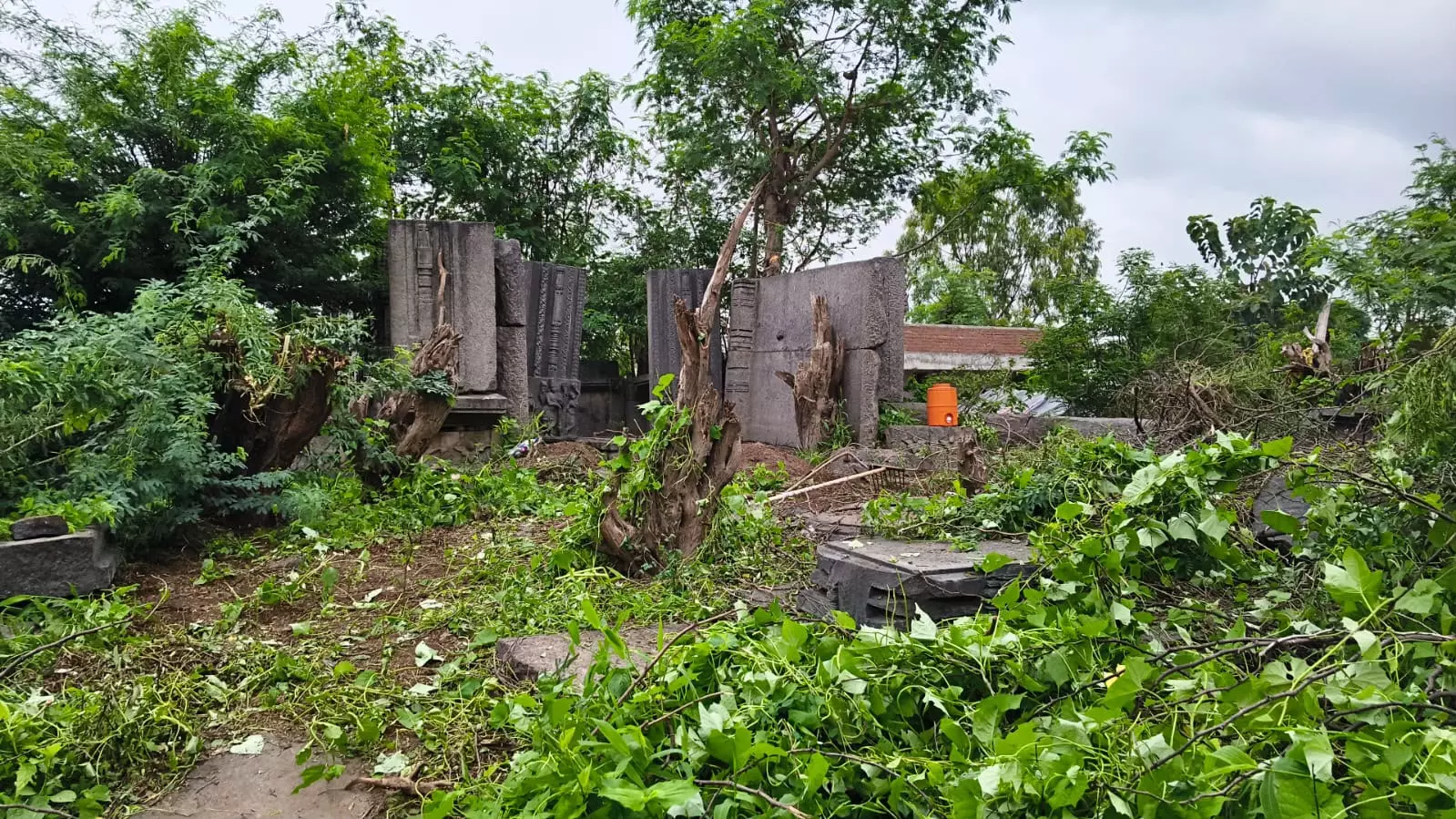
Hyderabad: In an example of community participation in heritage conservation, residents of Kondaparthy village, near Hanamkonda, have brought renewed attention to a neglected Kakatiya-era monument by clearing vegetation and debris from the ruins of the historic 500-pillar temple.
For several years, the temple remained beneath dense vegetation, thorny bushes and debris, leaving its architectural splendour hidden from public view. To protect their cultural legacy, the villagers voluntarily removed the overgrowth and cleaned the temple premises.
Their efforts have brought to light several stone pillars, sculptural fragments and structural remains that bear testimony to the artistic excellence and engineering expertise of the Kakatiya period.
Despite its historical and architectural importance, the temple is now in a severely dilapidated condition. Several carved pillars have collapsed, walls have crumbled, and portions of the complex have disappeared over time.
The villagers appealed to the heritage department to undertake the scientific conservation of the monument, documentation, structural conservation, protective fencing, and interpretative signboards. Villagers said that prolonged neglect had turned the temple premises into a location for illegal and antisocial activities.
“Some unidentified persons had also dug inside the garbhagriha (sanctum sanctorum) in search of gold. Therefore, we decided to clean the monument and protect it,” said Hareesh, a resident of Kondaparthy.
Village sarpanch Ashok Rao expressed concern that the monument could suffer further damage from encroachment and other illegal activities if regular monitoring and adequate protective measures were not introduced.
Beyond the 500-pillar temple, Kondaparthy occupies a distinguished place in Telangana’s medieval history. Historians say that the village served as an important military township under the Malyala chiefs, who were influential feudatories of the Kakatiya kingdom.
Chounda Senani, one of the military commanders under King Ganapati Deva between 1203 and 1206, led a successful Kakatiya expedition against the Velanati ruler Prithviswara, captured his treasury and extended Kakatiya authority into the Divi region. Historians believe that Chounda Senani subsequently constructed the Chounda Samudram irrigation tank in his native village and built a magnificent temple.