Vanishing Folk Art ‘Jadakoppulata’ Finds New Life in Adilabad

The play is also struggling for patronage amid changing social, political, and economic conditions in rural areas
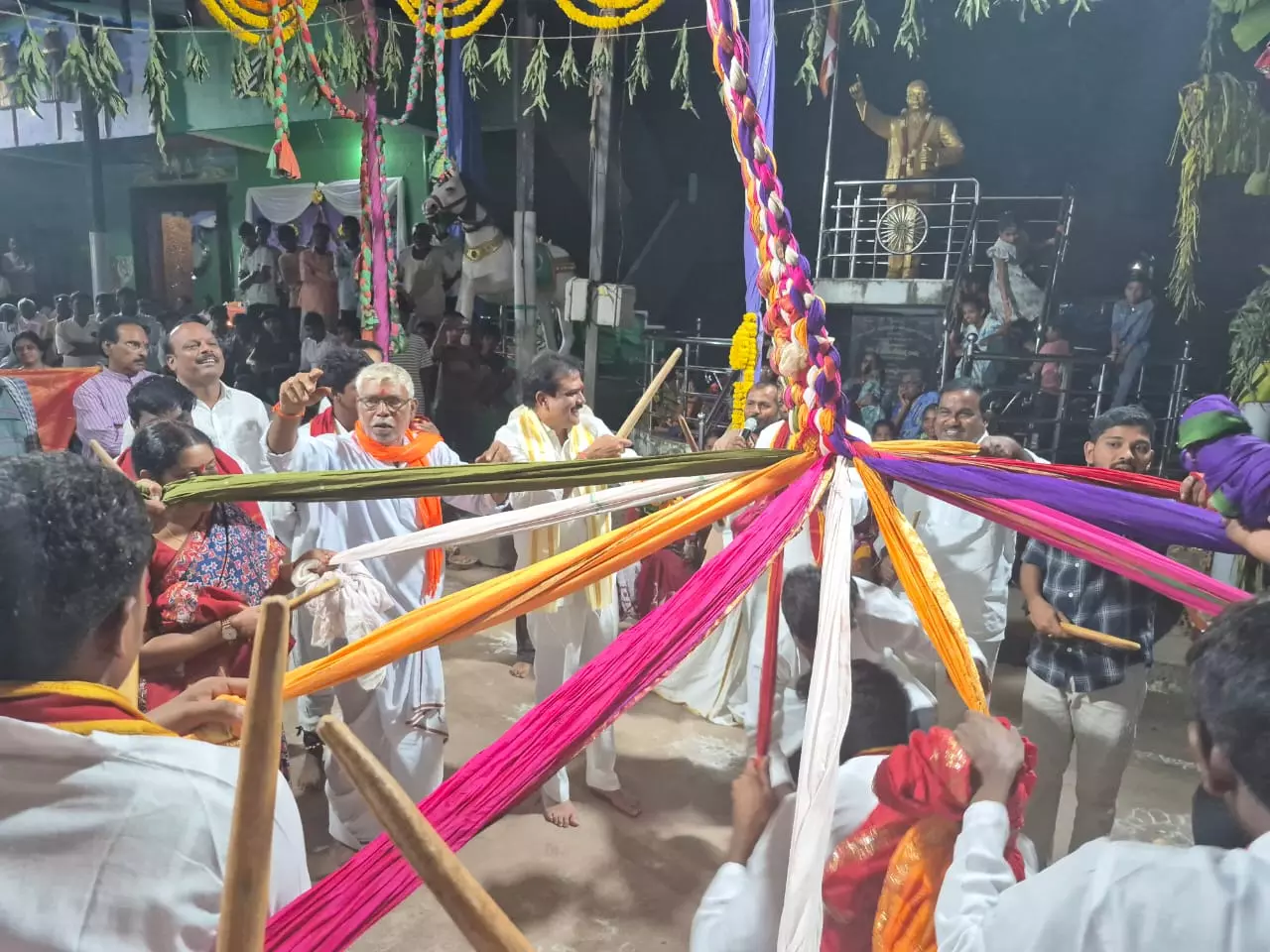
ADILABAD: The traditional and colourful folk play Jadakoppulata, which resembles the act of braiding hair, is on the verge of disappearing in Adilabad district, as younger generations show little interest in learning or performing it. However, a few senior artists have been making efforts over the past three years to revive this unique art form.
The play is also struggling for patronage amid changing social, political, and economic conditions in rural areas. Jadakoppulata, considered a distinctive local tradition of Adilabad, is typically performed under a mandapam during Diwali and Karthika Masam festivals.
Around 16 to 18 artists are required to perform, along with musicians who play traditional instruments such as dholak, tabla, harmonium, and talalu, and four singers who render songs during the performance. Traditionally, only men and boys played Jadakoppulata, but in recent years, women and girls have begun to participate, encouraged by senior artists.
The play is usually held at night, when villagers gather after their day’s work to relax and enjoy the performance. The braiding involves long silk cloths (pattu sagalu), tied to a wheel atop the mandapam, with the other ends hanging down. Artists interlace these strands in rhythmic patterns, creating a braid-like design, while simultaneously performing kolatam (stick dance). A single misstep can ruin the intricate braiding, making coordination vital.
The artists move rhythmically in a circle, singing songs that praise Lord Krishna’s childhood pranks and depict the love story of Radha and Krishna. The Jadakoppulata begins with Onama Jada two days before Diwali, followed by Thadaka Jada on Lakshmi Puja day, and both Gummi Jada and Lakshmi Jada on Diwali. The event concludes the next morning with Mangala Harathi. As part of the tradition, a goat is sacrificed, and a feast is held for the villagers.
Today, only a few senior artists remain in villages such as Jamdapur, Kuchulapur, and Kothaguda-Yapalguda, where they continue to train those interested in preserving the tradition. The play involves two days of braiding (jada veyyadam) followed by two days of unbraiding (jada theeyadam).
Government teacher Thaksande Charan Das, 56, of Yapalguda, said the play has gradually faded from public memory due to modern influences, but some senior artists are working to revive it. “Jadakoppulata is performed only when the house owner is willing to bear the expenses, which has limited its frequency,” he added. He also noted that learning and singing mythological songs as part of the play served as a form of informal education for the illiterate.
Once popular in villages like Ankoli, Mediguda, Chanda (T), Kapparla, Kuchulapur, Jamdapur, Sonala (Boath), Yapalguda, Hasnapur, Pendawada, Thoyaguda, and Chincharwada, Jadakoppulata now survives only in a few areas.
Senior artist Katakam Veeraiah of Yapalguda said, “Children and youth are not interested in Jadakoppulata because they are drawn to mobile phones and cinema, though villagers still enjoy watching it.” He added that he has trained several young people over the past 15 years, but many elderly artists are no longer able to perform due to health issues.
Another senior artist, Meesala Keshav of Jamdapur, said he is currently training 20 youths interested in Jadakoppulata. “The legacy continues only in villages where it still has patronage and has not spread beyond them,” he observed.
