UoH Sustainable Solution: Biochar From Waste

Study shows biochar made from farm waste can improve soil fertility and plant strength
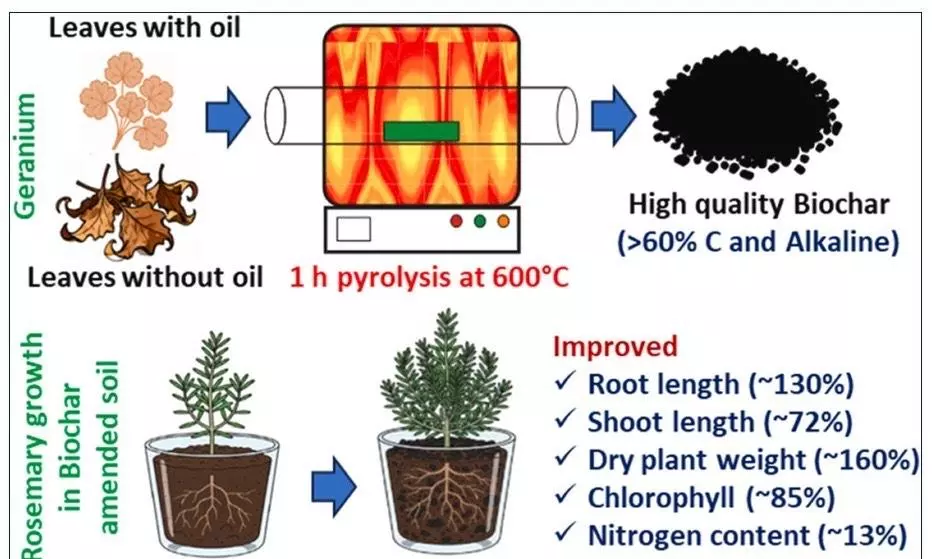
Hyderabad: Agricultural waste that usually ends up as discarded residue may soon become a soil enhancer that makes crops stronger. A research team at the University of Hyderabad (UoH) has demonstrated that waste geranium leaves from the essential oil industry can be converted into biochar, a carbon-rich material that restores soil and improves plant vigour.
Their findings, published in a special issue of Biomass and Bioenergy (Elsevier, November 2025), present a practical way to turn waste streams into a tool for sustainable farming.
The study, ‘Upcycling of waste geranium leaves into biochar for soil amendment’, was jointly led by Prof. Appa Rao Podile from the School of Life Sciences and Prof. Dr V.V.S.S. Srikanth from the School of Engineering Sciences and Technology. The interdisciplinary team, which included Dr Danteswari Ch, Dr Sarma P.V.S.R.N., Akshay Rao, Dharani Kumar and Dr Ravikiran, combined plant science and materials engineering to design the process.
Analyses showed geranium biochar had about 65 per cent carbon content and contained useful minerals including calcium, potassium, magnesium and phosphorus. Its alkaline nature was found to improve soil fertility. When tested on rosemary plants, soils amended with this biochar produced stronger growth and better nutrient uptake, indicating potential value for farmers who struggle with degraded or nutrient-poor soils.
Prof. Podile said the work showed “how a waste product from the essential oil industry can be turned into a sustainable soil enhancer that supports plant health, soil restoration and carbon sequestration.” Prof Srikanth added that collaboration between disciplines “enabled a holistic approach, from process design to agricultural application.”
The team noted that geranium residues were inexpensive and plentiful, with modest energy requirements of about 9 kWh per batch and a significantly lower production cost than many commercial biochar products. The project received support from the Department of Biotechnology, with analytical facilities aided by the Union Department of Science and Technology’s Fund for Improvement of S&T Infrastructure (FIST) and the Institution of Eminence programme at UoH.
