Unending Wait At Signals Frustrate Commuters

Uneven signals, VIP convoys worsen traffic snarls at Hyderabad’s busiest junctions
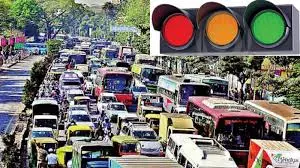
Hyderabad: A detailed analysis of traffic flow across the Hyderabad police commissionerate highlighted challenges being faced by people on the city's roads such as uneven signal cycles to politically-sensitive junctions frequently taken off automated control due to VIP movements.
According to figures from the Hyderabad commissionerate, 36 major junctions in the city experience heavy traffic flow, with some witnessing more than 15,000 vehicles during morning or evening peak hours.
“The CCTV cameras that count vehicles are placed at important junctions like the Nalgonda, Sangeet, Patny, Punjagutta and CTO crossroads. The most congested among them is Sangeet crossroad, with 19,484 vehicles recorded between 8 am and 11 am, and 11,634 vehicles in the evening slot — the highest in the dataset,” said an official.
Despite heavy traffic flow, officials claim that the average waiting time at these junctions remains under 180 seconds. Commuters complain that traffic snarls feel much longer, especially at signals with uneven timing cycles.
At Sangeet, Panjagutta, Masab Tank, Habsiguda, and seven other junctions, red lights stay on for 120 seconds while the green signal lasts 60 seconds, forcing multiple halts for the same set of vehicles.
Referring to the traffic signal at the Sangeet Crossroads, which has the highest volume, a regular commuter remarked, “It’s exhausting to wait through two or three signals continuously. The halting time makes me feel like I’m seeing red forever.”
S. Kavya, an MNC employee, said, “My commute to Uppal via the Sangeet junction is terrible. Whether I take a city bus, cab, or office shuttle, I end up waiting endlessly.”
Regarding the Nalgonda crossroads, a commuter travelling from Malakpet to LB Nagar said, “The road is narrow and poorly maintained, making it difficult to navigate. The traffic is always slow, and the stretch narrows even further near LB Nagar, making it hard to accelerate.” This junction sees a traffic count of 13,296 vehicles in the morning and 6,541 in the evening.
To ease congestion at pressure points, an official said that flyovers have been converted into one-way routes during peak hours as a temporary measure. “It is one of the solutions we came up with, but it’s not sustainable in the long term,” said a senior traffic official.
On the other hand, 16 major junctions — including Khairatabad VV Statue, Panjagutta crossroads, Ravindra Bharathi, Taj Krishna, Road No.s 10 and 12, Masab Tank, and Jubilee Hills checkpost — face a different set of problems, mainly emanating from VIP movements.
The traffic police frequently require a switch from automated signal systems to manual operation due to political movements and VIP convoys. This not only burdens traffic personnel but also leads to unpredictable signal timings, further slowing traffic during peak hours and frustrating the public. A commuter who passes through the Jubilee Hills Checkpost at least once a week remarked that he was relieved it wasn’t on his daily route.
He said, “I’m fortunate not to be stuck in these junctions regularly, especially during political movements. Once, while heading towards Secunderabad from Jubilee Hills Checkpost, a convoy and two ambulances were en route. Luckily, the convoy gave way to the ambulances. However, the convoy staff were rude, yelling at regular commuters to make way — and this continued all the way to Begumpet Airport.”
Questioning this behaviour, he asked why VIPs were treated as more important than the public.
Experts warn that such dependence on manual regulation is a step backward. “The city needs adaptive signal technology that can respond to real-time volume, even in sensitive zones,” said a senior analyst.
In addition to signal delays, the city’s growing number of vehicles — especially two-wheelers and cars — is adding pressure on intersections like Panjagutta, Nalgonda crossroads, and Patny, each clocking between 12,000 and 15,000 vehicles during morning rush hours, another official added.
Commuters are frustrated by what they call an unjustified and imbalanced signal system at major junctions — frequently seen at Narayanaguda, Sangeet crossroads, and the one Hitec City.
An official from the Madhapur zone commented that the signal near Cyber Towers is particularly busy, with only two roads available for commuters coming from Kukatpally and adjoining areas. He said, “At the Cyber Towers junction, of the four arms, two are the busiest — with at least one thousand vehicles of all kinds waiting at the signal. While it’s generally expected that the road from Gachibowli to Madhapur is the busiest, in reality, it's the Kukatpally-to-Hi-Tech City stretch that faces greater congestion.”
Another officer from Hyderabad added that the green signal duration depends entirely on traffic flow. “Red signals typically do not exceed 180 seconds unless the traffic volume is unexpectedly high. However, even this balance can sometimes result in persistent delays,” he explained.
