Trust Issues Dog KLIS Barrages’ Repair Plans
It is reliably learnt that the irrigation officials have been informed by the CWPRS that a report will be submitted on the test results and findings in due course.
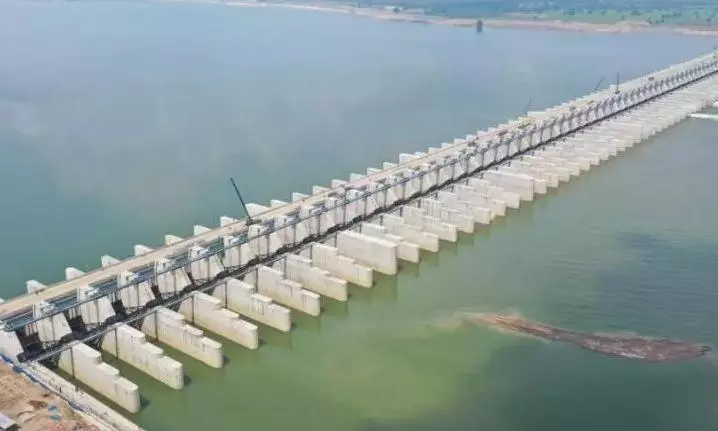
Hyderabad: A battle is brewing between the irrigation department and the agency it selected to conduct tests at the Kaleshwaram lift irrigation scheme’s three barrages over the sharing of data. The Pune-based CWPRS (Central Water and Power Research Station) is learnt to be reluctant to share raw test data with the department, while irrigation officials are insisting that this data must be provided to them to cross-check of reports.
These tests are critical for establishing the baselines on which any repair designs and eventual rehabilitation of the barrages can be taken up.
These differences come amidst allegations levelled by the BRS of “deliberate destabilising” of the immediate environment around the Annaram barrage through sand mining which, the party alleged, would weaken the foundations, and was being allowed by the Congress government to create problems at the site.
Things were learnt to have come to such a pass that irrigation engineers overseeing the testing at Annaram barrage by the CWPRS have informed their superiors in writing of the reluctance of the Pune-based body to share the raw data – that include geophysical, geotechnical examinations – of the river bed, the barrage structure, among other things.
It is reliably learnt that the irrigation officials have been informed by the CWPRS that a report will be submitted on the test results and findings in due course. The CWPRS has been contracted by the department to conduct tests at the Sundilla, Annaram, and Medigadda barrages. The data on the geology, and geophysical status of the river bed under the barrages, and their current structural stability, along with flow dynamics upstream,can be factored into preparing repair designs, for the barrages themselves, and especially for the downstream spillway areas.
“Irrigation officials believe there could be a ‘hidden agenda’ behind this reluctance in sharing raw data. The suspicion is that the report will hedge its bets, play safe, and kick the ball down the road on the findings. The fact is that some of the CWPRS staff are worried that if they find things are okay at the barrage and this is reflected in the raw data, then the institute would be blamed for faulty work if something went wrong after the repairs are done,” according to a well-informed source.
These fears were corroborated by a source in the government too who explained that the real fear is “no one wants to take the responsibility in case something goes wrong in the future.”
