Hyderabad To Turn Net Zero City By 2034, Says CM
India emerged as a services powerhouse driven by telecom & software, hosting global tech firms & largest no. of capability centers: Revanth Reddy
Hyderabad: Chief Minister A. Revanth Reddy on Wednesday said that Hyderabad will achieve Net Zero emissions by 2034 and a city-wide carbon footprint audit will be undertaken shortly.
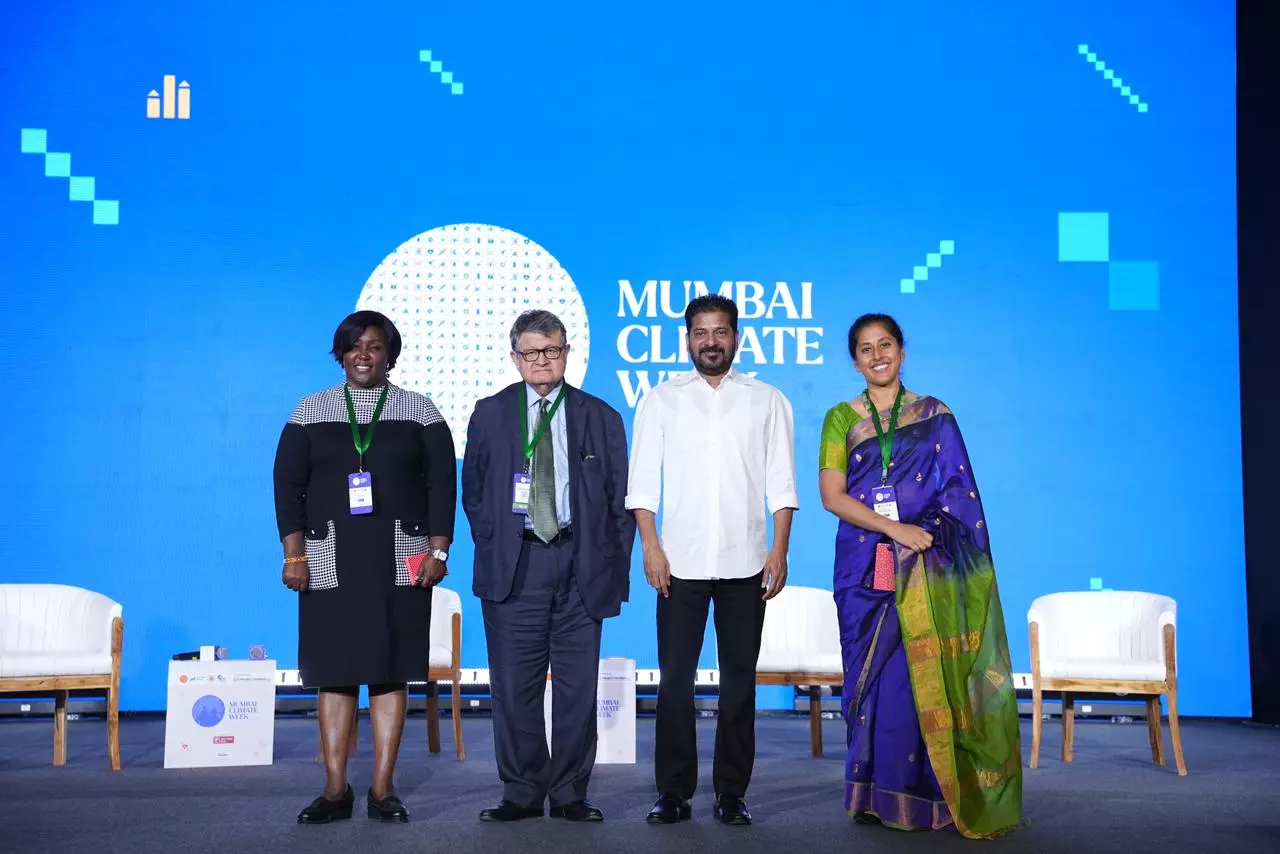
Addressing Mumbai Climate Week 2026 in Mumbai on Wednesday, the Chief Minister said that within the next five years there would be no factories within the Hyderabad urban area, as all manufacturing units will be shifted from the core urban region to peri-urban zones.
He highlighted sustainability initiatives in Hyderabad, including the rejuvenation of river Musi, restoration of lakes, strengthening of water and energy grids, and the establishment of HYDRAA, described as India’s first dedicated environmental police force.
Describing energy as central to economic growth, the Chief Minister said development is measured by power generation and consumption. Telangana currently consumes an average of 16,610 MW per day. The peak demand recorded last year was 17,162 MW, which is expected to exceed 19,000 MW this year and projected to cross 34,000 MW by 2034 as the state targets a $1 trillion economy. Nearly 25 per cent of the state’s energy is sourced from green power, he said.
In Hyderabad, he said, axes on electric vehicles have been removed, resulting in higher adoption. Discussions are under way with EV firms for manufacturing investments. Over 2 lakh auto rickshaws are being retrofitted towards green alternatives, more than 3,500 RTC buses are being replaced with electric buses, and the Hyderabad Metro is being expanded from 71 km to over 200 km, he added.
Revanth Reddy said every unit of power that turns green benefits the state, the country and the planet, and underlined the need for manufacturing growth powered by green energy.
Outlining Telangana’s long-term development vision, the Chief Minister linked economic growth with environmental sustainability. He said understanding 2047 required beginning with 1947, and noted that between 1950 and 1990 India prioritised education and irrigation, building educational institutions from village schools to premier institutes and constructing major dams for power and irrigation. By 1990, he said, India had achieved food sufficiency, improved life expectancy, and gained global recognition for its professionals.
Referring to the period from 1991 to 2020, he said the focus shifted to liberalisation, privatisation and globalisation, with India emerging as a services-driven economy led by telecom and software. He said that although the period delivered significant success, the manufacturing opportunity was missed, and added that the approach had changed particularly after Covid-19.
He reiterated Telangana’s target of expanding its economy from $200 billion to $1 trillion by 2034 and to $3 trillion by 2047. He listed the focus areas as economy, environment, education and skills, energy, employment, entrepreneurship and wealth creation.
The Chief Minister said Telangana’s development strategy is structured into three zones — CURE, PURE and RARE. Hyderabad has been designated as the Core Urban Region Economy (CURE) within the 160-km Outer Ring Road. The PURE zone, located between the Outer Ring Road and the 360-km Regional Ring Road, has been earmarked for manufacturing and positioned as a green energy-powered hub.
Referring to the impact of Covid-19 and climate change, he said both had altered governance approaches and described the current situation as a climate emergency, while stating that growth, investment and job creation must continue alongside sustainability.
