Telangana Neta Natter | Revanth’s Report Card On Government Schools

Taking on the long-held stereotype that government schools are only for the poorest, Revanth said his government is transforming them to match private and corporate institutions in infrastructure and quality
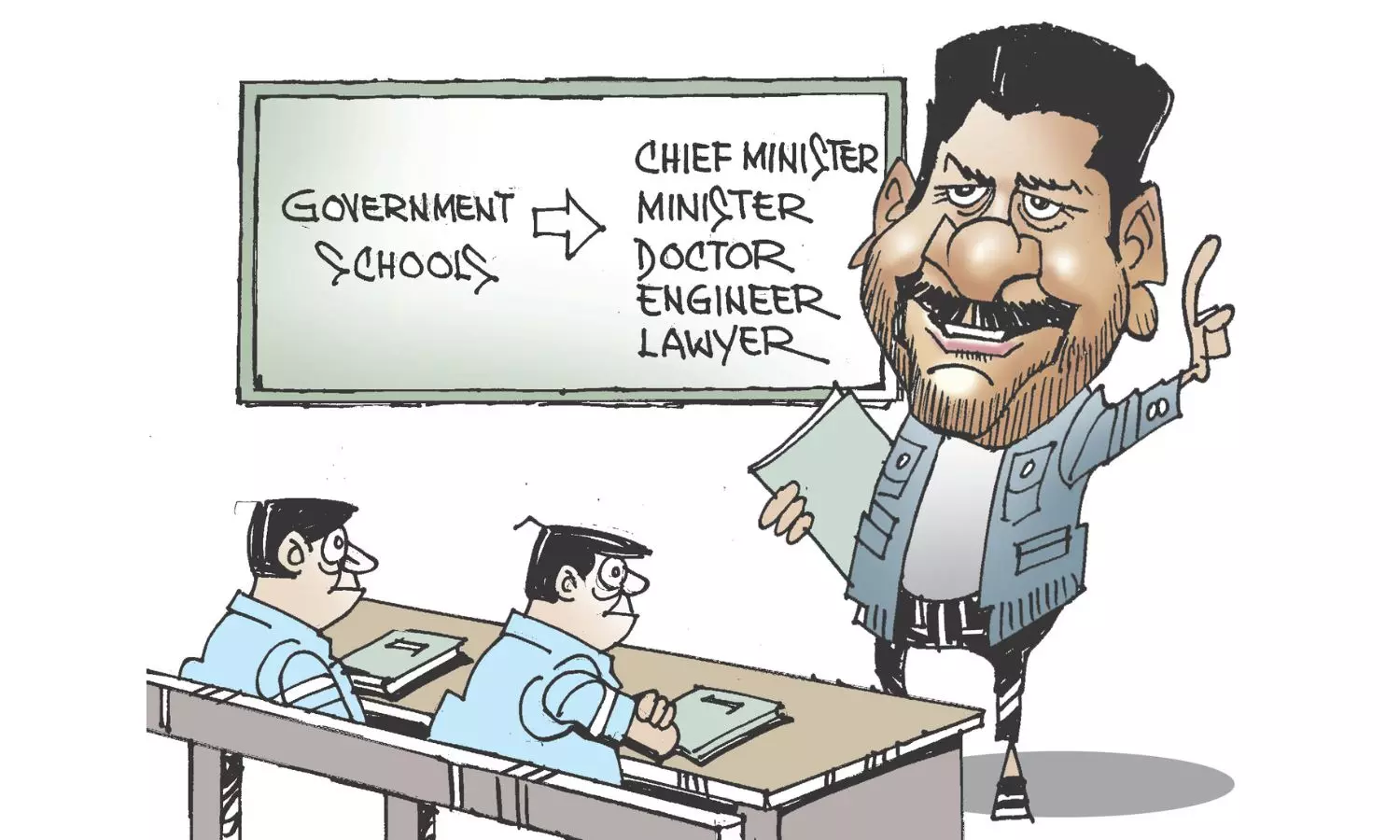
Chief Minister A. Revanth Reddy has turned into the brand ambassador of government schools — and his latest pitch had little to do with classrooms and everything to do with confidence. Addressing students, the Chief Minister urged them never to feel inferior if someone ridicules them for studying in a government school. Taking on the long-held stereotype that government schools are only for the poorest, Revanth said his government is transforming them to match private and corporate institutions in infrastructure and quality. Then came his most personal argument: “I studied in a government school and became the Chief Minister.” With that, he handed students a ready-made reply for anyone who looks down on them. If someone asks what they can possibly become by studying in a government school, he said, they should answer without hesitation: “A Chief Minister, a minister, a doctor, an engineer or a lawyer.” The message was clear — the name of the school does not determine success; ambition and opportunity do. In Revanth’s classroom, confidence is the first lesson.
BRS veterans keep a low profile as rivals gain ground
Lying low for a while when the going gets tough may not be a bad idea, but that tactic may not work all the time. For some BRS leaders in the erstwhile Nizamabad district, however, staying away from the limelight appears to be the best strategy, at least for now. Take the case of former MLAs from Nizamabad Rural and Kamareddy — Bajireddy Govardhan and Gampa Govardhan — who have been maintaining a studied silence for some time now. Known for their active public engagement as MLAs, they have more or less disappeared from the public eye. But one man’s silence could be another’s opportunity, and seizing it with both hands is BRS MLA V. Prashanth Reddy from Balkonda, who has been trying to draw public attention through protest programmes. Another former MLA, Jajala Surender of Yellareddy, has also been keeping busy by raising issues of public interest. The BRS, once a force to reckon with in the district, is facing pressure from both the Congress and the BJP, which have been playing active roles in politics across rural and urban areas. Party insiders say it may be time for all its leaders to end their mouna deeksha if they wish to remain relevant in the days to come.
BRS keeps moving goalposts to criticise government
Shoot at one target and scoot to the next. A much-preferred political strategy that takes talking past one another to the next level, this tactic has been evident over the past couple of weeks, ever since the BRS started demanding that Godavari water be pumped from the stricken Medigadda barrage. As the war of words escalated between BRS leader T. Harish Rao and Chief Minister A. Revanth Reddy, with the latter setting the record straight on why the BRS demand was impractical given the uncertainties surrounding the safety of the Kaleshwaram barrages, the multiple murders in Medak district occurred. Harish Rao immediately latched on to the incident, promptly holding Revanth Reddy, who also holds the home portfolio, responsible for the “failure” of law and order and the ham-handed handling of the case involving the accused, P. Rajkumar. Rajkumar, who was also facing charges under the Pocso Act, had secured bail in that case. The war over Godavari water was quickly pushed aside, once again demonstrating that, for the Opposition, shooting at one target and then moving on to the next in a bid to unsettle the government is an irresistible strategy.
Self-rating puts DCC chiefs in a political dilemma
One question in the feedback form given by the TPCC to DCC presidents to assess their performance was considered particularly tough: “How do you rate your performance as DCC president?” It was followed by a request to rate themselves on a scale of 1 to 10. This has apparently made the task of self-evaluation difficult, as their own ratings may or may not match the assessments already made by the TPCC and AICC leadership. The word doing the rounds is that some DCC presidents from the erstwhile Adilabad district sought feedback from friends and party workers to rate themselves appropriately and avoid any embarrassment when their self-scores are verified by the state party leadership. This is because their self-assessments will later be vetted by AICC Telangana in-charge Meenakshi Natarajan and TPCC president B. Mahesh Kumar Goud.
Congress puts leaders through the colour test
Forget report cards and performance appraisals. In the Telangana Congress, colours are set to decide political careers. The ruling party has devised a colour-coded grading system to assess the performance of its MLAs, MLCs, MPs and District Congress Committee (DCC) presidents. The message is simple: your colour today could shape your political future tomorrow. Those who impress the leadership will earn the coveted ‘green’ tag, signalling strong performance and brighter prospects. Leaders with an average record will be marked ‘yellow’, while those needing improvement will land in the ‘orange’ zone. The dreaded ‘red’ label is reserved for the poorest performers, serving as a political warning signal. This is more than an internal scorecard. The colour assigned to a leader is expected to weigh heavily when the party decides Assembly and Lok Sabha tickets, Cabinet berths, organisational responsibilities and even coveted nominated posts. In short, Telangana Congress leaders may soon find that politics is no longer just black and white or shades of grey. Their fortunes could, quite literally, hinge on whether they stay green — or slip into the red.
If students score, Lokesh too scores with Naidu
Marked for success? This is never an easy question to answer, but AP’s education minister N. Lokesh appears to have hit upon a cascading-effect solution to the problem. His solution? Students should work hard, score good marks and perform well in their classes. If they succeed, he, in turn, could earn good marks as education minister from his father and Chief Minister N. Chandrababu Naidu. Lokesh’s remarks about his performance as education minister being evaluated by the Chief Minister come in the wake of Naidu keeping close tabs on how his ministers are performing. And despite being the Chief Minister’s son, Lokesh does not get to cut corners. So far, his collective you-do-well-so-I-can-do-well approach appears to be working.
When law catches up, politicians suddenly seek compassion
Law, as politicians love to say, will take its own course. For the most part, at least, as long as they, their kin, or those close to them do not get caught up in a case or two. It was not too long ago that the BJP found itself in a fairly tricky situation over a case involving Telangana BJP leader and Union minister Bandi Sanjay Kumar. And now, it appears to be the turn of YSRC chief Y.S. Jagan Mohan Reddy to attempt a deft two-step act. During his visit to Visakhapatnam to commiserate with the families of fishermen who were recently lost at sea, and after demanding that the government provide compensation to the affected families, Jagan also used the occasion to defend YSRC leader Seediri Appalaraju’s son in a road accident case that resulted in a fatality. He hinted that lenience may be called for in the case, arguing that Appalaraju’s son was just an 18-year-old and that such accidents do happen. It suggested that, when it comes to downplaying how the law should deal with people close to them, politicians — regardless of party or state — tend to follow the same playbook.
Contributions from L Venkat Ram Reddy, Pillalmarri Srinivas, Balu Pulipaka, Narender Pulloor, Sampat G Samritan, Avinash P Subramanyam
