Telangana Legal Services Authority Launches Mobile Lok Adalats

Vikram Nath cautions against uncritical use of AI in legal profession
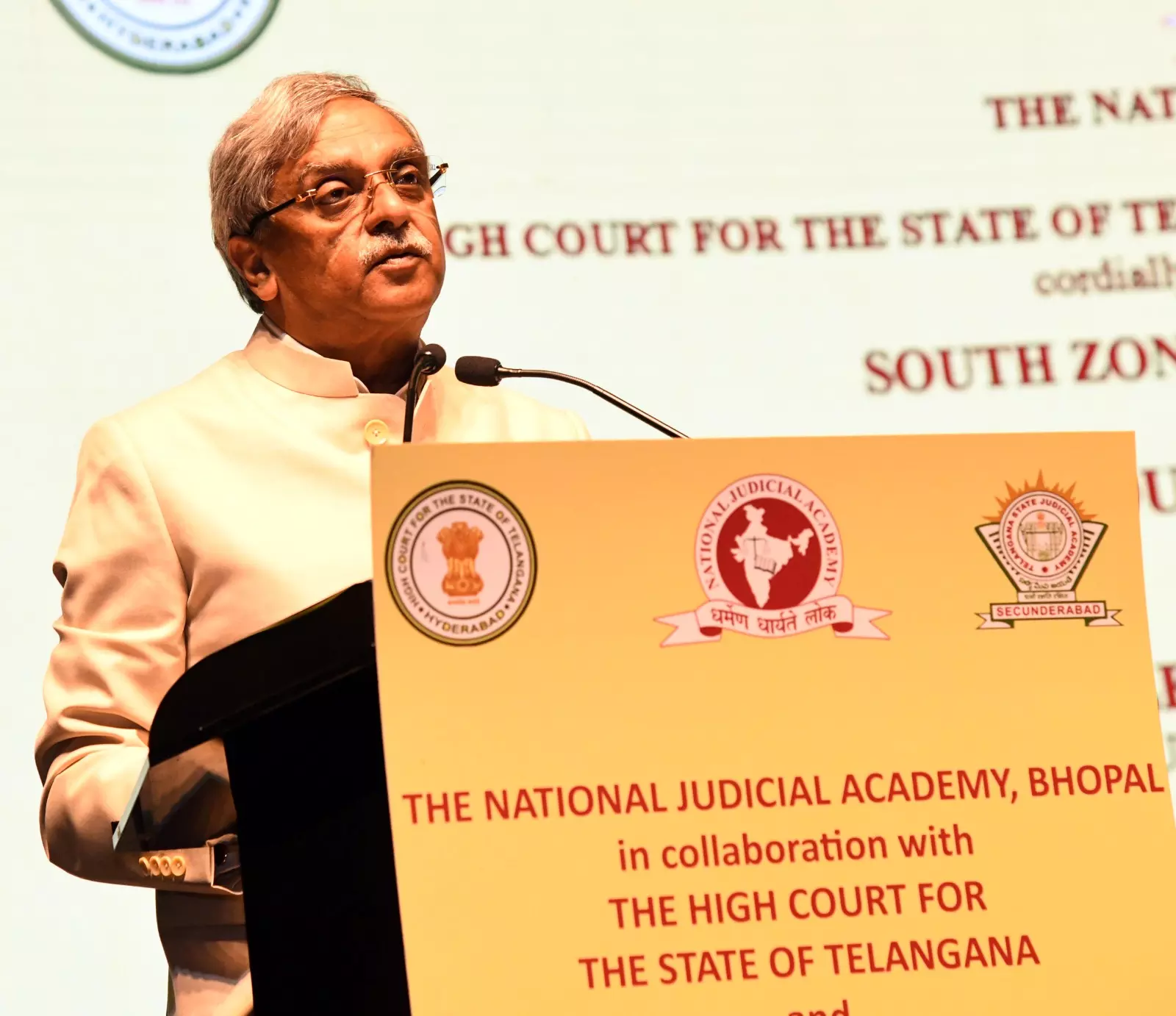
Hyderabad: Supreme Court judge Justice Vikram Nath on Saturday cautioned against the uncritical use of artificial intelligence (AI) in the legal profession, stating that while technology could assist legal work it could not replace the trained intellect, ethical responsibility and judgment that form the foundation of the justice system. Justice Nath emphasised that AI must remain a supportive tool rather than a substitute for human reasoning that is essential to law and adjudication.
He was addressing the South Zone-II Regional Conference, “Advancing Rule of Law Through Technology: Challenges and Opportunities”, here on Saturday. The two-day conference, jointly organised by the Telangana High Court, the National Judicial Academy and the Telangana Judicial Academy, brought together over 130 judicial officers from southern states along with Chief Justices and judges of High Courts.
Justice Nath observed that technology could make certain aspects of legal work more efficient, such as organising material or summarising documents. He warned that it should never be allowed to “invent the law” or influence judicial reasoning. “A tool must remain a tool. It cannot replace the trained mind of a lawyer, the ethical responsibility of an officer of the court, or the disciplined judgment required of a judge,” he said.
Raising concerns over the careless use of AI-generated content in legal submissions, Justice Nath pointed to instances where fabricated citations and non-existent authorities had been included in documents, and these had even reached the Supreme Court. Such inaccuracies, he noted, were not merely technical errors and undermined the integrity of legal arguments and the credibility of the judicial process.
Justice Nath also cautioned against rejecting emerging technologies entirely due to their potential risks. According to him, the appropriate response lay in informed and responsible use, guided by ethical discipline and professional standards. Technology presents both opportunities and challenges and it can widen access to justice and improve transparency, but it can also deepen exclusion or lead to distortions if used irresponsibly, he said.
Justice Satish Chandra Sharma, judge of the Supreme Court and a former Chief Justice of the Telangana High Court, spoke on the expanding role of technology in the judiciary. “Technology provides powerful tools, but the rule of law remains in the domain of human judgment. No algorithm can govern a human soul,” he remarked.
Justice Sharma also noted: “So let the circuits assist the court, Let knowledge flow in a widening stream; But let the gavel remain in human hands, Guarding the promise of the constitutional dream”.
Justice Sharma highlighted the growing risks associated with algorithmic bias and data security as courts become increasingly digitised. “The days have come when voices travel through fibre and light. The law will still ask its oldest question: What is fair? What is just? What is right?, Justice Sharma said. “A screen now opens doors once barred, making the path to courts less hard”.
Telangana High Court Chief Justice Aparesh Kumar Singh, speaking at the conference, reflected on the evolving relationship between law and technology. Quoting eminent United States jurist Benjamin N. Cardozo, Justice Singh noted that “the law, like the traveller, must be ready for the morrow,” underscoring the need for the legal system to adapt to changing societal and technological realities while remaining anchored in constitutional principles.
Justice Singh also spoke about the growing importance of technology in dispute resolution, particularly through online dispute resolution platforms that enable remote mediation, digital documentation and virtual settlements. However, he cautioned that the rapid spread of information in the digital age also raises complex questions about balancing freedom of expression with the need to preserve the fairness and integrity of judicial proceedings.
The conference witnessed the participation of Andhra Pradesh High Court Chief Justice Dhiraj Singh Thakur, Sikkim High Court Chief Justice A. Muhamed Mustaque and several judges from Telangana High Court and neighbouring High Courts.
Justice Anirudha Bose, former judge of the Supreme Court and presently director of the National Judicial Academy and judicial officers from southern states participated in discussions and interactive sessions on matters like effective use of technology in alternative dispute resolution, the role of courts in the safeguarding privacy, impact of media reporting, digital media and censorship in the era of electronic and digital media and others.
