Telangana High Court Stays 42% BC Quota in Local Body Polls

Court adjourns hearing for two weeks, directs state to file counter on reservation order
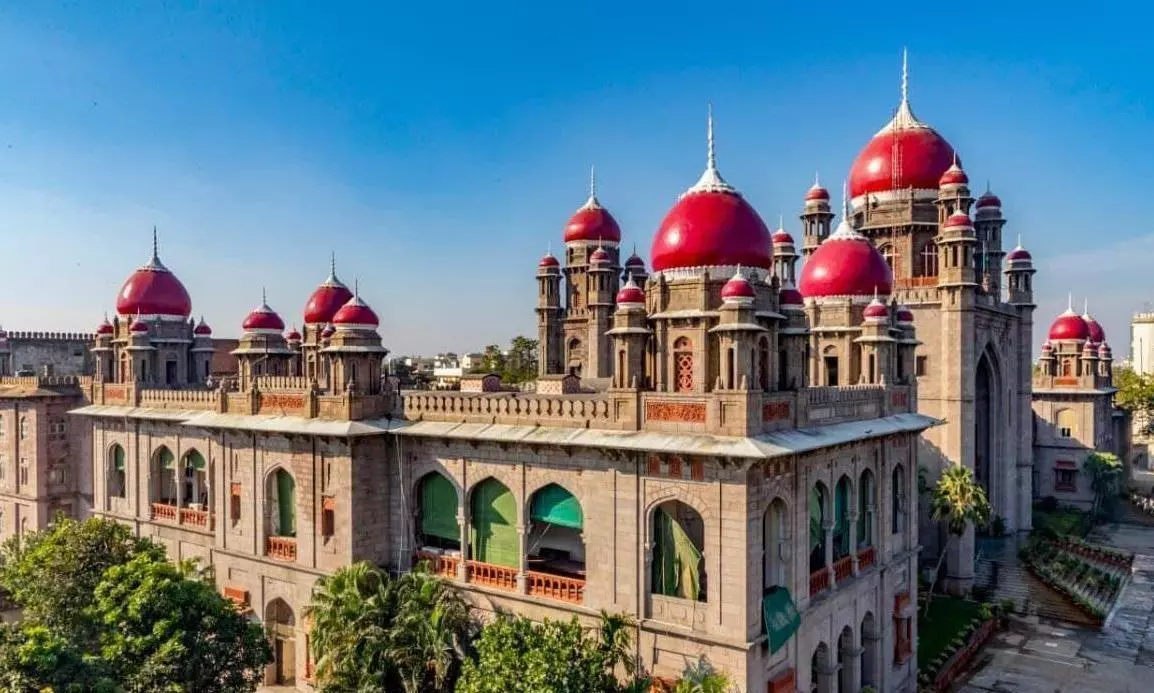
Hyderabad: The Telangana High Court on Thursday stayed Government Order (GO) 9 issued for the enhancement of the reservations for the Backward Classes communities to 42 per cent in the local body elections.
A division bench comprising Chief Justice Aparesh Kumar Singh and Justice G.M. Mohiuddin, after two days of hearings, directed the state government to file its counter-affidavits in the petitions challenging GO 9 within four weeks and gave the petitioners two weeks thereafter to file their rejoinders if they wanted to.
After six weeks, the court would hear the final arguments, including those of the implead petitioners who came to the court in support of the government order.
Till the court passes final orders or till Thursday’s interim stay get vacated, the local body elections will not be conducted. The state government has decided to file an appeal before the Supreme Court on the stay order, after getting it examined by legal experts.
The court on Thursday resumed for hearing in the post-lunch session, following the four-hour hearing on Wednesday.
Advocate-General A. Sudershan Reddy, representing the state government, on Thursday submitted replies to the questions posed by the court the day prior. He said that the state Assembly had passed a unanimous resolution for the BC caste survey and had cleared the following legislation to enhance the quota.
According to the Advocate-General, it was not necessary for the government to issue a gazette or further notification in view of the deemed assent to the Bills which were pending before the Governor.
Citing the Supreme Court ruling on deemed assent, in ‘State of Tamil Nadu V Governor of Tamil Nadu’, the AG contended that the pending Bill would become an Act or a law, after a time period of three months, by the virtue of the judicial pronouncement.
Sudershan Reddy explained to the court that the 42 per cent reservations to the BC community was given on each local body, not as a state-wide measure or by taking the state as a unit.
He argued that the 50 per cent cap brought in in the ‘Indira Sawhney’ case was not applicable for political representation and cited several case laws. Further, the state government argued that according to the Article 243(O), courts cannot interfere in the election process of panchayats.
Senior counsel Prof. Ravi Varma, also representing the state government , argued that SC, ST and BC communities together constituted 85 per cent of the population and 67 per cent reservation was being given to them. He explained that 33 per cent reservation was available to the remaining 15 per cent of the population. After hearing the arguments, the bench issued interim orders, imposing a stay on the notification.
