Telangana High Court Cautions HYDRAA Chief On Power Misuse

Asks Ranganath to work within limits of rule of law
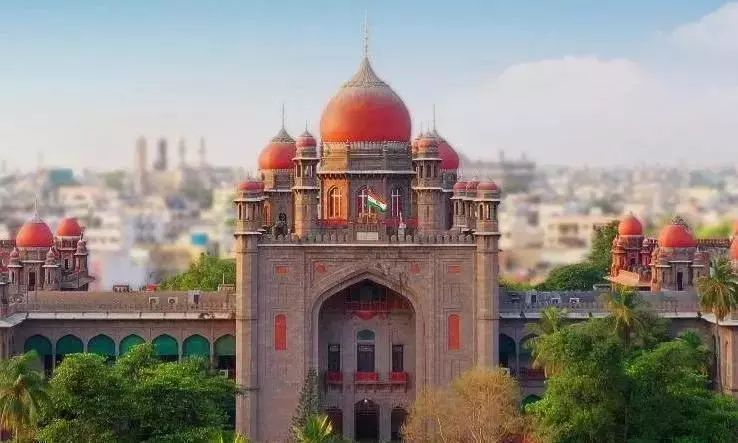
Hyderabad:The Telangana High Court on Friday cautioned HYDRAA and commissioner A.V. Ranganath against the misuse of authority and violation of court orders, in the name of protecting water bodies and rejuvenating lakes. “Work within the limits of the rule of law,” Justice B. Vijaysen Reddy said.
“Don’t make the court show its superior power,” Justice Vijaysen Reddy told Ranganath, who had appeared virtually before the court in contempt cases. “Persons who sit in the Secretariat with authority, do they think it is not necessary to follow the social order or public order? Or (do) they forget them,” the judge asked.
“Authority is not given for showing power. Please do good to the people with the authority… and be humanistic. If you want to show your power, then the court has superior power,” Justice Vijaysen Reddy said. “What we have to do, we will do. Don’t make us use such power. The court conveyed has its message… please understand and follow the rule of law.”
Justice Vijaysen Reddy noted that contempt cases were being filed against the commissioner and HYDRAA for violating court orders and cautioned that the court knew the value of its orders. If the orders were not complied with or were violated, “the court also knows how to react,” he said.
The judge was dealing with contempt cases against HYDRAA and Ranganath with regard to violation of status quo orders passed by the court on work in the land near Tammidikunta in Khanamet village.
Despite court orders issued in April, HYDRAA went on with the works, the petitioners said. The landowners said that HYDRAA under the guise of restoration or rejuvenation of lakes was manoeuvring to dispossess them of the land and allowing it to be flooded and rendered unusable, without conducting any survey for establishing the full tank level (FTL) and buffer zone. They raised an objection to HYDRAA’s claim that it was assignment land, and questioned the authority of agency in deciding on the classification of the land.
The judge questioned Ranganath under which provision of the law it was empowered to go for rejuvenation of lakes and the GO issued for establishment of HYDRAA showing that it was formed for protection of water bodies. “Do you act suo motu? Let us know where the HYDRAA works and to what extent the agency can go,” Justice Vijaysen Reddy said. “Is HYDRAA empowered to do all the work to be done by GHMC, HMDA, municipalities, HMWS&SB, revenue, roads, and all other departments.”
Justice Vijaysen Reddy questioned Ranganath about his perception of HYDRAA’s powers and its role in the rejuvenation of lakes.
When commissioner Ranganath said the people were praising HYDRAA’s work and were approaching it with complaints on violations and encroachments, the judge cited Supreme Court guidelines that demolitions must be done be in accordance of law and after giving prior notice or an opportunity of hearing to the affected parties. “Where did you follow it? If you follow it, why are the people coming to court,” the judge asked.
“People invest in property…. knowingly or unknowingly they might have purchased land in the FTL or buffer zone. You are throwing them on the roads without notice and you are demolishing (the structures) highhandedly without following the law. Even after court orders, HYDRAA is violating it,” the judge said.
“If you want restore lakes, purchase the land in the FTL and buffer zone and complete the works. You don’t have such a mechanism. Do not do harm in the name of doing good,” Justice Vijaysen Reddy said. He expressed deep concern over instances where officials allegedly demolished small shelters constructed on plots measuring 50 to 100 square yards, often on weekends and without issuing notice. “Where will they go,” the court asked, noting that governments themselves later regularise such structures under the building and land regulation schemes.
The judge repeatedly advised Ranganath to ensure that petitioners do not have to approach the court citing violation of its orders by HYDRAA or for not following due procedure.
Jagan Case: CBI Urges HC on Frozen Assets
Hyderabad:The Central Bureau of Investigation (CBI) argued before the Telangana High Court on Friday that the properties frozen in connection with the disproportionate assets case involving YSRC president and former chief minister Y.S. Jagan Mohan Reddy should not be released until the trial before the CBI Special Court is concluded.
The agency argued that the interim petition filed by Jagati Publications, Janani Infra and Indira Television seeking release of three properties frozen in 2012 was not maintainable, particularly when the final order was issued in 2021. The CBI submitted that Supreme Court precedents relating to assets seized in major financial crime cases must be taken into account.
CBI special counsel Srinivas Kapatia stated that Jagati Publications’s current accounts worth `46.82 lakh were frozen, but the High Court had permitted operation of these accounts subject to conditions. As part of the arrangement, a bank guarantee of `23.42 lakh and three properties valued at `6.30 crore near Bengaluru, were furnished as security. The agency argued that these securities should continue until the investigation concluded.
The High Court adjourned the matter to Monday.
HC upholds businessman Sanjith Das detention
Hyderabad:The Telangana High Court has upheld the detention of Sanjith Das, a businessman settled in the city, who was taken into custody after it was found that he held identity documents from both India and Bangladesh.
Das, originally from Tripura, came under scrutiny in September when immigration officials at the Rajiv Gandhi International Airport prevented him from boarding a flight to Abu Dhabi. During checks, he was found carrying an Indian passport along with a Bangladeshi national identity card, sparking suspicion that the Indian passport had been secured by using forged documents. He was transferred to the foreigners’ detention centre at the Central Crime Station.
Challenging this, Das’ father Nirmal Das filed a habeas corpus petition alleging that his son had been detained unlawfully. The state, represented by special government pleader Swaroop Oorilla, disputed this claim, and asserted that Sanjith Das was held under the Immigration and Foreigners Act, and that the possession of dual identity documents clearly pointed to his status as a Bangladeshi national.
A division bench comprising Justice Moushumi Bhattacharya and Justice Gadi Praveen Kumar examined the circumstances under which Das was taken into custody by the Foreigners Regional Registration Office (FRRO).
The bench noted that the FRRO’s actions were consistent with statutory provisions and saw no basis to order Das’ release. The court added that while the habeas corpus relief was not warranted, Das could still pursue remedies available under the Act and make appropriate representations before the FRRO.
