Telangana HC Rejects PIL on Pollution of River Godavari

Petitioner urged action against sewage and industrial waste discharge; court directs him to NGT.
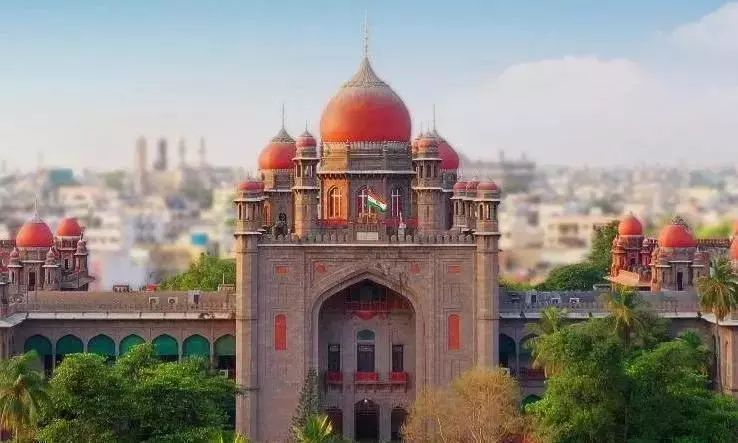
Hyderabad: A two-judge panel of the Telangana High Court refused to entertain a Public Interest Litigation (PIL) highlighting alleged unchecked discharge of untreated sewage and industrial effluents into the River Godavari and its tributaries. The panel comprising Chief Justice Aparesh Kumar Singh and Justice G.M. Mohiuddin was dealing with a PIL filed by Aakula Sampath Kumar. The petitioner contended that continuous discharge of untreated sewage and effluents has severely degraded the water quality of the river, affecting aquatic life, agriculture, and irrigation purposes. The petitioner, arguing the case in person, contended that failure on the part of the state authorities to eliminate the release of untreated waste into the Godavari is a blatant violation of environmental laws. The petitioner sought directions to the authorities, including the Telangana State Pollution Control Board, to immediately curb the pollution in the Godavari river and its connected water bodies by ensuring that all existing Sewage Treatment Plants (STPs) are made fully functional. He further sought a direction for the framing of sewage management rules in accordance with the Constitution and environmental laws of India. After hearing the matter, the panel dismissed the PIL, advising the petitioner to seek an alternative remedy and granting liberty to approach the National Green Tribunal.
HC reserves verdict on SpiceJet tax liability
A two-judge panel of the Telangana High Court on Tuesday reserved its judgment in a writ petition filed by M/s SpiceJet Limited challenging the orders passed by the Customs Department and appellate authorities imposing penalties in connection with alleged overvaluation of goods exported through the Free Trade Warehousing Zone (FTWZ). The panel comprising Justice P. Sam Koshy and Justice S. Chalapathi Rao was hearing the plea questioning the validity of the final order dated January 20, 2025, passed by the Customs, Excise and Service Tax Appellate Tribunal (CESTAT), Southern Regional Bench. It is the case of the petitioner that the airline acted merely as a warehousing agent for its foreign principal, M/s NADFA Trading FZE, under a service agreement, and had no role in or control over the valuation of goods exported by suppliers such as M/s UIEPL and M/s Wintaxel. Counsel argued that the customs authorities wrongly imposed penalties without providing a fair hearing and that the appeals were dismissed on limitation grounds, in violation of principles of natural justice. Standing counsel for the Customs Department, Dominique Fernandez, argued that SpiceJet, being the Importer-Exporter on Record and operator of the FTWZ, had a statutory duty to verify the legitimacy and valuation of consignments. He argued that lapses on the part of the petitioner facilitated fraudulent overvaluation to claim export incentives and, under Section 147 of the Customs Act, 1962, both the principal and agent are jointly and severally liable. He further argued that the writ petition filed is not maintainable since the appeals were filed beyond the prescribed limitation period at every stage. After hearing both sides, the panel reserved its judgment.
HC records state concession on tourist vehicles to city
Justice N. Tukaramji of the Telangana High Court closed a ‘no-entry’ writ petition filed by tour operators. The judge observed that since the police authorities permitted the vehicles to ply round the clock within the Commissionerate limits for transporting pilgrims, excursion groups, and sightseeing passengers and accordingly closed the writ plea filed by a group of transport operators. The judge was dealing with a batch of writ petitions filed by Jignesh Kumar Saraiya and 49 others, who sought to declare the action of the police authorities in not granting permission to operate their vehicles during “no-entry” hours as arbitrary, illegal, and violative of their right to trade and business under Article 19(1)(g) of the Constitution. They also sought directions to permit their vehicles to operate without restriction or, alternatively, to restrain authorities from imposing fines on vehicles operating during restricted hours without permission. The petitioners contended that their business involved transporting passengers for social and religious events such as marriages, excursions, pilgrimages, and sightseeing tours, and that the restrictions imposed by the police severely affected their livelihood. They argued that the denial of permission to operate within the city limits during “no-entry” hours was discriminatory, as similar operators had been granted permissions earlier. The authorities maintained that the movement of heavy and commercial vehicles was regulated under the Motor Vehicles Act and relevant traffic orders to ensure road safety and smooth traffic flow, particularly during peak hours. During the hearing, it was brought to the notice of the court that the grievance was addressed by the police authorities, by permitting the vehicles of the petitioner to ply within the Commissionerate limits subject to regulations. Recording the submission, Justice Tukaramji observed that since the issue was resolved, no further orders were required.
HC tells NMC to consider MediCiti plea
Justice Nagesh Bheemapaka of the Telangana High Court directed the National Medical Commission (NMC) to consider a statutory appeal filed by MediCiti Institute of Medical Sciences (MIMS) for increasing MBBS intake from 150 to 200 seats for the 2025-26 academic year. The judge was dealing with a writ petition filed by MIMS, recognised by the NMC and affiliated to Kaloji Narayana Rao University of Health Sciences. It was contended that the institution applied for enhancement of seats and submitted all requisite compliance documents; however, the NMC issued a letter of disapproval citing deficiencies in faculty strength, clinical material, and infrastructure. Aggrieved by this decision, the college filed a statutory appeal under the provisions of the National Medical Commission Act, 2019. Observing that the appeal remained pending despite the nearing deadline for medical admissions fixed by the Supreme Court, Justice Bheemapaka observed that any further delay would jeopardise the opportunity of the institution to admit students for the ensuing academic year. The judge also referred to decisions of the Supreme Court and reiterated that the NMC must function transparently and adhere to the prescribed academic timelines.
