Telangana HC Inaugurates Legal Services Clinic for Defence Personnel, Ex-Servicemen and Families

After inauguration of the clinic at the Sainik Welfare Office at Somajiguda, Justice Sam Koshy said that the clinic was established with a pious cause to extend legal assistance that defence personnel, their dependents and ex-servicemen and their family members require.
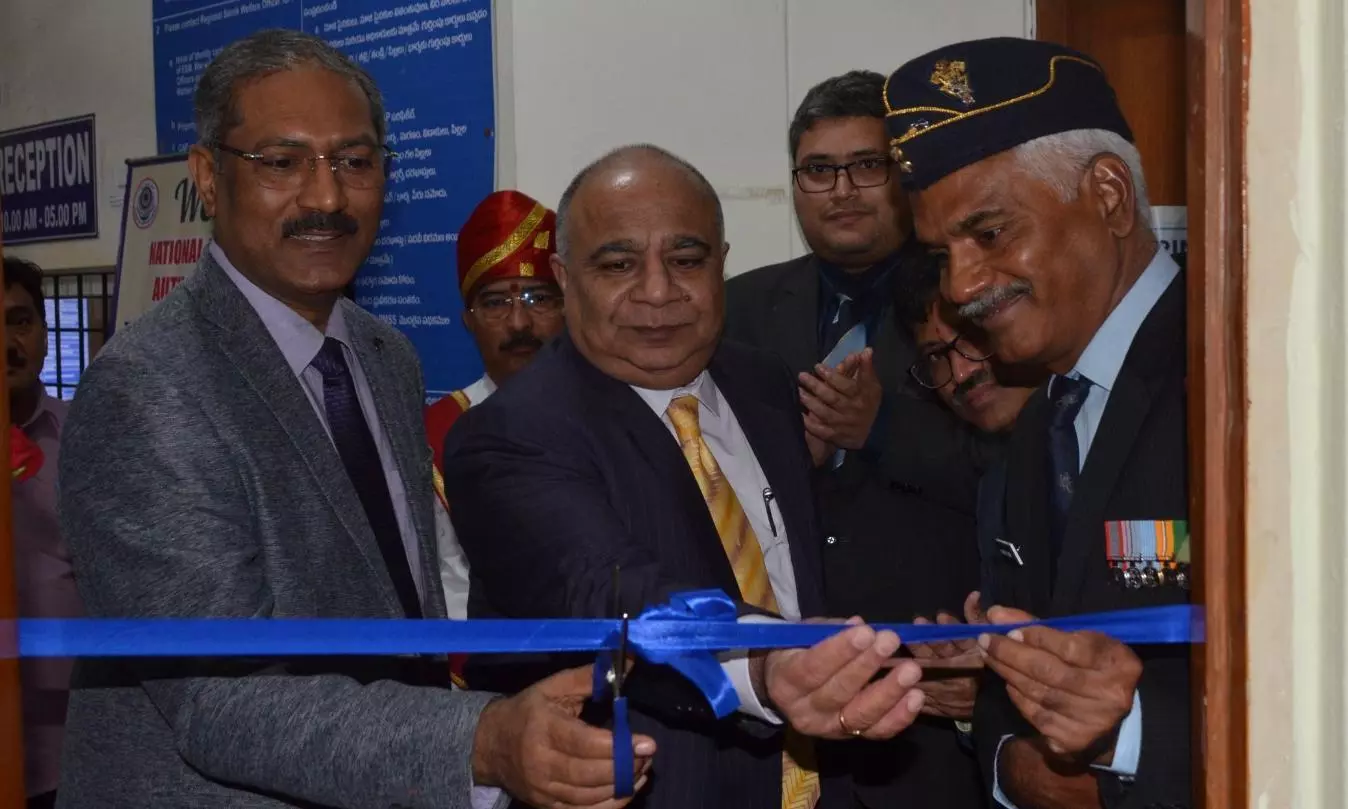
Hyderabad: Justice P. Sam Koshy of the Telangana High Court, Executive Chairman of the Telangana State Legal Services Authority, on Saturday inaugurated a legal services clinic to provide free legal services to defence personnel, ex-servicemen and their family members.
The programme was formally launched in a virtual mode at national level by Supreme Court judge Justice Surya Kant on Saturday. It is part of an initiative of the National Legal Services Authority for the establishment of legal services clinics under the NALSA Veer Parivar Sahayata Yojana.
After inauguration of the clinic at the Sainik Welfare Office at Somajiguda, Justice Sam Koshy said that the clinic was established with a pious cause to extend legal assistance that defence personnel, their dependents and ex-servicemen and their family members require. Defence personnel are posted at one place and their families stay at another.
To provide them legal services in case of need, the clinic was set up. This process would be gradually extended in every district, the judge said. S. Ravi Gupta, special chief secretary, home, participated in the programme.
Telangana High Court Upholds State's 15-Year Recovery Rule for Commuted Pension from Retired Employees
Hyderabad: The Telangana High Court has upheld the state government's decision to recover the money taken in advance by retired government employees under the commuted pension scheme for 15 years. The court rejected the several petitions seeking to allow the time period of 11 years and three months.
The court clarified that the period for recovery of the amount was decided as per the recommendation of the Pay Commission. It noted that the Centre was also following the same policy.
The court dismissed several petitions filed by superannuated employees, who contended that the recovery was contrary to the terms of Pension Payment Orders and requested the court to declare the Rule 18 of the Telangana Civil Pensions Commutation Rules and GO 44 issued by the finance and planning department as illegal.
Telangana High Court Warns Collegiate Education Official with Imprisonment for Non-Compliance on Employee Salary
Hyderabad: The Telangana High Court cautioned the regional joint director of collegiate education, Hyderabad, to either comply with court orders regarding payment of salary to a reinstated employee or be ready to undergo two months imprisonment and to pay a penalty of Rs.2,000.
Justice T. Madhavi Devi gave the officer two weeks to comply with the orders.
The judge was dealing with a contempt case filed by Srinivas Rao, junior assistant at the Government Degree College in Kalwakurthy of Nagarkurnool district. When his services were terminated on account of absence on the medical grounds, the High Court set aside the orders and directed the government to pay the salary for the period of his termination. The authorities did not comply and deliberately modified those days as “dies non’ from the days of “on duty”.
Telangana High Court Upholds Summary Rent Enquiry, Directs Tenant to Pay ₹5.85 Lakh Arrears for King Koti Property
Hyderabad: The Telangana High Court specified that courts were competent and under obligation to make a summary enquiry as to the rent payable for the premises and arrears due by the tenant.
Justice Alishetty Laxmi Narayana upheld the trial court’s decision in determining the quantum of rent for a commercial property located in King Koti, Hyderabad, and directed the tenant to pay arrears of around `5,85 lakh.
The tenant, Syed Farees Ahmed, challenged the trial court orders fixing the rent at `7,500 per month for the commercial property that he had taken on rent from A. Vema Lingam in 2006.
According to the landowner, the tenant committed default in payment of rent from March 2018. He filed a suit before the trial court for eviction of the tenant as well as recovery of rents.
During the trial, the tenant argued that the rent was Rs.3,500 per month and the landowner refused to accept the payment intentionally to make him a defaulter and evict him from the premises. He submitted that he had sent the rent through the money order of Rs.3,500 per month, but the landowner refused it.
The landowner submitted that at the time of letting out the premises, the tenant had agreed to pay Rs.5,000 per month in 2006 and it was enhanced to Rs.7,500 per month in 2018. The tenant tried to pay `3,500 per month. Based on this, the trial court determined Rs.7,500 per month as rent and directed the tenant to pay the arrears at the rate till 2024 and to pay the future rent at the same quantum till the suit was disposed of.
Challenging it, the tenant approached the High Court complaining that the trial court erroneously determined the quantum of rent.
Justice Laxmi Narayana upheld the considerations made by the trial court which had cited that the commercial premises were situated in a prominent place and that the monthly rent could not be static.
The judge cited the apex court`s observations which stated that summary enquiry under Order XV-A Rule 2 of CPC made it obligatory on the courts on the rent payable for the premises and arrears due by the tenant. Otherwise, it would amount to encouraging unscrupulous tenants who intend to avoid payment of rent for decades, which would result in substantial loss to the landlord during the pendency of the eviction suit or proceedings based on account of abortive pleas raised by the unscrupulous tenants.
