Telangana HC directs state to submit status of permissions relating Old City Metro Rail

The state government also submitted that the mandatory five-metre distance between the metro track and the structures was being maintained. With regard to Aliyabad Sarai, it was stated that the owners and tenants had already consented to acquisition.
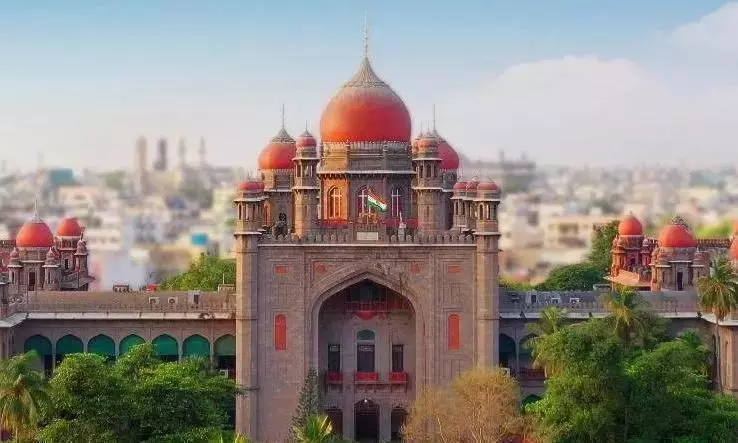
Hyderabad: The Telangana High Court directed the state government and Hyderabad Airport Metro Limited (HAML) to submit a detailed affidavit explaining the status of permissions and construction activities relating to Metro Rail Phase-II project which connects Mahatma Gandhi Bus Station to Falaknuma, particularly with reference to heritage structures and their precincts falling along the proposed seven-kilometre route.
Directions were issued by a division bench comprising Chief Justice Aparesh Kumar Singh and Justice G.M. Mohiuddin while hearing a Public Interest Litigation and a connected writ petition raising concerns over alleged violations of the Telangana Heritage (Protection, Preservation, Conservation and Maintenance) Act , 2017.
The Bench also made it clear that the affidavit should also explain as to the stage of any construction related activity being undertaken touching any of the heritage structure or its precincts. The affidavit should also indicate and state whether the Conservation Committee is constituted and fully functional or not.
The High Court passed the order after reviewing a powerpoint presentation made by HAML, which was intended to demonstrate that the proposed Metro alignment does not affect structures protected under the state heritage law. The presentation was made in the court hall as per the court’s earlier direction of the court by considering the contentions of the petitioners, who had submitted that several heritage structures have been demolished for the metro alignment.
According to the state government, the project corridor passes through areas where several religious and historical structures exist, but it was asserted that none of the protected heritage structures were being directly impacted.
Additional Advocate General Mohd. Imran Khan informed the Bench that out of 102 structures identified along or near the alignment — including temples, mosques, dargahs, chillas and graves — none would be touched by the metro track and they are below the alignment level.
He stated that only three old structures, namely the old GHMC (Baldia) building near Aza Khana Zohra, the clock tower at Raja Rai Devdi (Shyam Raj building), and Aliyabad Sarai, were likely to be affected. These structures were described as dilapidated and allegedly damaged due to rains, and it was claimed that they did not have any religious connection.
The state government also submitted that the mandatory five-metre distance between the metro track and the structures was being maintained. With regard to Aliyabad Sarai, it was stated that the owners and tenants had already consented to acquisition.
The authorities further claimed that an attempt had been made to integrate the Raja Rai Devdi structure into the proposed metro station, but the idea was abandoned due to the condition of the structure . Further, he submitted that the works on shifting utilities from these centres have been going on. On a query by the court, additional advocate general submitted that the works of Metro project have not been commenced and no work at all taken up.
The petitioners, however, strongly opposed these submissions. Immaneni Rama Rao, appearing for the petitioner in the PIL, contended that excavation and other construction activities had already commenced without obtaining prior approval from the Conservation Committee as required under the 2017 Act.
He alleged that the committee itself had not been constituted, rendering the entire exercise illegal. It was further argued that the High Court had previously held that heritage structures cannot be reconstructed or recreated once damaged, yet the authorities were proceeding in a manner that could cause irreversible harm.
Rama Rao also disputed the claim that the old GHMC building was dilapidated, asserting that any damage to the structure was the direct result of government action, particularly the demolition of an adjacent structure.
According to him, the state government’s claim that only three structures were affected was misleading, as several other structures along the alignment were vulnerable to damage due to ongoing works. He also brought to the notice of the court that the Section18 of the heritage law mandates that the supervision of the director, department of heritage for excavation and other works near the structures and their precincts. But, the excavation works are being carried out, without following the provision.
In the connected writ petition, Syed Yousuf, the counsel for the petitioner, raised serious objections regarding Aliyabad Sarai, stating that it is a 300-year-old notified Wakf property. He argued that the structure was being wrongly treated as a private property and that acquisition proceedings were being carried out based on the consent of persons whose ownership was itself disputed.
Taking note of these rival contentions, the High Court directed the state government and Metro Rail Ltd to file an affidavit detailing the stage of processing of applications seeking construction permission at locations involving heritage structures or their precincts. The affidavit is also required to disclose whether any construction activity is presently being undertaken affecting such structures and clarify whether the Conservation Committee has been constituted and is fully functional. The court directed that the information be furnished in an Excel sheet format and adjourned the matter for further hearing to March 3.
