Telangana Government to Consult Non-BJP Ruled States on VB-G RAM G

The committee held detailed discussions on whether Telangana should challenge the legislation in the Supreme Court instead of implementing it in line with the Centre’s guidelines.
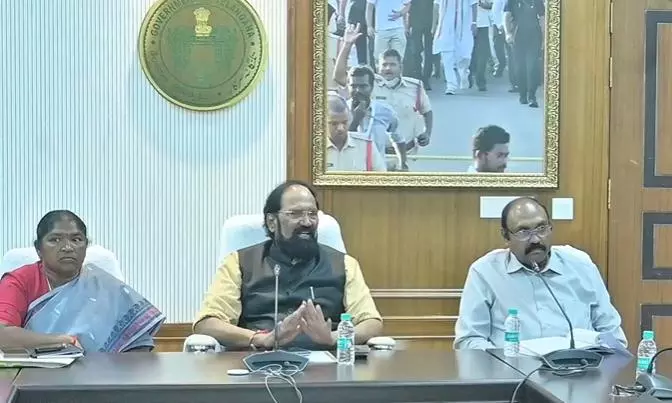
Hyderabad: The Telangana Cabinet sub-committee examining the Union government’s proposed VB-G RAM G to replace the Mahatma Gandhi National Rural Employment Guarantee Act on Saturday favoured reaching out to other non-BJP ruled states, including Karnataka and Kerala, to explore coordinated legal and political action.
The sub-committee felt that the wider political and administrative implications of the proposed legislation had not yet been adequately communicated to the public. It decided to place the issue before the state cabinet on July 2. The Cabinet is expected to take a final decision on whether Telangana should adopt the central framework, enact its own legislation, approach the Supreme Court, or pursue a combination of legal and administrative measures.
The sub-committee, chaired by minister for irrigation and civil supplies N. Uttam Kumar Reddy, met for the second time in less than a week and proposed consultations with the chief ministers of Karnataka and Kerala to assess whether the two states would be willing to pursue a common legal strategy or other coordinated measures to protect the powers and financial interests of states.
Sharing the concern voiced by the members of the committee, minister Uttam Kumar Reddy said that an appropriate decision was the need of the hour. There is growing concern over the proposed central legislation which threatens to weaken the federal structure by reducing the role of state governments in implementing rural employment programmes.
Rural development and panchayati raj minister Danasari Anasuya Seethakka attended the meeting in person, while agriculture minister Thummala Nageswara Rao and employment minister G. Vivek Venkataswamy participated virtually. Senior officials, including special chief secretary Dana Kishore and commissioner of panchayati raj and rural development D. Divya, participated in the discussions.
Members of the committee strongly felt that the proposed law infringes upon the constitutional powers of states and contains several provisions that may not withstand judicial scrutiny. Legal experts informed the committee that they had identified multiple constitutional issues that could form the basis of a challenge before the Supreme Court.
The committee held detailed discussions on whether Telangana should challenge the legislation in the Supreme Court instead of implementing it in line with the Centre’s guidelines.
The Cabinet panel received suggestions from the representatives of nearly 20 civil society organisations. They also sounded critical of the centre introducing sweeping changes without consulting state governments. They described the move as a violation of cooperative federalism, saying employment guarantee programmes directly affect state finances, rural livelihoods and local implementation.
The organisations urged the Telangana government to enact its own employment guarantee law under the constitution instead of simply adopting the proposed central framework, which they estimated could cost the state exchequer nearly `2,500 crore. They also warned that the proposed changes could reduce employment opportunities for thousands of agricultural labourers.
Civil society representatives opposed the proposal to limit employment to 60 days and demanded that Telangana guarantee at least 200 days of wage employment every year, along with payment of statutory minimum wages. A major part of the discussion focused on the proposed 60:40 funding pattern between the centre and the states. The committee decided that the state legal department should thoroughly examine the issue before any final decision is taken.
Members also criticised the Centre’s proposed allocation formula, arguing that it would penalise better-performing states while rewarding poorer performers. They noted that Telangana had already submitted suggestions to the union government seeking changes to the formula, but expressed disappointment that these recommendations were reportedly ignored.
