Telangana: Faulty Escalators Force People To Take Cross Roads Despite Risks

A ground check in other parts of the city presented a similar problem with FOB lifts out of service: Reports
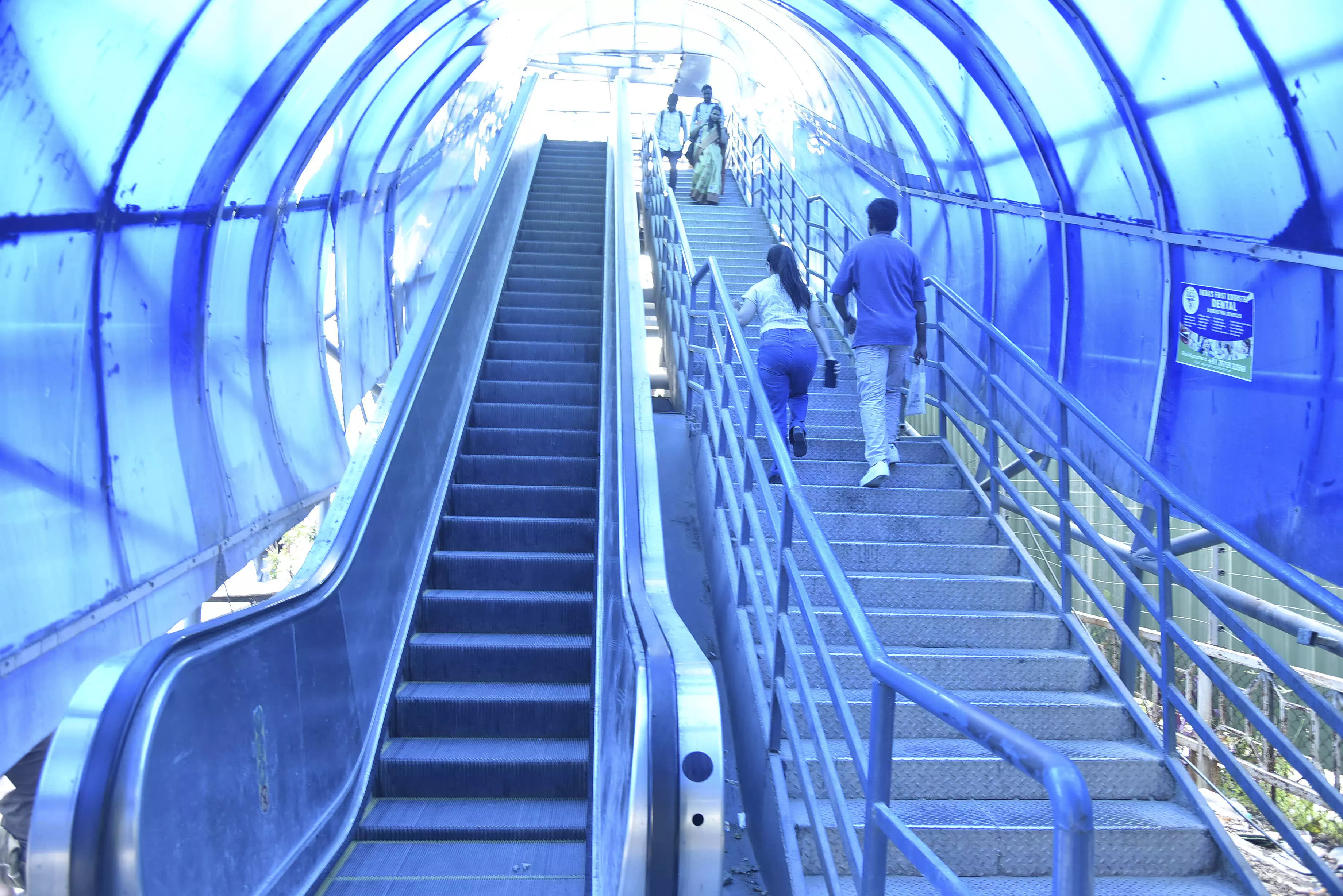
HYDERABAD: A foot overbridge (FOB) stands only a few yards from where 26-year-old Bharati Mukhi was fatally hit near a mall in Madhapur on August 16. However, its escalators are out of service, which leaves pedestrians to tackle a long flight of stairs to cross a road where those who work nearby say finding a gap in traffic is itself difficult.
A ground check in other parts of the city presented a similar problem with FOB lifts out of service and pedestrians saying that even zebra crossings do not offer any comfort.
A visit to the FOB near the mall on Friday showed what using that facility means when the escalators stop. With a staircase running alongside the escalator, people climbed the stairs and the stationary escalator to cross the road. One side alone involves a considerable climb before a pedestrian reaches the bridge and must then make the descent on the other side.
Pronoy, an employee working nearby, was among those who took the staircase, relatively fit and young. The climb did not trouble him personally, he said, but he questioned what the same crossing means for somebody who cannot manage stairs easily.
“I rarely care whether the escalators work or not because I can, but it can be a problem for many people. I cannot imagine a person with a disability, an elderly person, or someone with any mobility issues taking this FOB. It is simply not accessible for them,” he said.
Ashish Sinha, who also works close to the stretch, has largely dealt with the problem differently. He avoids crossing the road unless he has to. “I rarely have to use the FOB because I don't usually cross this road. In fact, I choose not to. There is a food street on the other side, but crossing here is hardly an option,” he said. “I have rarely seen the escalators working. Sometimes one side works, but most of the time they don't. The traffic is constant and cars simply don't stop.”
Sinha said another signal farther down the road made crossing somewhat easier, though he did not consider that much better. His experience points to a consequence that is easy to miss in discussions about pedestrian behaviour. Some people do not take a risky crossing or struggle up an FOB. They simply decide not to go to the other side.
Much the same difficulty appeared in other parts of the city. FOB lifts in Begumpet mostly do not work, and pedestrians said crossing at road level remained stressful even where a zebra crossing was available. “I am terrified of crossing the road here in Begumpet, so I avoid it most of the time. The FOB is quite difficult to use without the lift. I have knee problems, so most of the time I simply cannot manage it,” said Ritu Roy, who lives nearby.
Dr Donthi Narasimha Reddy, public policy expert, said the problem begins with treating an FOB as an automatic solution for pedestrians. “FOB does not help the pedestrians because we have to walk up and walk down,” he said. Reddy argued that road design and traffic enforcement have to work together. Pedestrian crossing points should be clearly defined, motorists should be made to stop there, and busy locations may require traffic personnel during peak periods. Signals by themselves achieve little when drivers do not yield, he said. “In India, those crossover points need to be defined with police presence,” Reddy added.
Footpaths matter just as much, according to him. A walkway that stops abruptly, is blocked, or takes a person away from where they actually need to go encourages people to find another route, sometimes across moving traffic. Continuous footpaths and properly placed road-level crossings could allow pedestrians to reach designated crossing points without making long detours.
Narasimha Reddy's comments follow his recent representation to city police commissioner V.C. Sajjanar concerning the one-way traffic arrangement around KBR Park. He had sought an assessment of its effect on pedestrians, public transport users, elderly people, children, patients and others travelling through the area. Indian cities have already experimented with putting walking higher in street planning, although none offers a perfect model like Chandigarh, Pune, or Chennai.