Telangana CM Revanth Gets 300-Page Report on Backwardness

Of the 243 sub-castes identified, 73 account for 96 per cent of the state’s population. These include 10 Scheduled Castes (SCs), 7 Scheduled Tribes (STs), 45 Backward Classes (BCs), and 11 from Other Castes.
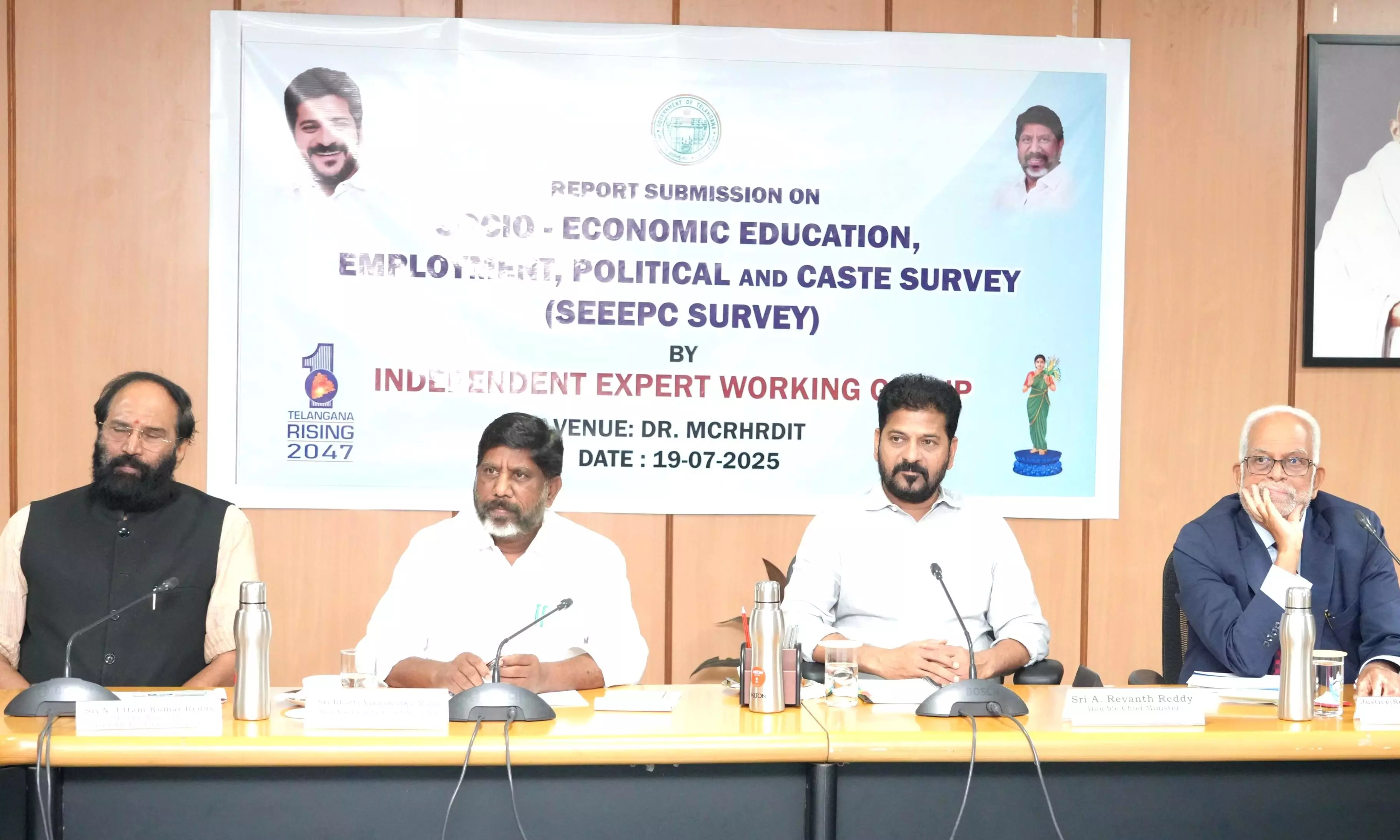
Hyderabad: Chief Minister A. Revanth Reddy on Saturday said that the state government would make effective use of the data collected through the recent caste census to empower marginalised sections and uplift backward communities. He said the findings would be crucial in directing resources toward welfare schemes and development programmes aimed at improving the socio-economic status of the underprivileged.
The Chief Minister received a detailed 300 page report prepared by the Independent Expert Working Group (IEWG), chaired by retired Supreme Court judge Justice B. Sudarshan Reddy. The IEWG, appointed by the state government, analysed data from the Socio-Economic, Education, Employment, Political and Caste Survey (SEEEPC), commonly referred to as the caste census. The report offers valuable insights into the social and economic backwardness of various communities and provides recommendations for targeted policy interventions.
Speaking at an event held at the Dr MCR HRD Institute, CM Revanth Reddy said the caste census was more than just a data exercise. Describing it as “Telangana’s mega health check-up,” he remarked, “We conducted this caste-based survey in line with the promise made by our leader Rahul Gandhi, to bring real change to the lives of weaker sections.”
He added that the findings would help formulate precise and equitable policies, especially to address rural-urban disparities. “I urge the expert committee to study these regional gaps and propose concrete measures to uplift the marginalised in rural areas,” he said.
One of the major innovations introduced by the IEWG was the Composite Backwardness Index (CBI), designed to evaluate the relative backwardness of 243 sub-castes in Telangana based on SEEEPC data. Unlike traditional approaches that focus on population share, the CBI prioritises levels of deprivation, using 42 parameters ranging from education, land ownership, and living conditions to discrimination in public and religious spaces.
Each sub-caste was assigned a backwardness score ranging from 0 to 126, calculated using a quartile-based statistical method. Individual parameters were scored from 0 to 3, with 3 indicating the highest level of deprivation.
Of the 243 sub-castes identified, 73 account for 96 per cent of the state’s population. These include 10 Scheduled Castes (SCs), 7 Scheduled Tribes (STs), 45 Backward Classes (BCs), and 11 from Other Castes.
Officials stated that the CBI is the first index of its kind in India, and possibly the world. It is expected to play a transformative role in shaping targeted welfare policies and resolving caste-based disparities with greater precision and fairness.
