Students Protest at OU After Delhi Police Action

The mix of people outside Arts College was part of what mattered to Zia. “Voices that were shut down over the past decade are beginning to rise again. The stagnation is slowly giving way, and it is hopeful to see young people coming out.”
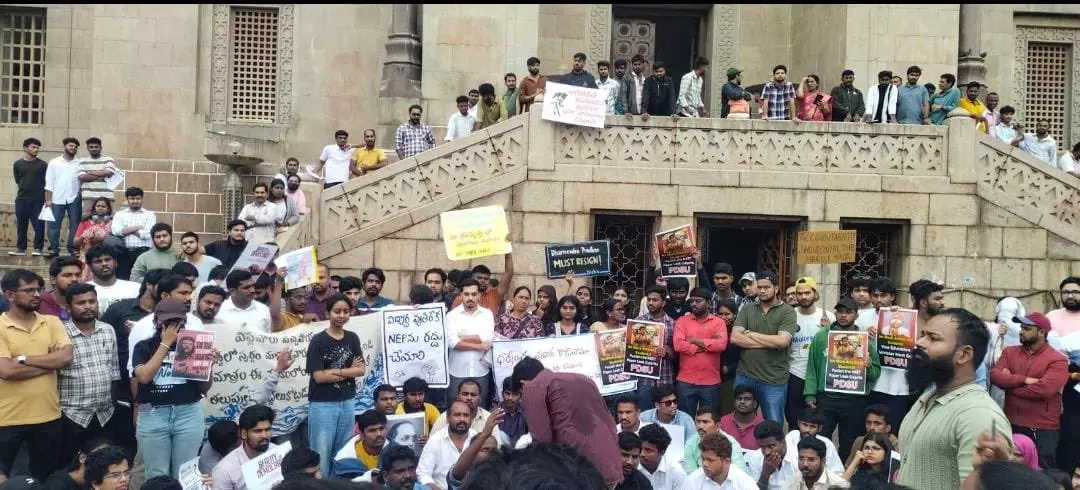
Hyderabad: A large student protest returned to Osmania University’s Arts College on Wednesday, two days after police action against the ‘Sansad Chalo’ protesters at Delhi’s Jantar Mantar intensified solidarity demonstrations across Hyderabad. Students and youth groups demanded the resignation of Union education minister Dharmendra Pradhan, dissolution of the National Testing Agency, a judicial inquiry into the police action and repeal of the National Education Policy 2020. Paper leaks, student suicides, falling enrolment, low education spending and restrictions on campus protest were also raised.
Hyderabad had already seen demonstrations in support of Sonam Wangchuk’s hunger strike, but Monday’s police action widened mobilisation. Several protests followed across the city, with large groups of students and young people joining solidarity programmes. The OU gathering came amid criticism that the campus, long associated with student movements, had remained largely absent from recent mobilisations.
“My friends and I are here to express solidarity after the police brutality we saw at Jantar Mantar on July 20,” said Zia, a protester. “Several organisations protested across Hyderabad yesterday as well. This is Hyderabad standing up, with its young people coming onto the streets to show that they care.”
Independent student and youth organisations organised Wednesday’s programme rather than a single group, said R.L. Murthy, a research scholar in OU’s Sociology Department, former SFI Telangana state president and state convener of the Nirudyoga JAC.
“Our main demands are the immediate resignation of Union Education Minister Dharmendra Pradhan, the dissolution of the NTA and a response from the Prime Minister,” Murthy said. “The government must respond immediately, and Parliament should discuss the issue.”
Murthy linked those demands to wider changes in education. “The Modi government is communalising education, and the National Education Policy is part of this larger process. Constitutional rights are being curtailed,” he said.
Protesters carried posters of B.R. Ambedkar, the Constitution and Jyotirao Phule. Amit, holding a Phule placard, said the reformer represented the need to question those in power. “Jyotirao Phule is an ideal for me because he taught us rationality and the importance of asking questions. This is a critical time to question the government and ask why it is not taking responsibility for the students who have died by suicide.”
The police action in Delhi remained the immediate reason for the protest. Manchala Kiran Kumar, a PhD scholar in Public Administration and SFI university unit vice‑president, described it as “completely inhuman”. He rejected the argument that absence of permission justified violence. “Police have no right to beat students. There are lawful ways to stop a march or proceed against those accused of violating restrictions,” he said.
The mix of people outside Arts College was part of what mattered to Zia. “Voices that were shut down over the past decade are beginning to rise again. The stagnation is slowly giving way, and it is hopeful to see young people coming out.”
Amit was cautious about expecting immediate reform, but said the protest could still “plant a seed” and show that people could stand up against injustice. “At the very least, people are beginning to wake up and question what is happening.”
