Students From All Over The City Take Part In Open Day CSIR NGRI On Friday

“So far, our methods to tackle this issue have been like repairing a punctured tyre again and again,” said Dr Subhash Chandra, chief scientist at the National Geophysical Research Institute (NGRI), Hyderabad.


Hyderabad: For farmers, the struggle for water is becoming harsher with each passing year. Groundwater tables are falling, rivers are drying and the once-reliable weathered rock layers that served as natural aquifers have been exhausted. What remains are fractured rocks with limited porosity, storing small amounts of water that are fast disappearing.
“So far, our methods to tackle this issue have been like repairing a punctured tyre again and again,” said Dr Subhash Chandra, chief scientist at the National Geophysical Research Institute (NGRI), Hyderabad. “We are tapping deeper and older water, which is not only scarce but also of poorer quality. Agriculture is already suffering and if we continue this way, even trees will begin to dry up.”
He was talking about NGRI's Airborne Electromagnetic (AEM) technology that is being used to gauge groundwater levels in various parts of India. According to him, there is a great potential in using this technology for mapping not only groundwater but also determining soil porosity, recharge and discharge of aquifers, water budgeting and much more, which can help governments in planning water availability for urban areas as well as agriculture.
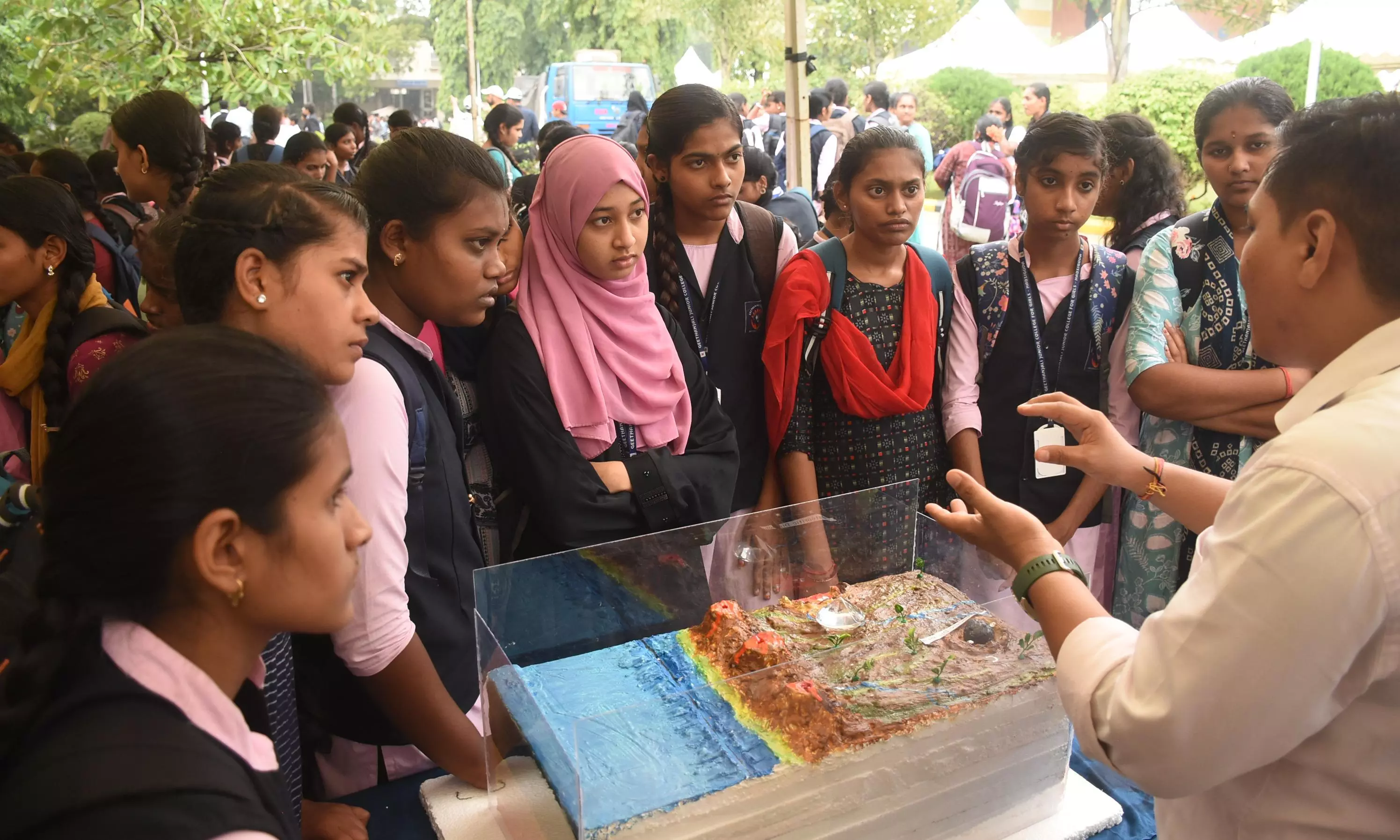
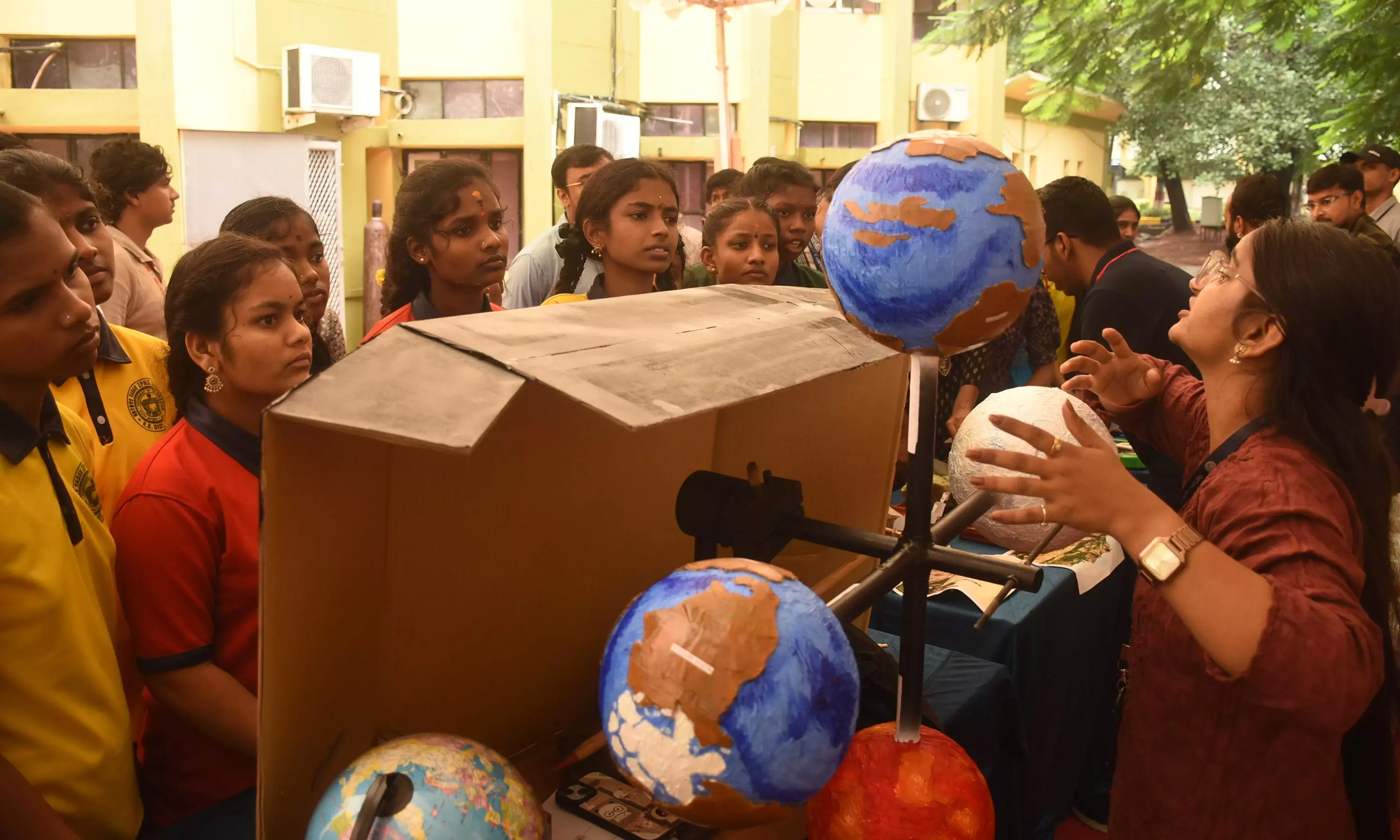
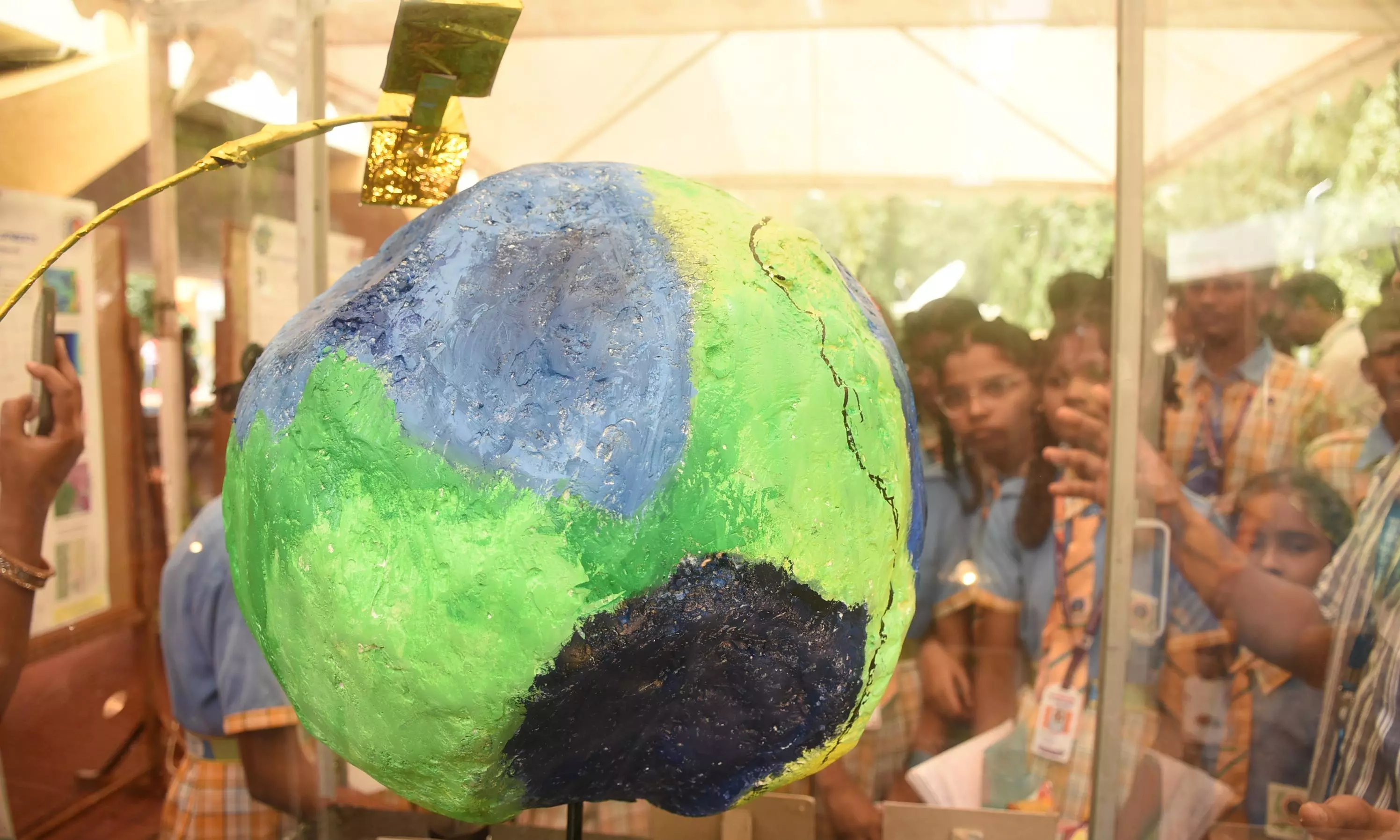
This was explained at CSIR's open day, where hundreds of school and college students and citizens had opportunity to interact with scientists working at research institutes here. At NGRI, the scientists put up exhibits of their researches in ground water tracking, geology, thermal energy, seismology, etc.
Telangana’s geology, unlike alluvial plains, has granitic hard rock, which stores water only in fractures (cracks formed over geological time). But these fractures are unevenly distributed and not always connected. A borewell sunk in one spot may strike water, while another, at the same depth just a few hundred meters away, yields nothing.
“This is why we see so many failed borewells,” explained a PhD student working under Dr Chandra's supervision, demonstrating a model of water movement. “Water flows from ridge areas down to valleys, slowly percolating through fractures. If fractures are connected, they recharge the aquifer. But if they are blocked by barriers or remain disconnected, water cannot flow. Even at the same depth, one borewell may work while another dries up. To understand this, we need to know the geology, the fracture disposition and how water moves through them. That is where airborne surveys help,” she said.
The advanced airborne electromagnetic (AEM) technology involves a helicopter that carries equipment that sends controlled pulses of current into the ground. Depending on underground conditions, the induced current behaves differently, revealing aquifers. “In just two hours, a helicopter can map about 100 square kilometres, with measurements taken every two to three metres. We can see aquifers as deep as 500 metres, even in hard rock terrains where fractures decide whether water will be found or not,” Dr Chandra said.
Unlike satellites, which provide only broad-scale information, or ground surveys, which cover tiny patches, AEM strikes a balance — offering both coverage and detail. It can even differentiate between water-bearing zones and massive dry rock and also quite effectively shows aquifer geometry, complete with its depth, length and breadth. “It’s like having a transparent window into the earth,” Dr Chandra remarked. “In Telangana’s granite, this could be the most efficient way to reliably map groundwater,” he added.
Since 2012, pilot projects have been carried out in Rajasthan, Bihar, Nagpur, Karnataka and coastal Andhra. One survey uncovered a buried ancient river system, stretching 200 km, with clear hydrological features of recharge and discharge. AEM has also been used to guide tunnel construction for railways and highways, where sudden encounters with water-bearing zones can derail projects. "Using this, we are now working with SLBC for more planned and guided tunnel construction," Dr Chandra said.
The next step is to harness artificial intelligence and machine learning. AEM surveys generate vast amounts of data, which, when combined with borehole and satellite readings, can paint a detailed picture of water availability. “With AI, we can automatically translate this data into practical advice—whether an area is suitable for paddy, which needs standing water, or cotton, which needs well-drained soil. We can even do scientific water budgeting, to track how much rainfall is actually recharging the aquifers,” Dr Chandra explained.
“It is our moral duty to use this knowledge here in Telangana and Andhra,” the scientist concluded. “But it requires vision and investment from policymakers. Without that, both farming and the future of water security will remain at risk,” he said.
NGRI’s tech
The Hyderabad-based National Geophysical Research Institute (NGRI) has implemented a helicopter-borne system that helps spot water underground.
The advanced airborne electromagnetic (AEM) equipment, carried by a helicopter, sends controlled pulses of current into the ground.
Depending on underground conditions, the induced current behaves differently, revealing aquifers.
In just two hours, a helicopter can map about 100 square kilometres.
Scientists can see aquifers as deep as 500 metres, even in hard rock terrain.
In contrast, satellites provide only broad-scale information
Ground surveys cover tiny patches.
Since 2012, pilot projects have been carried out in Rajasthan, Bihar, Nagpur, Karnataka and coastal Andhra.
One survey uncovered a buried ancient river system, stretching 200 km, with clear hydrological features of recharge and discharge.