SSCTU fails tribal youth promise
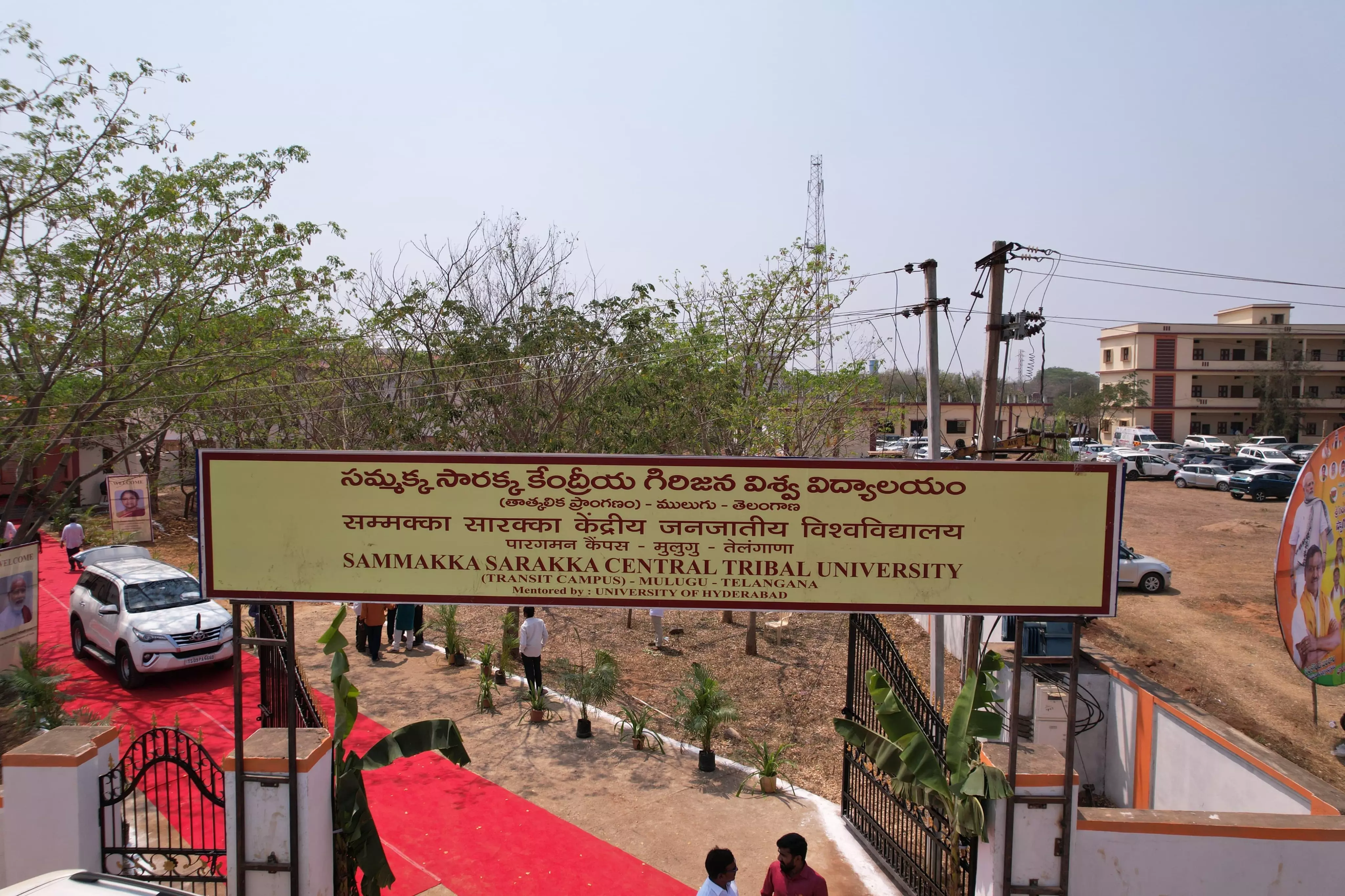
Sammakka Sarakka Central Tribal University (SSCTU) (Image:X)
Hyderabad: Launched with the promise of transforming higher education for tribal communities, the Sammakka Sarakka Central Tribal University (SSCTU) in Jakaram village, Mulugu district, is yet to live up to its vision. Established by the Central Government to bridge the educational divide in tribal regions, the university was expected to offer skill-based, employment-oriented courses aimed at empowering local youth and driving socio-economic progress.
Despite the appointment of local academician Prof. Y.L. Srinivas as the first vice chancellor, the university’s development has been sluggish. For the 2025–26 academic year, SSCTU has announced just two BA (Honours) programmes—in English and Economics—with only 25 seats each. The limited and conventional course offerings have disappointed many, especially when compared with the Central Tribal University of Andhra Pradesh (CTUAP) at Vijayanagaram. Since its establishment in 2019, CTUAP has introduced a range of job-oriented undergraduate and postgraduate programmes, including Artificial Intelligence, Tourism Management and Biotechnology.
In Mulugu, expectations were high for relevant and locally beneficial courses in forestry, agriculture and social work. Those hopes remain unmet. “There is no campus, no awareness and nobody from my area knows how to apply,” said Lakshman, a student from Mulugu. “We want a place that truly belongs to tribal youth, not just a signboard.” Saritha, a student from Mahabubabad, said, “My dream was to study in a central university close to home and learn new skills. I hope they will introduce professional courses soon so our community can really benefit.”
The requirement of a CUET (UG) 2025 score has further deterred students from remote tribal hamlets with little exposure to competitive examinations. Critics also point to the absence of basic infrastructure, low student intake and the lack of industry linkages as signs of inadequate planning and vision. While Prof. Srinivas had pledged to shape SSCTU into a “Centre of Excellence,” the university’s current state tells a different story. Critics suggest that the VC’s purely academic background, without dynamic outreach or industry tie-ins, has slowed the institution’s development. Attempts by Deccan Chronicle to contact him for comments went unanswered.
Union minister for coal and mines G. Kishan Reddy recently urged Union education minister Dharmendra Pradhan to prioritise the university’s development, citing the urgent need for improved educational opportunities and infrastructure for tribal youth in Telangana. Radha, an aspirant from Khanapur, reflected the prevailing mood: “We were expecting courses in computer applications, agriculture and tribal management to help us get jobs. Just English and Economics are not enough.”
In sharp contrast to its Andhra Pradesh counterpart, which has grown steadily since 2019, Telangana’s central tribal university—established in 2024—has begun with only two courses and 50 seats. Unless SSCTU expands its academic offerings soon, its foundational vision may remain unrealised, leaving another generation of tribal youth underserved.
In Mulugu, expectations were high for relevant and locally beneficial courses in forestry, agriculture and social work. Those hopes remain unmet. “There is no campus, no awareness and nobody from my area knows how to apply,” said Lakshman, a student from Mulugu. “We want a place that truly belongs to tribal youth, not just a signboard.” Saritha, a student from Mahabubabad, said, “My dream was to study in a central university close to home and learn new skills. I hope they will introduce professional courses soon so our community can really benefit.”
The requirement of a CUET (UG) 2025 score has further deterred students from remote tribal hamlets with little exposure to competitive examinations. Critics also point to the absence of basic infrastructure, low student intake and the lack of industry linkages as signs of inadequate planning and vision. While Prof. Srinivas had pledged to shape SSCTU into a “Centre of Excellence,” the university’s current state tells a different story. Critics suggest that the VC’s purely academic background, without dynamic outreach or industry tie-ins, has slowed the institution’s development. Attempts by Deccan Chronicle to contact him for comments went unanswered.
Union minister for coal and mines G. Kishan Reddy recently urged Union education minister Dharmendra Pradhan to prioritise the university’s development, citing the urgent need for improved educational opportunities and infrastructure for tribal youth in Telangana. Radha, an aspirant from Khanapur, reflected the prevailing mood: “We were expecting courses in computer applications, agriculture and tribal management to help us get jobs. Just English and Economics are not enough.”
In sharp contrast to its Andhra Pradesh counterpart, which has grown steadily since 2019, Telangana’s central tribal university—established in 2024—has begun with only two courses and 50 seats. Unless SSCTU expands its academic offerings soon, its foundational vision may remain unrealised, leaving another generation of tribal youth underserved.
( Source : Deccan Chronicle )

Next Story