SLBC Rescue Operations to Be Scaled Down
“All the experts from these agencies were unanimous that any future work at the site will have to follow the traditional drill and blast method, as the only option available for undertaking a rescue operation and for any future attempts,” a senior government official said
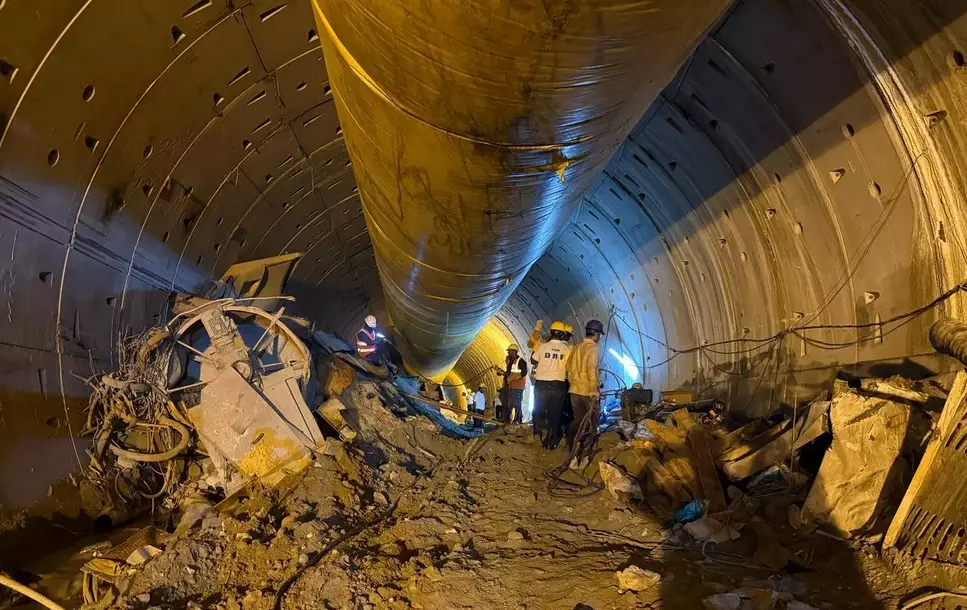
Hyderabad: Rescue operations inside the SLBC tunnel that began soon after the February 22 collapse of a section of the tunnel in which eight workers were buried alive and lost their lives, are to be scaled down.
A decision to this effect, along with some others on the way forward, was taken at a meeting of a specially constituted technical committee with experts from various agencies involved in the rescue mission so far, which met in Hyderabad on Thursday.
To start with, the committee approved decommissioning the services of the NDRF, and the Indian Army — two agencies that were among the first to rush to the rescue — but decided that services of the SDRF, Singareni Collieries rescue specialists, and the Indian Railways will continue until the final clean-up operations of removing silt, rocks, and protruding portions of the tunnel boring machine till the point where a ‘critical zone’ has been declared.
Of the eight missing workers, the bodies of two, that of Gurpreeet Singh and Manoj Kumar, have been found so far. The bodies of the other six are believed to have been buried in the final 50 metres of the tunnel, which has been declared a no-go zone due to fears over the stability of the accumulated silt, and possible fresh collapse putting the lives of rescue workers in jeopardy if this material is removed.
Though it was decided to scale down the operations, this does not mean efforts to find the still missing bodies have been stopped. The committee also approved the disbursal of Rs 25 lakh ex-gratia from the CM’s Relief Fund to the families of these workers, as was the case with the families of the two workers whose bodies have been found, an official said.
The meeting also called for setting up of a sub-committee comprising experts from Geological Survey of India, National Geophysical Research Institute, National Centre for Seismology, the National Institute of Rock Mechanics, National Remote Sensing Centre, Central Institute for Mining and Fuel Research, and Border Roads Organization which will be represented by Col. Pariskhit Mehra, with a mandate to study the conditions in the sensitive zone of the tunnel, and the rocks above, and submit a site-specific report on the way forward.
“All the experts from these agencies were unanimous that any future work at the site will have to follow the traditional drill and blast method, as the only option available for undertaking a rescue operation and for any future attempts,” a senior government official said.
This means from the inlet side of the tunnel in Domalapenta village of Nagarkurnool district where the accident happened, there will be no further drilling using a tunnel boring machine. However, in the meantime, it is likely that tunneling using a second TBM, awaiting repairs in the outlet side of the tunnel in Nalgonda district, may be allowed to begin once the machine is repaired and approvals are given for continuing the work.
The goal is to examine the feasibility of all future work will follow the thresholds as defined by the Ministry of Environment, the official added.
Important Points:
SLBC tunnel collapse
February 22
8.15 am: Collapse began. Eight workers trapped, 42 made to safety
9 am: 25,000 tonnes of rock and silt fell into the tunnel.
The first body of the missing worker Gurpreet Singh found on March 9
The body of the second missing worker, Manoj Kumar found on March 25
No sign of the six missing workers, believed to be buried in the critical no-go zone, buried inside TBM and silt, rocks.
27 agencies are involved in rescue operations
Among them NDRF, SDRF, SCCL, Army, Navy, Railways, NDMA, NGRI, NCS, GSI, Kerala Police, Rat Miners, Navayuga, L&T and Solinas, IIT-Madras.
