Shehr Festival Walks in Before Hyderabad Fades

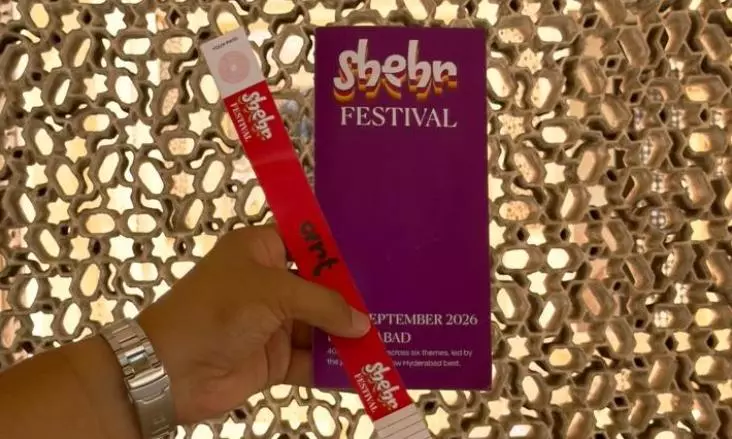
Saturday morning, the Hyderabad photographer asked around two dozen people at the Paigah Tombs to stop and record what was in front of them. That photowalk opened one part of Shehr, a first of its kind, 16-day festival that Deccan Archive is organising tll September 20.
Hyderabad: To call a festival a love letter is easy. One has to only ask where the affection actually is at and the Shehr festive puts it in things that can be pointed to and walked towards. From lettering across a shopfront to an old house that disappears before anyone thinks to photograph it, the inexpensive cafe a neighbourhood once used as a third place, a lake, a bird, or a commercial district whose place in Hyderabad’s story rarely fits in the usual heritage circuit.
“Sometimes we look back and wonder, ‘I wish I had photographed that’,” said photographer Kishor Krishnamoorthi, thinking of Marredpally in Secunderabad, where he grew up. He remembers old independent houses across the neighbourhood. Apartments now stand where those houses once did.
Saturday morning, the Hyderabad photographer asked around two dozen people at the Paigah Tombs to stop and record what was in front of them. That photowalk opened one part of Shehr, a first of its kind, 16-day festival that Deccan Archive is organising tll September 20. The programme has roughly 48 to 50 events. Historians, journalists, researchers, photographers and other collaborators lead them. Ameerpet’s skilling district, Cyberabad, Gandipet, Patancheru and the Musi all appear on the schedule.
Sibghatullah Khan, founder and managing trustee of The Deccan Archive Foundation, said, “We’ve come across a lot of very interesting individuals who do these walks independently. We realised that some people don’t have the same platform. They don’t get that exposure; they don’t get enough publicity about certain walks they do,” he said, adding, “We don’t want to do it ourselves. We want to make sure that everyone who’s participating can own it as their own thing.” Khan includes ecology, culture and things people inherit even when they cannot see them in his idea of heritage.
Ragini Siruguri looks at another kind of object that can vanish almost without notice. The book designer and typography researcher will lead a September 20 walk through Usmanganj, a major commercial market. The route focuses on signboards and the forms of lettering people see in English, Telugu, Urdu and other scripts.
“So we’re going to explore the city, we’re going to explore that particular neighbourhood, look at designed objects, look at scripts, languages, the politics of these, the design aspects of these, and hopefully learn to appreciate Hyderabad from a different perspective,” Siruguri said.
Her question is practical. What goes into making a signboard that has several languages on a single surface? Siruguri divides what people will see into hand-painted lettering, fabricated metal or acrylic signs and digitally made type. She is interested in what happens after a type designer releases a font and other people begin using it.
That lettering walk also shows why Khan wanted collaborators who work outside Deccan Archive’s own areas of expertise. He singled out food and art as parts of the programme where other specialists mattered.
Siruguri’s interest lies in what happens when older signs remain beside newer ones on the same commercial street. She said cheaper and easier production has replaced some older forms of sign-making, especially in newer parts of Hyderabad. “You often see the old and the new next to each other. So you kind of see the transition happening in front of you.”
Khan counted about 35 people among event leaders, participants and the organising team. He described Shehr as Hyderabad’s first walking festival and the name was deliberately broad. “We wanted it to be a thing that broadly fits the definition of a city or urban life.”