SCR Achieves Unprecedented Growth With Consistent Performance: Jain

The SCR has achieved record highs in revenue and freight loading: Jain
Hyderabad: The South Central Railway (SCR) has entered a historic phase of growth and transformation by consistently delivering outstanding performance for three consecutive financial years - 2022–23, 2023–24, and 2024–25.
Over the last three years, the SCR has achieved record highs in revenue and freight loading. The gross originating revenue rose impressively to Rs.18,976 crore in 2022–23, further increasing to Rs.20,339 crore in 2023–24 and Rs.20,569 crore in 2024–25.
Correspondingly, freight loading reached new benchmarks, registering 131.8 million tonnes in 2022–23, 141.1 million tonnes in 2023–24, and peaking at 144.1 million tonnes in 2024–25. Freight revenue also saw substantial growth with Rs.13,051 crore, Rs.13,620 crore, and Rs.13,864 crore recorded respectively during the same years.
Reflecting on this period of sustained excellence, Arun Kumar Jain, SCR General Manager, stated that “The remarkable achievements of SCR over the past three years is the result of the collective efforts and unwavering dedication of every member of this organization.”
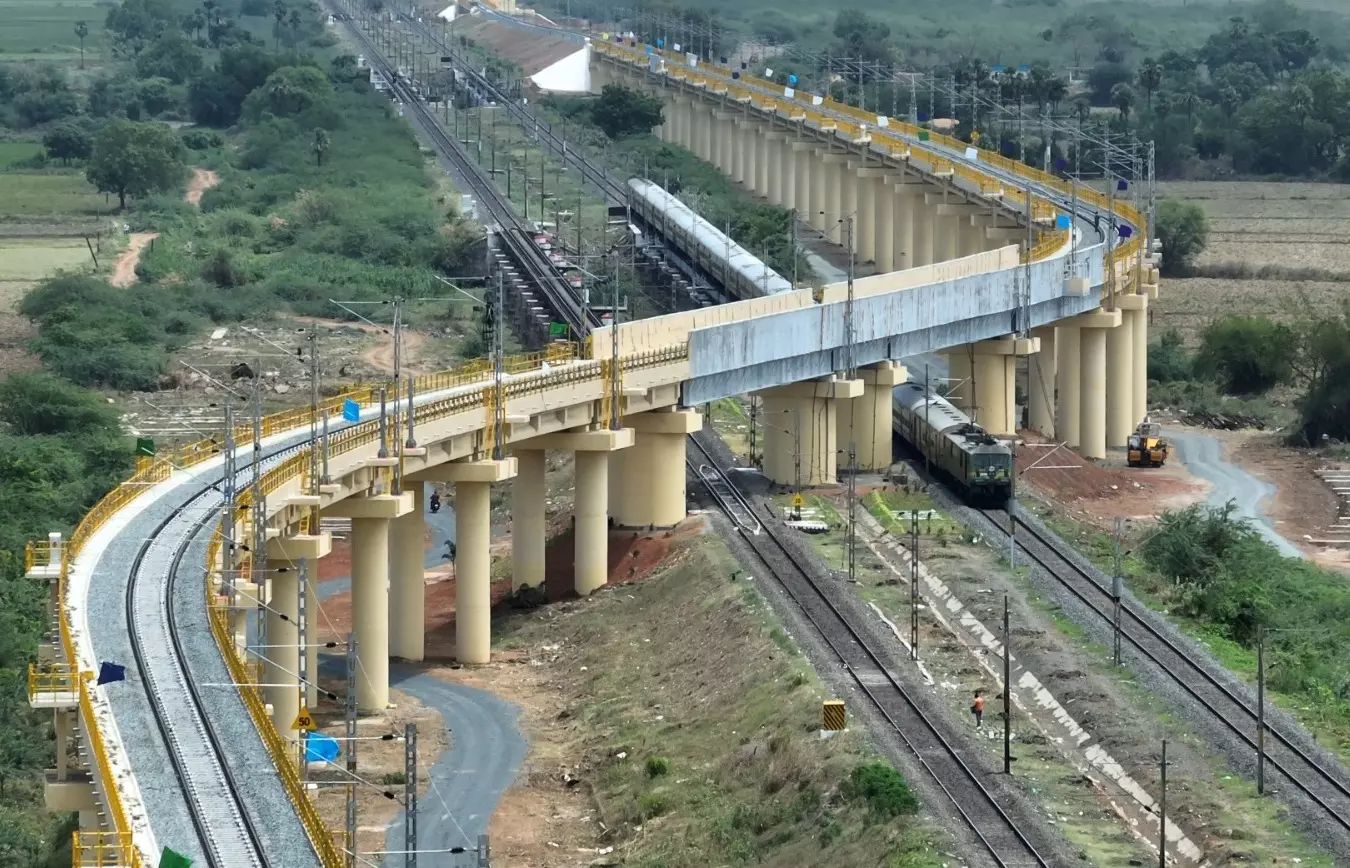
Likewise, the Revenue from passenger segment has crossed the Rs.5,000 crore mark in each of these three years, The zone also made substantial progress in network expansion by adding a total of 960 kilometers of track over this period in the form of new lines, doubling, tripling etc. In the field of engineering, the SCR executed some of its most significant projects, including the construction of the zone’s longest rail flyover near Gudur measuring 2.2 kilometers and the commissioning of its first-ever rail-under-rail structure near Kazipet as part of the Kazipet bypass project.
The capital expenditure also reached record levels, totaling Rs.47,050 crore across the three years. In alignment with the Ministry of Railways’ vision under the Amrit Bharat Station Scheme, the SCR has identified 119 stations across the zone for comprehensive redevelopment at an estimated cost of Rs.6,500 crore. This transformative initiative includes major upgradation works at prominent stations such as Secunderabad, Tirupati, Nellore, Hyderabad, Vijayawada, Kacheguda, Nanded, Aurangabad, and Jalna. Three Amrit stations viz., Begumpet, Karimnagar and Warangal have already been inaugurated, offering state-of-the-art passenger amenities and enhanced facilities.
Thirteen Gati Shakti Cargo Terminals were commissioned, further enhancing freight movement and multimodal logistics capabilities. Further strengthening terminal infrastructure in the Hyderabad twin city region, a new coaching terminal has been developed at Charlapalli at a cost of Rs.413 crore. This modern terminal, now operational, is equipped with world-class amenities and a contemporary station building, significantly improving travel convenience for the city’s residents.
Electrification of the entire broad-gauge network of the zone was completed, except for the recently completed or under-construction lines. The zone’s locomotive strength saw a notable boost with the commissioning of 396 electric locomotives in three years, increasing the total to 1,268 and making SCR the second-largest electric loco-holding zone in the country. SCR’s commitment to enhancing passenger services is reflected in the introduction of eight Vande Bharat Express trains, 15 new Express services, and 28 additional MMTS services, catering effectively to the growing travel demand. In terms of safety enhancements, the zone eliminated 234 manned level crossings and constructed 32 Road Over Bridges and 204 Road Under Bridges. To improve speed and capacity, the maximum permissible speed was raised to 130 kmph on key routes of SCR covering 1,835 route kilometers. In addition, 173 permanent speed restrictions were either removed or relaxed, nine longer loop lines were constructed, and 27 intermediate block signals were commissioned to support seamless train operations.
Modernization of signalling systems was another major focus area, with 289 route kilometers brought under Automatic Block Signalling and modern electronic interlocking commissioned at 128 stations.