Governor Varma said, "The Salar Jung Museum stands as an important place of cultural heritage for future generations"
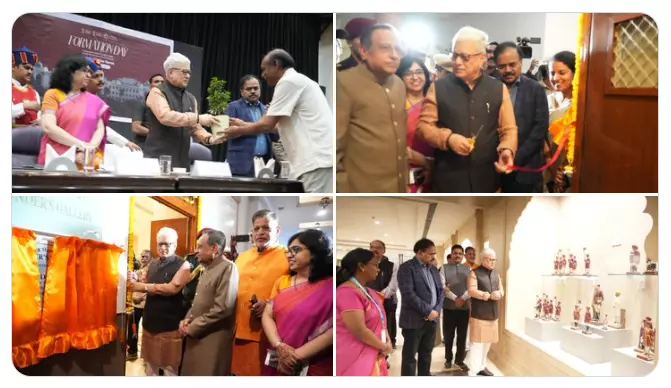
Hyderabad: The 57-year-old Founders Gallery at Salar Jung Museum has a new look, renovated and relaunched as part of its 74th Formation Day celebrations here on Tuesday. The gallery, inaugurated by Governor Jishnu Dev Varma, displays objects and artefacts relating to the family of Salar Jung, the Nizam-era prime minister.
Among the artefacts is a dark blue porcelain vase prepared for Salar Jung-1 during his visit to England in 1876 and a coal port factory commemorative vase produced in 1897 to mark Queen Victoria’s Diamond Jubilee.
Governor Varma said, "The Salar Jung Museum stands as an important place of cultural heritage for future generations."
Referring to challenges faced by museums across the country, including declining footfalls, he expressed confidence that the Salar Jung Museum could serve as a model by emerging as a participatory, inclusive and vibrant institution.
As for the collection, gold and silver objects, and mementos received by Salar Jung-I during his visits to England were also displayed. The gallery includes a gold casket presented by the Corporation of City of London in 1876, a large silver monteith presented by H.R.H. Albert Edward, Prince of Wales and Ewer and Basin of silver presented by the Duke of Edinburgh.
Further, a number of fine cut glass objects such as wine red, dark blue and clear-cut glasses from Czechoslovakia, and tea and coffee sets of English porcelain factories present in the gallery showcases the elegance of Salar Jung -II period.
The gallery houses a collection of fine arts from across the world, silver furniture, prizes, Sherwanis, caps, dastars and Masnad of Salar Jung-III Mir Yousuf, who remained as a bachelor and devoted his time to fine arts.
The museum origin lies in the Dewan Deodi, the ancestral palace of the Salar Jungs, where the collection of Salar Jung-III was first housed. It also displayed different buildings like Aina Khana, Lakkad Kot, Chini Khana, Nizam Bagh and other portraits, which no longer exist.
Following Salar Jung-II's demise and the absence of a direct heir, the idea of establishing a museum was conceived. It was launched by then prime minister Jawaharlal Nehru on December 16, 1951. In 1968, the museum moved to its present building on the bank of Musi river.

