Road accidents: Experts Warn Against Driving During Sleep Hours

Somnologists said the brain goes to deep sleep from 1 am to 5 am as per sleep disorder system in circadian rhythm and driving during such time would pose a grave danger to life.
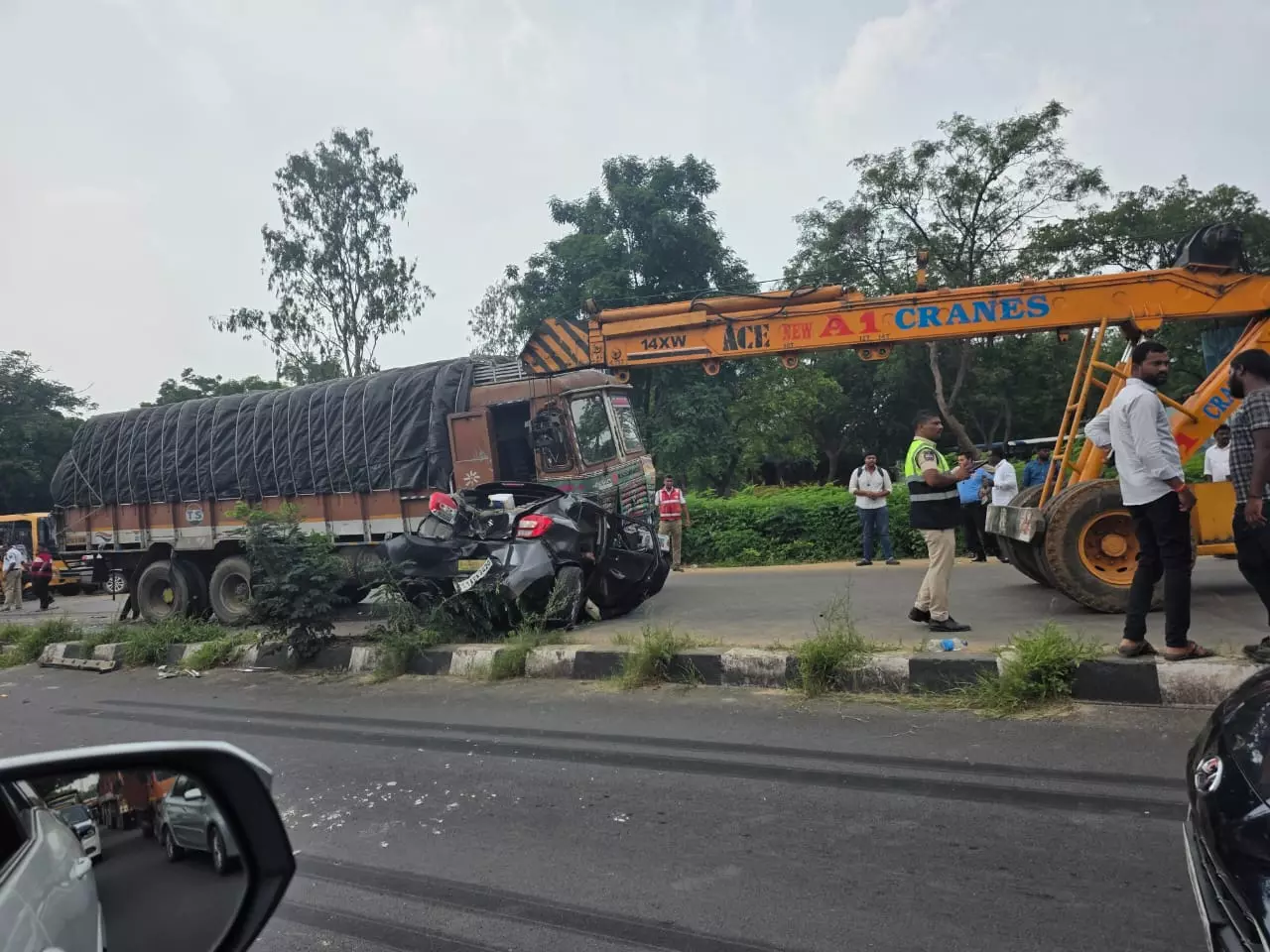
Hyderabad: The ghastly road accident that snuffed out the lives of two Deputy Superintendents of Police (DSPs) from Andhra Pradesh recently at Choutuppal on Hyderabad-Vijayawada national highway (NH-65) came to fore the safety aspect of driving during odd hours.
Two DSPs, M. Chakradhar Rao (57) from Goshamahal and J. Shantha Rao (54) from Hayathnagar, died on the spot when they were on the way to Hyderabad in an SUV around 4.30 am, the police said.
While the Choutuppal police suspect over-speeding and drowsiness could be the cause of the accident, sleep disorder experts cautioned the drivers not to travel during odd hours especially from 1 am to 5 am. The Choutuppal accident is not an isolated one. Several road accidents occurred earlier on the NH-65 covering from Pune to Machilipatnam via Hyderabad and Vijayawada.
The ever-busy stretch is the main link for thousands of motorists travelling to Hyderabad from Andhra Pradesh and in return direction.
Of the total national highways covering 4,926 kms in the State, the NH-65 is the crucial link connecting Telangana and Andhra Pradesh where a massive traffic movement is registered every day. The vehicular traffic increases manifold during festivals especially Sankranti.
Referring to spate of road accidents on the highways during odd hours, somnologists said the brain goes to deep sleep from 1 am to 5 am as per sleep disorder system in circadian rhythm and driving during such time would pose a grave danger to life.
The main cause of various road accidents that took place earlier on the highways and other arterial roads in the wee hours was when drivers doze off while driving. “It’s all because of tiredness,” said a sleep disorder specialist, Dr. Vyakaranam Nageshwar, while interacting with Deccan Chronicle.
Elaborating further on the causes of road accidents, he said two main factors that were forcing most drivers into sleep were consumption of alcohol or ganja before driving. If a driver consumes alcohol in the evening and by 12 am at midnight it will add to circadian rhythm because of Melatonin.
Melatonin plays a crucial role in regulating the human circadian rhythm, which is the body's natural sleep-wake cycle. It acts as a signal to the body, telling it when it's time to sleep, primarily by increasing in the evening and peaking at night in response to darkness, Dr. Nageshwar explained.
Adding alcohol to the body causes more sleepiness to the driver. “So, driving in an intoxicated condition is always dangerous,” he said. Another reason is consumption of ganja, which is rampantly available these days.
“Consuming ganja makes a person more intoxicated than alcohol and several drivers aged between 25 and 40 tend to use it while driving, which is also risky,” he said. He stated that persons with obese, belly fat and more neck circumference cannot concentrate while driving at night.
When his attention was drawn to the precautions to be taken by drivers while attending to emergency situations during odd hours, he said each driver must undergo sleep apnea syndrome or polysomnography test. Based on the test findings, a decision might be taken whether to allow the driver to proceed with his duty.
The drivers can also carry digital watches monitoring sleep apnea apart from blood pressure (BP) and saturation levels.
He recalled that the drivers of Telangana State Road Transport Corporation (TGSRTC) were undergoing polysomnography tests before joining the duty at night. Dr. Nageshwar also highlighted the importance of polysomnography tests at a workshop conducted with the RTC drivers recently.
With respect to food to be taken at night before driving, he said that the drivers should strictly avoid curd apart from spicy food with masalas as it would prompt drivers into drowsiness. “It is always advisable to have light meals before driving,” he said.
After the Choutuppal incident, officials from the Rachakonda Police Commissionerate and NHIA inspected the accident spot to know the main reason behind the accident. The major portion of the highway falls under the jurisdiction of the Suryapet district police and Rachakonda Police Commissionerate.
A senior official of NHIA said the drivers of heavy vehicles follow lane discipline and reach their destinations safely. However, several car drivers were found to be not adhering to speed limit rules resulting in accidents.
He said the sign boards indicating the speed limit of 80 kmph were put up at the black spots to caution motorists. The actual speed limit on the high is 100 kmph but it was reduced to 80 kmph as several car drivers were driving at 120 kmph and putting their lives at risk.
According to the official, the Ministry of Road Transport and Highways is primarily responsible for development, operation and maintenance of national highways. Further, guidelines have been issued for regular safety audit of all NHs at design, construction, pre-opening stage of NH projects as well as on existing ones for ensuring road safety.
Road construction for other categories of roads including State Highways is undertaken by States and Union Territories (UTs.). Immediate short-term measures like road markings, signages, crash barriers, road studs, delineators, closure of unauthorized median openings, traffic calming measures, etc.
Long-term measures like improvement of road geometrics, junction improvements, spot widening of carriageway, construction of underpasses and overpasses, etc. are taken as permanent rectification measures, based on the findings of site specific road safety audit reports.
Electronic Detailed Accident Report (eDAR) (erstwhile iRAD – Integrated Road Accident Database) portal has been developed which acts as a central database or a repository for reporting, management and analysis of road accidents data across the country It assists in providing data-based insights to the implementing agencies and State agencies for
formulation of policy measures and in strategic decision making, enabling authorities to identify accident spots or blackspots through analytics and take preventive measures and efficient processing of road accident claims and reducing the time taken in settlement of such cases.
Explaining various measures being taken in the larger interest of passengers, TGSRTC officials said when every bus driver reports for duty at the depot, the staff would check him with a breathalyzer to know the Blood Alcohol Content (BAC) levels.
If the BAC levels of any driver were found to be more than 10 mg/100 ml, then he would not be permitted to attend duty. “We carry the exercise across all depots in the State every day under the supervision of depot manager and traffic supervisor,” said an official.
This exercise is in addition to orientation classes for drivers and conductors, who report for duty daily. “We ask drivers to strictly adhere to speed limits apart from avoiding mobile phone driving using ear phones. We also ask them to be polite with passengers,” the official said, adding that the RTC was regularly conducting training sessions highlighting the importance of passengers.
To address the fatigue issue of drivers, the RTC is deploying two drivers depending upon the journey based on steering hours. It currently has around 15,000 drivers operating 9,300 buses to various destinations.
The private bus operators said they would also accord top priority for the safety of passengers and added that they were deploying two drivers for each bus service to not only ensure the safety of passengers but also avoid unnecessary stress on drivers.
For example, if a bus starts from Miyapur to reach Rajahmundry via Hyderabad and Vijayawada highway, the first driver would drive the vehicle from Miyapur to Choutuppal in Suryapet district covering a major portion of the city.
After taking a short break for tea, the second driver would handle the steering till Eluru facilitating the first driver to take rest. After one more break, the first driver would resume duty till the vehicle reaches Rajahmundry.
The same pattern was followed by all drivers in the two Telugu States. As the drivers know the topography of the route and road conditions, the operators continue them in the same route, said N P Gautam Kiran, an Executive Member of Bus Operators Confederation of India.
Members of Andhra Pradesh Lorry Owners Association said the accidents on highways were happening because of car drivers. “The biggest problem is that four-wheeler drivers do not have experience. Less night driving experience coupled with inexperience in long driving and high speed are two factors resulting in accidents,” Association general secretary YV Eswararao explained.
Highlighting various causes for the road accidents, Ministry of Road Transport and Highways, in publication on “Road Accidents in India 2022”, said that during 2022, a total of 4,61,312 accidents were recorded in the country, of which, 1,51,997 (32.9 per cent) took place on the national highways including expressways, 1,06,682 (23.1 per cent) on State highways (SH) and the remaining 2,02,633 (43.9 per cent) on other roads.
Out of the total of 1,68,491 fatalities reported in 2022, 61,038 (36.2 per cent) were on national highways, 41,012 (24.3 per cent) were on State highways and 66,441 (39.4 per cent) were on other roads. Out of the total, 1,55,781 fatal accidents reported in 2022, 55,571 (35.7 per cent) were on national highways, 37,861 (24.3 per cent) were on State highways and 62,349 (40 per cent) were on other roads.
During 2022, road crashes in India claimed about 1.68 lakh lives and caused injuries to more than 4.4 lakh people. Road accidents being the result of inter-play of multiple factors, multipronged measures are needed to reduce the number of accidents and fatalities. Therefore, the Ministry has initiated a proactive policy approach towards road safety by incorporating active participation of all stakeholders across the country
It further stated that road accidents are multi-causal and are often the result of interplay of various factors like human error, road environment and vehicular condition. In 2022, under the category of Traffic Rule Violations, over speeding is a major killer, accounting for 71.2 per cent of persons killed followed by driving on the wrong side (5.4 per cent).
For the fourth consecutive year in 2022, the fatal road accident victims largely constitute young people in the productive age groups. Young adults in the age group of 18 - 45 years accounted for 66.5 per cent of victims during 2022.
People in the age group of 18 to 60 years share 83.4 per cent of total road accident fatalities. Among vehicle categories involved in road accidents, two-wheelers for the second consecutive year, accounted for the highest share in total accidents and fatalities during 2022. Light vehicles consisting of cars, jeeps and taxis together come at a distant second.
In terms of road-user categories, the share of two-wheeler riders in total fatality has been the highest (44.5 per cent) during 2022 followed by pedestrian road-users with 19.5 per cent of persons killed in road accidents.
Nature of accident or collision types at aggregate national level data shows an increase in 2022 compared to 2021. 'Hit from Back' accounted for the largest share in total accidents deaths (19.5 per cent), followed by 'Hit and Run' and 'Head on Collision' which accounted for 18.1 per cent and 15.7 per cent respectively. 'Hit from Back' accounted for the largest share in total accidents (21.4 per cent), followed by 'Head on Collision' and 'others' which account for 16.9 per cent and 16.5 per cent respectively.
The other major type of collision which caused death is 'hit from side' (12.1 per cent). The Motor Vehicle Amendment Act 2019 provides enhanced rates of Rs. 2,00,000 on the death of a victim in Hit and Run as against Rs 25,000 earlier as compensation. A hit from the back or a rear-end collision occurs when a vehicle crashes into the one in front of it.
Common factors contributing to rear end collisions may be due to driver's lack of attention or distraction, tailgate (to drive or follow closely behind another vehicle or person), panic stops and reduced traction due to wet weather or worn pavement etc. Other categories like “Run off the Road” may happen because of loss of control by the driver. This may be due to excessive or inappropriate speed, distraction, misjudging a curve, attempting to avoid collision with another road user or an animal.
