Revanth Wants Taskforce to Create Six Global Cities in India

He proposed a national task force empowered to act swiftly and sought an investment of `1 lakh crore for each metropolis, describing it as an investment in infrastructure that would generate jobs, revenues and economic growth.
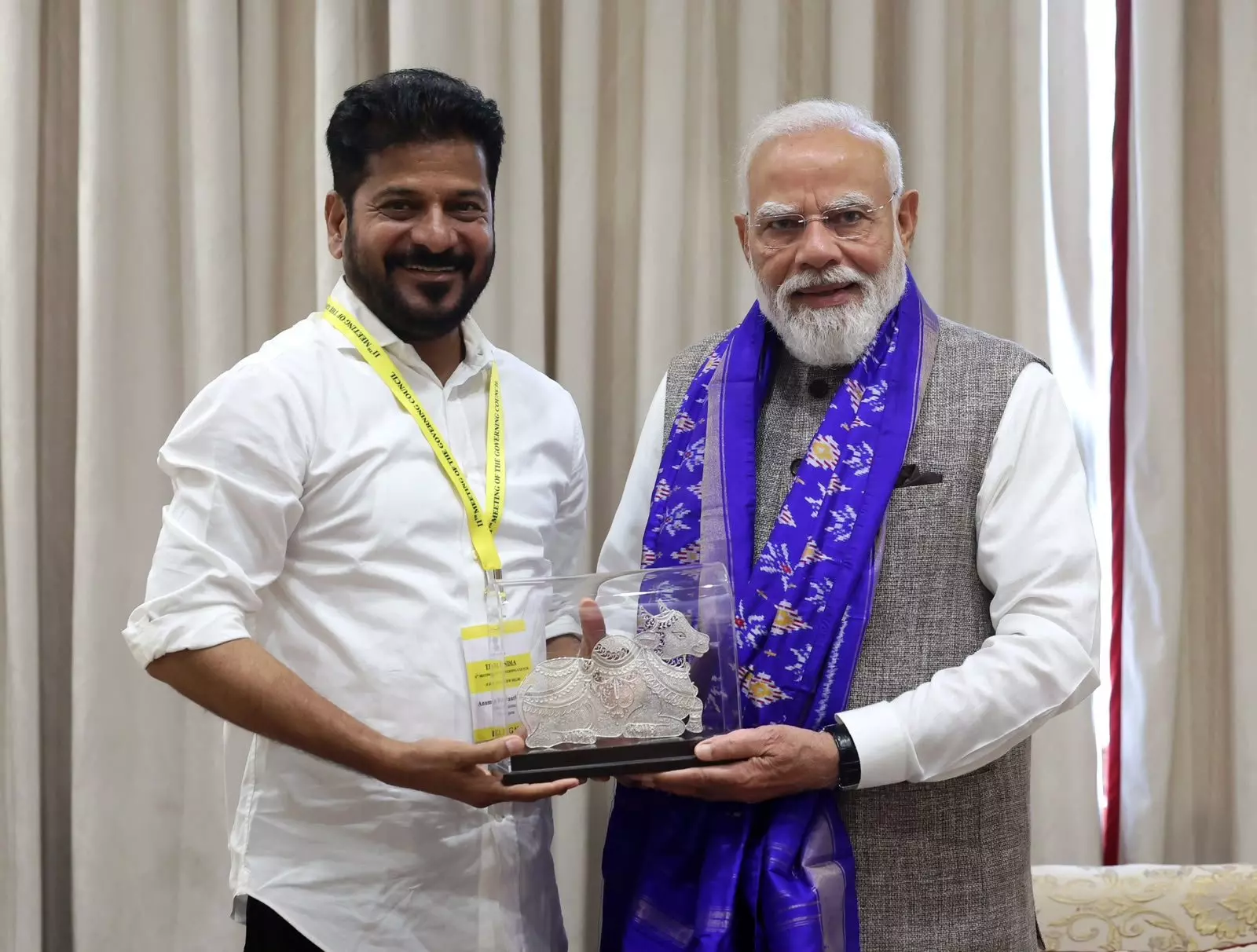
Hyderabad: Chief Minister A. Revanth Reddy on Thursday urged the Centre to establish an “M6 Cities Taskforce” to transform India’s six metropolitan cities — Delhi, Mumbai, Kolkata, Chennai, Hyderabad and Bengaluru — into globally-competitive urban centres.
Addressing the governing council meeting of Niti Aayog, chaired by Prime Minister Narendra Modi, in Delhi, Revanth Reddy said these six cities housed nearly 10 per cent of India’s population and contributed almost one-fourth of the nation’s GDP, yet continued to lag behind leading global cities.
He proposed a national task force empowered to act swiftly and sought an investment of `1 lakh crore for each metropolis, describing it as an investment in infrastructure that would generate jobs, revenues and economic growth.
The Chief Minister also sought the Centre’s support for eight major projects in Telangana, which include the Regional Ring Road, a 12-lane expressway linking Bharat Future City with Machilipatnam Port, Hyderabad Metro Rail Phase-II, Musi River rejuvenation, recognition and funding for the 30,000-acre Bharat Future City project, assistance for the Palamuru-Rangareddy lift irrigation scheme, support under the India Semiconductor Mission, including APMP and OSAT facilities and a Micro-LED fabrication unit, and establishment of an Indian Institute of Management (IIM) in Hyderabad.
Revanth Reddy presented a report titled “Inclusive Human Development – For Viksit Bharat @2047”, outlining Telangana’s strategy for inclusive growth through education, skill development and a knowledge-driven economy.
The report drew on findings of the SEEPC survey, which covered 3.55 crore people across 242 castes and nearly 97 per cent of households, revealing significant educational disparities among social groups and underscoring the need for education-led social transformation.
The report identified key shortcomings in the existing education system, including declining public confidence in government schools, lack of English-medium education, inadequate transport facilities, absence of pre-primary education and limited digital learning opportunities. To address these challenges, the government is establishing Telangana Public Schools offering education from pre-primary to Class XII on a single campus with transport, meals, laboratories, libraries and digital learning facilities.
The government was also setting up one Young India Integrated Residential School in each of the state’s 105 Assembly constituencies outside the capital at an estimated cost of `24,000 crore. Other initiatives include free electricity to over 26,000 educational institutions, strengthening of Kasturba Gandhi Balika Vidyalayas, the Anna Akka Learning Initiative for AI and digital literacy, notification of over 11,000 teacher posts and formulation of a State Education Policy aligned with the National Education Policy 2020.
The report highlighted Telangana’s focus on skill development through the Young India Skills University and the transformation of 65 ITIs into Advanced Technology Centres in partnership with Tata Technologies. Through TOMCOM, the state is also preparing youth for overseas employment opportunities. Revanth Reddy said Telangana aims to become a $1-trillion economy by 2034 and achieve a $3-trillion GSDP by 2047 through a development model built on urban, peri-urban and rural growth.
