Revanth To Inaugurate Survey For SLBC Tunnel Today

The survey aims to map the features in the ground above the tunnelling site, where a disaster on February 22 claimed eight lives. Information gleaned from the survey will be passed on to the National Geographic Research Institute (NGRI) which will submit a report to the irrigation department suggesting the way forward after studying various geographical features like underground lakes and fault zones
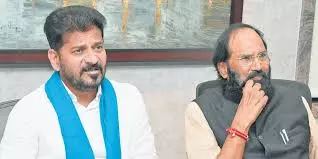
Hyderabad: Chief Minister A. Revanth Reddy will inaugurate the aerial electromagnetic survey for the Srisailam Left Bank Canal (SLBC) tunnel at Mannevaripalli on Monday. Irrigation minister N. Uttam Kumar Reddy will accompany the Chief Minister during the event.
The survey aims to map the features in the ground above the tunnelling site, where a disaster on February 22 claimed eight lives. Information gleaned from the survey will be passed on to the National Geographic Research Institute (NGRI) which will submit a report to the irrigation department suggesting the way forward after studying various geographical features like underground lakes and fault zones.
Following the tragedy, a high-level technical committee was formed, which recommended advanced tunnelling methods, observational techniques, and scientific monitoring to enhance safety. One of the proposals was to abandon the tunnel boring method and resort to blasting to build the tunnel.
The Cabinet, on October 23, , approved the adoption of these advanced methodologies with the goal of completing the tunnel before mid-2028, within the original budget.
Tunnelling experts recommended a heliborne electromagnetic survey to better understand the geological complexities. Acting on this advice, the state government sanctioned a VTEM plus magnetic geophysical survey to be conducted by scientists from the NGRI.
Given the complexity of the project, the government has constituted a technical committee comprising leading tunnel and rock mechanics experts. The committee has already held six meetings. To strengthen oversight, the government has roped in Lt. Gen. Harpal Singh (Retd.), former engineer-in-chief of the Indian Army, as a special adviser, and Col. Parikshit Mehra, a tunnel specialist, has been deputed for one year to assist in planning and execution.
The 43.93-km SLBC tunnel is meant to source 3 tmc ft feet water from the Krishna river to irrigate 3 lakh acres in Nalgonda district. It will also supply drinking water to fluoride-affected villages in Nalgonda district. Once completed, the tunnel would set a global record as it would be the longest tunnel in the world excavated without intermediate access.
So far, a 13.94 km long tunnel was excavated from Srisailam, where water begins its journey, and a 20.4 km tunnel was dug from Devarakonda, which will be the water's final destination. The 9.8-km tunnel is still left to be dug between the two ends. Terrain passes under reserve forest, Quartzite and granite rock formations and 15 nalas and four perennial streams.
The current lift irrigation system costs over Rs 500 crore annually in power bills. The tunnel will enable gravity flow, saving huge recurring costs.
Electromagnetic survey: How does it work
Helicopter flies 200 km along tunnel alignment.
A 24-m ‘loop’ fires electromagnetic (EM) signals into the ground.
Signals reflected from the ground are detected by a receiver loop.
The received signals are used to map the subsurface.
The signals can penetrate to 1,000 into the ground.
The survey identifies fault zones and underground water bodies to guide safe tunnelling.
Timeline
1983: AMRP initiated to tap Krishna waters for drought-prone Nalgonda.
2009: Floods submerge tunnel boring machine (TBM) at inlet.
Feb. 2025: Tunnel flooding tragedy claims 8 lives; TBM buried.
Oct. 2025: Telangana Cabinet clears advanced tunnelling plan.
