Retired Engineers Tell State Not To Rush Into Tummidihatti With Half-baked Plans
With 70 per cent of the water coming from Wainganga and 30 per cent from Wardha at the proposed artificial confluence, what could happen there must be studied in detail before any decision is taken, Shyamprasad Reddy added.
Hyderabad: The Telangana Retired Engineers Association has urged the irrigation department not to rush into finalising plans for a barrage for the Pranahita-Chevella Lift Irrigation Scheme at Tummidihatti.
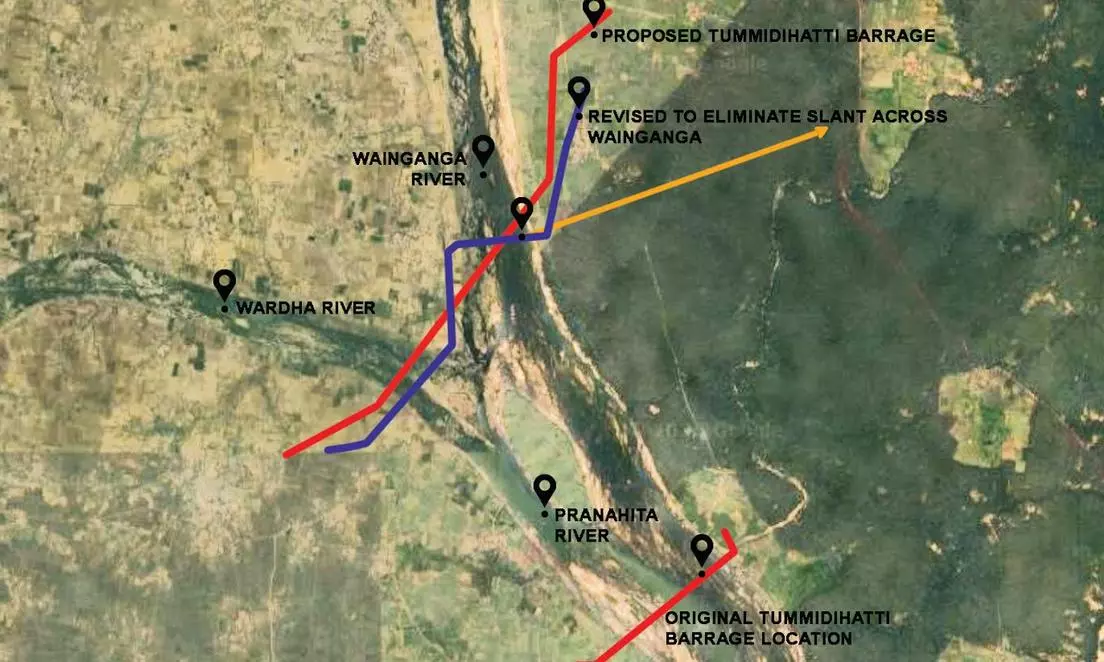
Warning of potentially serious problems if the government pursues its current plan of a two-leg barrage — with one stretch on Wainganga and the second on Wardha river ahead of their confluence, the Association called on the department to take up comprehensive feasibility studies, as well as model studies of the proposed structure.
On Wednesday, the Association, in a letter to Adityanath Das, said the current Tummidihatti barrage proposal is to build it in two parts — with one section across Wainganga, and another on Wardha — the two rivers which after joining downstream from the chosen location, form the Pranahita river. These two barrages are to be connected an impermeable wall forming a continuous structure and an artificial confluence.
Such a design, if taken forward without fully understanding its implications, could result in serious problems that will result in serious turbulence at the structure. The turbulence in the river water could include formation of large eddies, cross-currents, and secondary helical flows, all of which could impact the “artificial confluence” of the two rivers and the barrage structure itself, the Association informed Adityanath Das, requesting him to impress upon the government the need for comprehensive studies before any further steps are taken on the project.
“Never has a barrage been designed in two sections with a connecting wall. And the real issue is how the artificial confluence will behave but the problems we listed are a certainty. The thing is the velocity of water at Wainganga is much much higher than the speed at which water flows in the Wardha. This differential will result in formation of large and serious eddies that will have an impact on the river bed, and the structure, and that is one of the primary concerns,” the Association president and former executive engineer Mereddy Shyamprasad Reddy explained.
With 70 per cent of the water coming from Wainganga and 30 per cent from Wardha at the proposed artificial confluence, what could happen there must be studied in detail before any decision is taken, he added.
Incidentally, among those from the Association who met with Adityanath Das, were those who were in an expert committee of retired engineers tasked by the then government to study feasibility of a barrage at Medigadda, an idea that the committee was not in favour of. This committee’s report was one that was cited by the then opposition party Congress to point out mistakes made by the previous government in executing the Kaleshwaram project of which the barrage at Medigadda is a key structure.
