Rescuers Plan Sideways Search, Hope for Faster Results
2 layers of TBM cut till danger zone in SLBC tunnel
Hyderabad: The enormous complexities being encountered in the search for seven more missing workers inside the Srisailam Left Bank Canal (SLBC) tunnel appear not to let up forcing rescue workers to rely on the very elements they battled to overcome for the past 21 days.
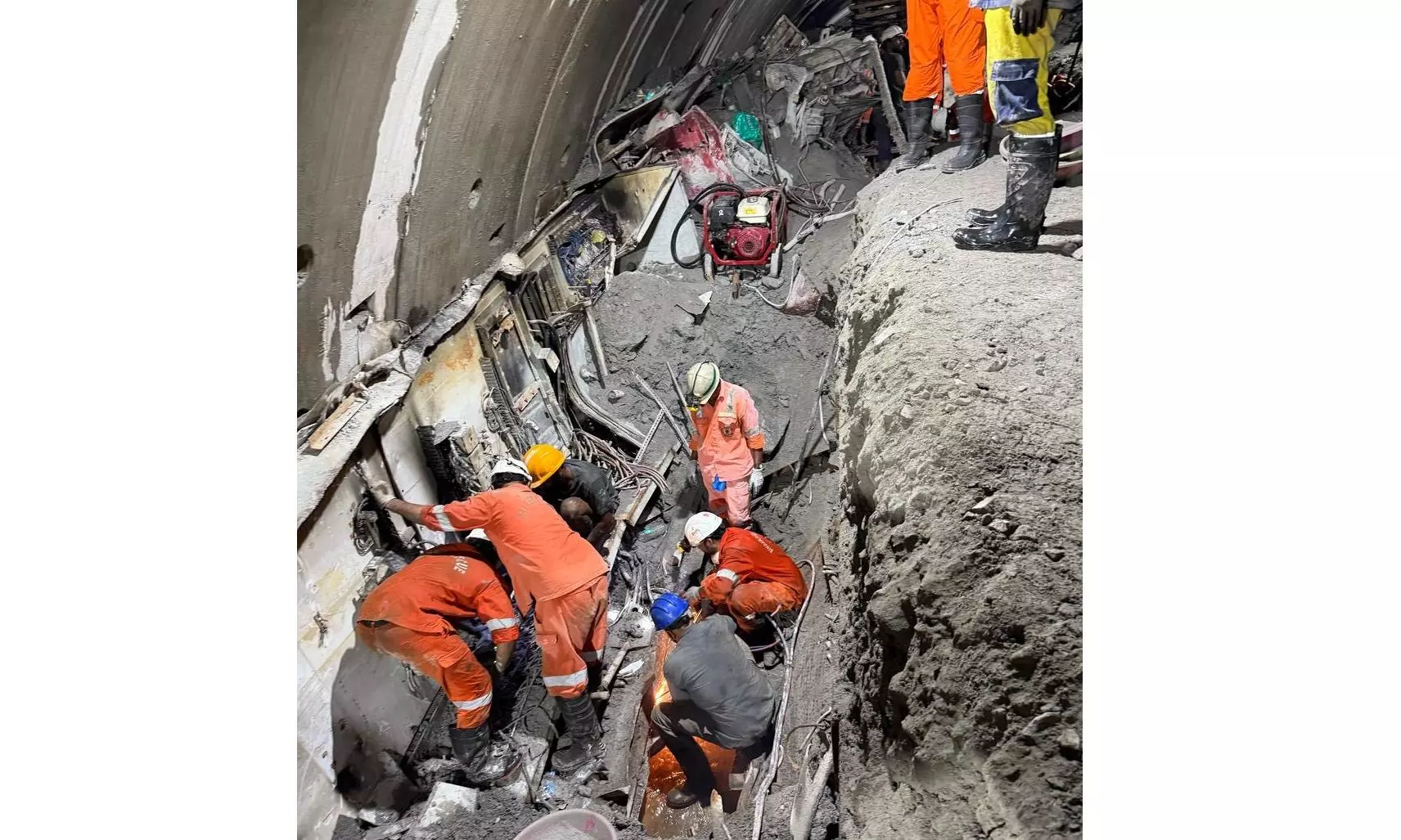
Meanwhile, on Friday, rescuers completed the cutting of two layers of steel plates of the tunnel boring machine even as a trench in the slowly solidifying silt they were digging through touched the D1 point, 50 metres from the tunnel face where the collapse occurred on February 22. This point marks the farthest NGRI and GSI scientists have said rescuers can work in relative safety but any activity beyond this might turn extremely hazardous very quickly because of the unstable conditions in the last 50 metres towards the tunnel end.
Now that the top two levels of the machine have been cut through, we can dig from the sides into the silt between the machine’s top two tiers. This we hope, will help us progress faster in the search work,” special chief secretary of disaster management, Arvind Kumar said on Friday.
But the successful ongoing dewatering work to tackle the up to 5,000 litres of water pouring into the tunnel from the rocks above and it’s channelisation has meant that the silt is now hardening, making digging through it difficult.
This being the case, rescuers have now begun spraying water, the very element that in the early days of the rescue was a huge challenge to overcome, on the silt to make it softer and easier to remove.
With the trench now extending to the D1 point, the idea is to scan the entire area up to that spot from the end of tunnel to trace out the workers. The hardening of silt is proving to be time-consuming and water sprayers are being used to soften the silt, Arvind Kumar said.
A liquid ring vacuum pump that can suck up upto 620 cubic metres of material an hour was taken into the tunnel on Friday to aid in removing the silt from the farther reaches of the tunnel and pump it to a spot from where excavators can then lift the same onto the conveyor belt to remove it out of the tunnel.
Arvind Kumar said Singareni Collieries mine rescuers were working in three shifts of 50 men each, while SDRF is doing the same with teams of 15 each. These are in addition to those from NDRF, HYDRAA, and rat miners, working in clearing the freshly cut tunnel boring machine parts and other steel debris and in digging.
