
Discovery sheds light on 11th-century religious traditions in Telangana
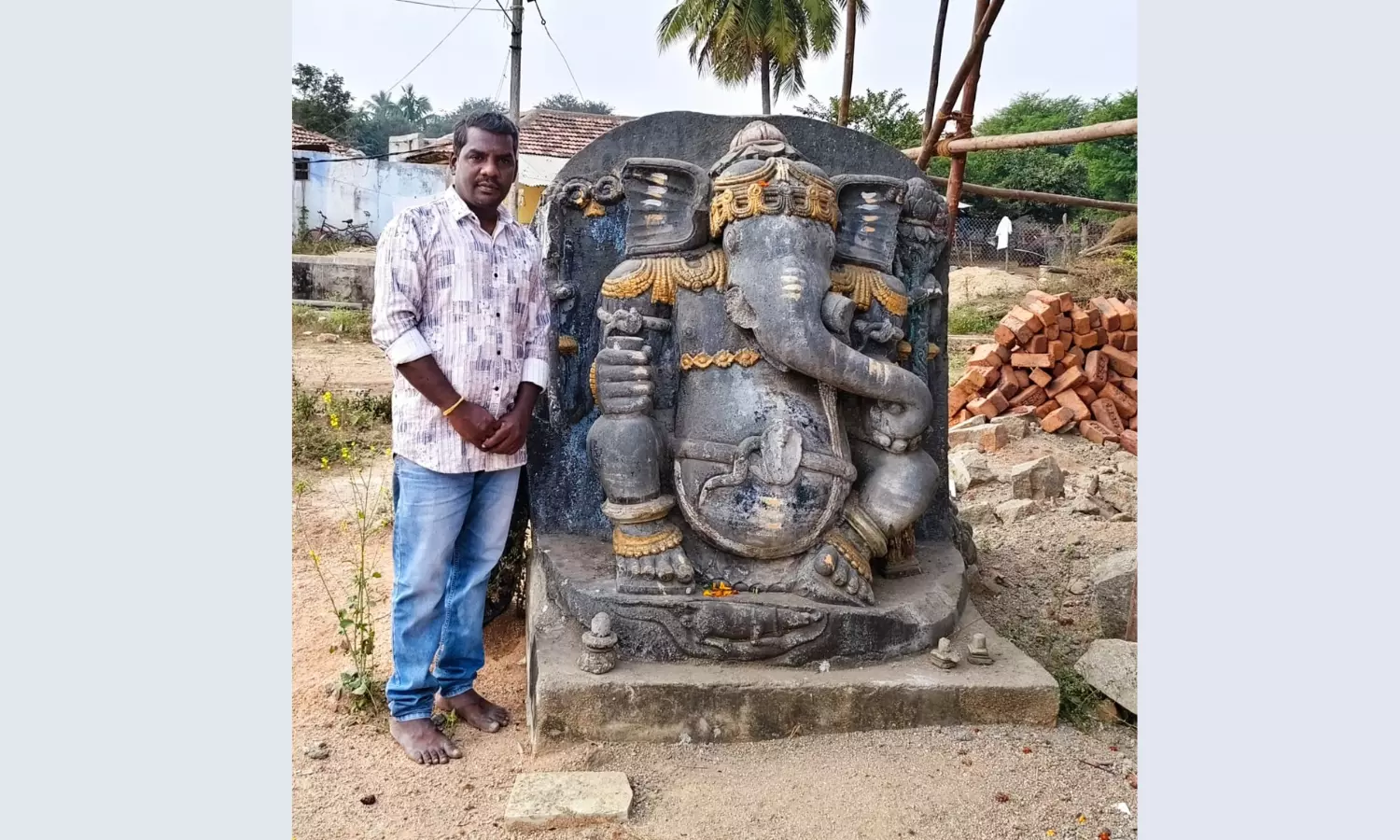
A rare 11th-century stone idol of Lord Ganesh was recently identified by Dr. Samaleti Mahesh, a dedicated research member of the Kotha Telangana Charitra Brundham (KTCB), during an inspection of ancient sculptures located near a local temple currently undergoing renovation here in Vallampatla village of Maddur mandal in Siddipet district.
Karimnagar: A significant archaeological find here has come to light, where a rare 11th-century stone idol of Lord Ganesh has been recently identified by Dr. Samaleti Mahesh, a dedicated research member of the Kotha Telangana Charitra Brundham (KTCB), during an inspection of ancient sculptures located near a temple currently undergoing renovation in Vallampatla village of Maddur mandal of Siddipet district.
The centerpiece of the findings is a massive five-foot-tall ‘Chaturbhuja’ (four-armed) Ganesha sculpture. This impressive stone carving depicts the deity in the Lalitasana (a relaxed royal pose). The intricate craftsmanship shows Ganesha holding a parasu (battle-axe) and a flower in his upper hands, while his lower hands hold a broken tusk and a modak (sweet). His trunk is gracefully turned toward the left, a traditional feature in such carvings.
Further examination of the sculpture revealed unique ornamental details that help date the piece. The idol features include a Nagabandham (snake belt) around the belly and a Jandhyam (sacred thread) visible over the shoulder. At the base of the five-foot structure, his vehicle, the mouse, is clearly depicted. Based on these decorative styles and the specific form of the stonework, experts have identified the idol as dating back about 1,000 years to the Chalukya period. Historians believe this discovery is highly significant for understanding the religious landscape of ancient Telangana.
According to Dr. Mahesh, the presence of such a rare and grand Ganesha sculpture suggests that the Kalamukha Shaivism and Ganapatya traditions were once very prominent in this region. The find highlights Vallampatla as a site of historical importance, reflecting the rich cultural and architectural heritage of the 11th century, he added.
( Source : Deccan Chronicle )


Next Story