Rajnath Launches Kusha Indigenous Air Defence System
Addressing scientists and staff, Singh said he felt proud to be among the country’s scientific community
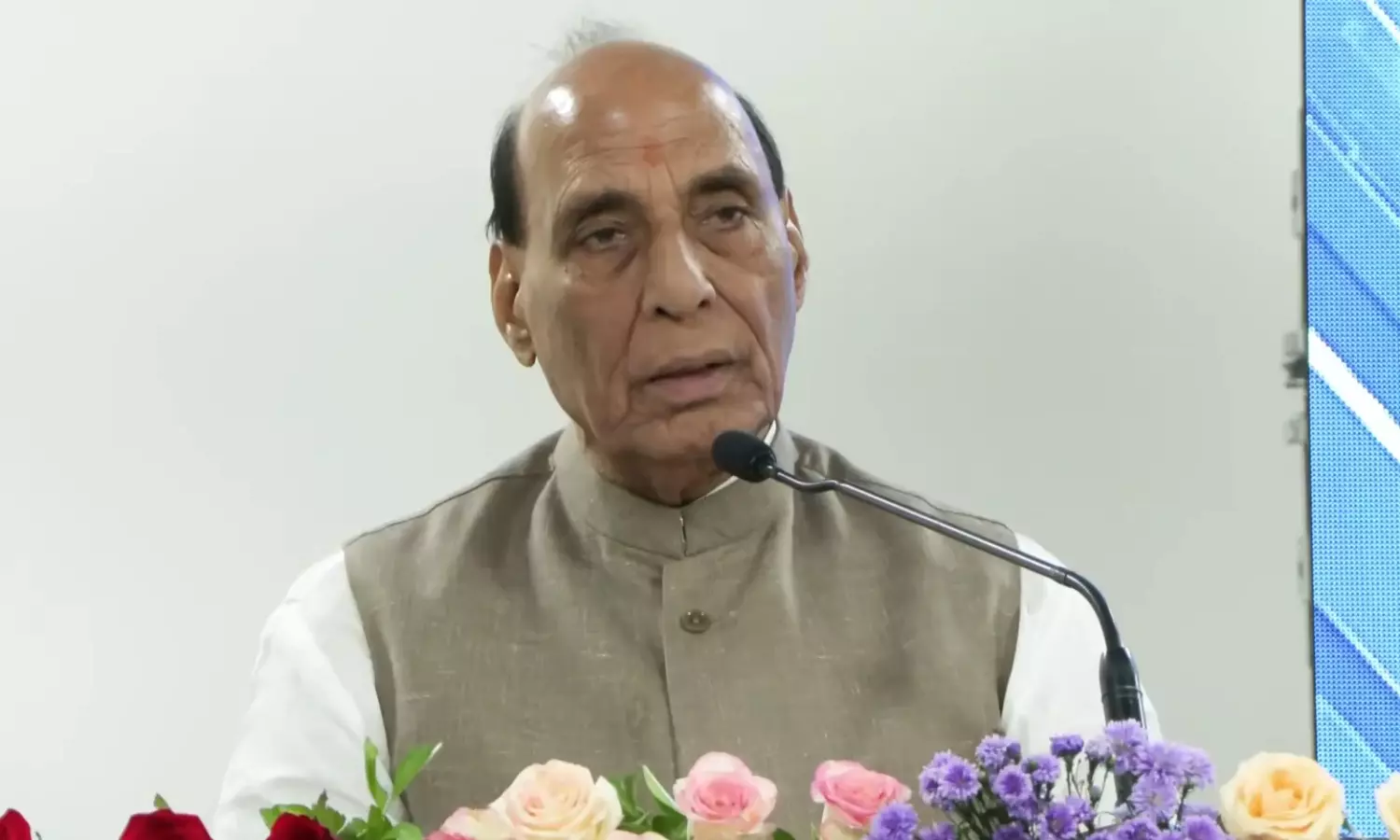
HYDERABAD: Union defence minister Rajnath Singh on Friday said strategic self-reliance is essential so that the country need not depend on others for critical defence capabilities. He described Project Kusha as a game changer for India’s security architecture and called its indigenous air-defence systems world class, noting their vital role during operational contingencies and in conflict zones.
After inaugurating the Integration Complex built under the Defence Research and Development Laboratory’s (DRDL) Project Kusha at the Dr APJ Abdul Kalam Missile Complex in Hyderabad, Singh praised the institution’s role in strengthening India’s technological and strategic autonomy.
Linking Project Kusha to the government’s broader “Mission Sudarshan Chakra” announced by the Prime Minister, Singh said it will be an important component of the multi-layer missile-defence architecture intended to protect military installations, critical infrastructure and civilian assets while minimising disruption to citizens during hostilities.
He framed the inauguration as more than a technical ceremony, saying it signified the nation’s resolve to remain alert, capable and self-reliant in the face of changing conflict dynamics. He urged DRDO and DRDL to anticipate future needs, invest in futuristic technologies and prepare for emerging forms of warfare — including precision-strike capabilities, integrated air-defence, hypersonics, autonomous platforms, artificial intelligence, electronic warfare and advanced sensors.
Singh said the evolving global security environment demands resilience — the ability to absorb shocks and recover — and credible deterrence to impose costs on potential aggressors. He expressed confidence that institutions like DRDL and programmes such as Kusha will provide that resilience and help India sustain defence modernisation and strategic autonomy.
Addressing scientists and staff, Singh said he felt proud to be among the country’s scientific community. He lauded the missile complex for underpinning many of India’s historic defence achievements and called it a symbol of the nation’s top scientific talent and innovation. He noted that missile-based weapon systems developed here — across underwater, land and air platforms — have significantly bolstered the armed forces’ deterrence and operational preparedness.
He described each technological breakthrough, successful flight test and system inducted into the armed forces as proof not only of scientific accomplishment but of the researchers’ dedication and discipline. He highlighted the performance of DRDO systems such as Akash and BrahMos during “Operation Sindur” as evidence that India can compete in the global defence-technology ecosystem and that Indian scientific talent matches that of developed nations.
Project Kusha is India’s upcoming indigenous long-range air defence system, designed by DRDL under DRDO to counter threats from China and Pakistan and to provide a shield against enemy aircraft, drones, cruise missiles and ballistic missiles. Valued at approximately ₹21,700 crore, the programme is named after Lord Rama’s son Kush. It will operate as a three-tier layered interceptor system comprising M1, M2 and M3 missiles. The system will integrate with India’s Uttam AESA radar and have a detection range of up to 500 km. It will be networked with the Integrated Air Command and Control System (IACCS) for multi-threat tracking and faster response times.
The M3 interceptor is expected to undergo its first trial by 2028. The programme enhances India’s strategic autonomy, enables continuous upgrades without external restrictions, and positions India among nations with very-long-range air defence capability comparable to Russia’s S-500 system.
