Sitar maestro to perform at Ustad Bade Ghulam Ali Khan Festival on Dec 13–14.
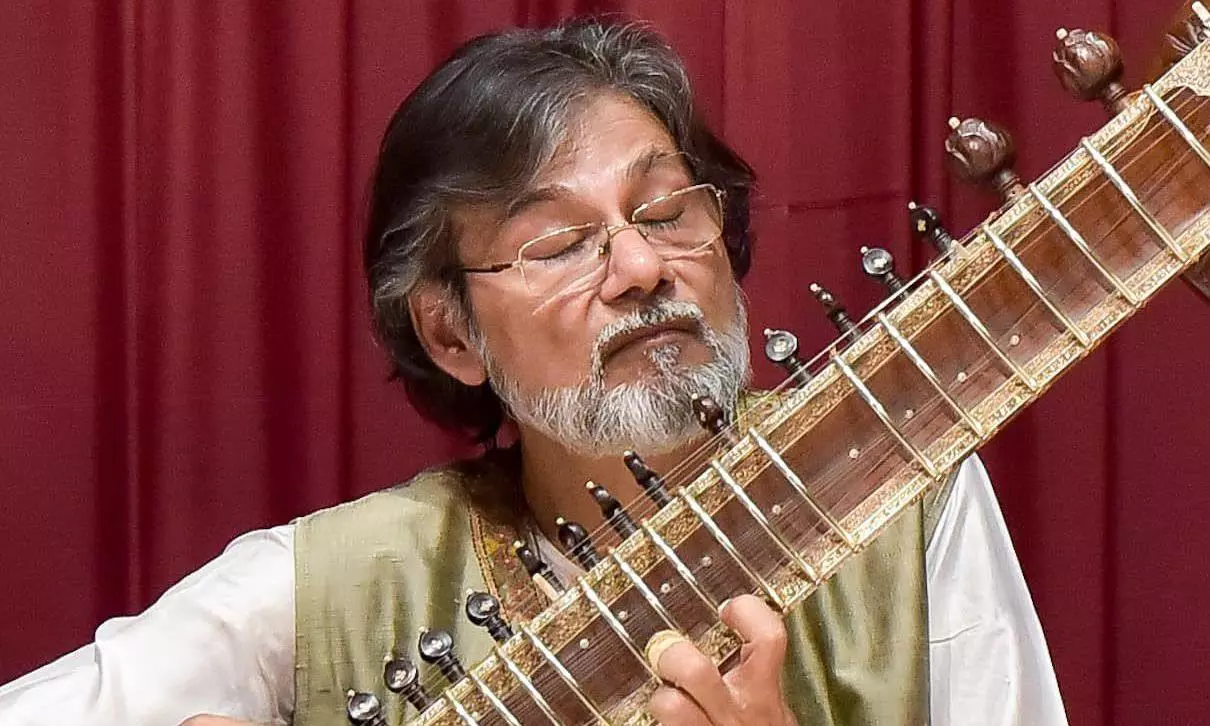
Hyderabad: Seven notes, seven colours, seven days. That is how sitar maestro Pandit Partha Bose thinks about music and about the Hyderabad stage he will walk onto. “Seven reminds us of our shared humanity,” he said. “All over the world we have seven musical notes, seven days in a week, seven colours in the rainbow. Our music, which is represented by Saptaswara, is in itself a manifestation of one world, one music.”
That idea of “one music” is what got him to the Ustad Bade Ghulam Ali Khan National Festival of Music and Dance 2025 at Ravindra Bharathi on December 13 and 14, organised by Sangitanjaly Foundation with the department of language and culture, Telangana.
The festival honours the Hindustani legend who spent his last years in Hyderabad, and whose name now shelters two evenings of Odissi, jugalbandi, thumri, sitar, sarod, vocal recitals and a classical dance finale by film actor Rituparna Sengupta. “Being invited in a festival which is commemorating the great Ustad Bade Ghulam Ali Khan Sahib, a festival named after him, I would consider a rare privilege, a great honour,” Bose said. “I feel humbled by this opportunity.”
The sitarist has visited Hyderabad only once before the pandemic, for an evening concert arranged. That single visit left him with the sense of a city that listens carefully. “My experience was that Hyderabad has a sizable audience of discerning music lovers,” he recalled. He links that to history and the arts-friendly court of the Nizam, but he also sees a contemporary reason.
“Hyderabad happens to be geographically situated in the middle of India, so it is a bridge between the north and the south,” he said. “I would like to believe in an India where we speak only of Indian music, not North Indian or South. Hyderabad to me represents that.”
Food slips into the conversation as Bose describes himself as someone whose “addictions are twofold, gaana and khana”, and grins over the phone about his plans of Hyderabadi biryani between rehearsals.
Behind this easy humour sits a long relationship with the sitar. Bose grew up in a business family in Kolkata and was sent to music class at six, the way many Bengali children are nudged towards some art form after school. “I don’t claim to come from a musical family or a musical background,” he said.
“I was introduced or initiated to music at the age of six under my guru Manoj-ji, and I have been fortunate to have been taught by him for 53 years.”
School meant Don Bosco for him, followed by an Economics degree at Presidency College. Music, he said, was always the real plan. “Since the age of 21, since I graduated from Presidency College, I have been full-time into music.”
He also remembers playing at the Children’s Little Theatre in Kolkata at 14, and featuring on All India Radio and Doordarshan at 16, in 1978. A North America tour in 1991 “set my career floating”, as he put it, and Dover Lane Music Conference in 1993 felt like a turning point back home.
“It makes a difference if you come from a musical family. Even getting an opportunity to meet someone, to introduce yourself, it always helps if you are somebody’s son or nephew or you are a disciple of an iconic musician.”
He is careful not to sound bitter and sees that difficult phase as useful. “I’m proud of it because that experience helped me to believe in myself, to harden my resolve,” he said.
Inside the music, the routes are more layered. Bose belongs to the Maihar gharana of Baba Allauddin Khan, the lineage that produced Ravi Shankar and Nikhil Banerjee. His Guru, Pandit Manoj Shankar, learnt from Ustad Bahadur Khan, a sarod player in the same family of training. “My Guruji’s style was a kind of a blend of Ravi Shankar and Nikhil Banerjee,” he said. “The strong influence of dhrupad style on this gharana’s instrumental playing has left a deep mark on my repertoire.”
From Bahadur Khan, through Manoj Shankar, came another layer. “My Guruji did some wonderful research into incorporating the sarod style, adapting the sarod style in the genre of sitar playing,” Bose said.
“I have to some extent tried to follow in his footsteps. Music connoisseurs have told me that they recognise in me a different style. They find manifestations of sarod-ang, or sarod style, but played on sitar. It has been integrated into the sitar.”
Asked about technical display versus emotional pull, he answered in a way that folded both. “My sitar playing would offer to the audience different elements like peace, tranquility, depth, emotion,” he said.
“At the same time, those aspects which endear you to the audience, for example speed, spontaneity, exchange of rhythms.” He compared a concert to a long table where listeners can choose what they like. “I conceive music as a kind of a buffet meal where different items are laid on the table. There is everything for everyone,” he concludes.

