Plastic Ban Only On Paper In Hyd As Single-Use Market Booms

A senior official from the Telangana Pollution Control Board emphasised the need for stronger public cooperation.
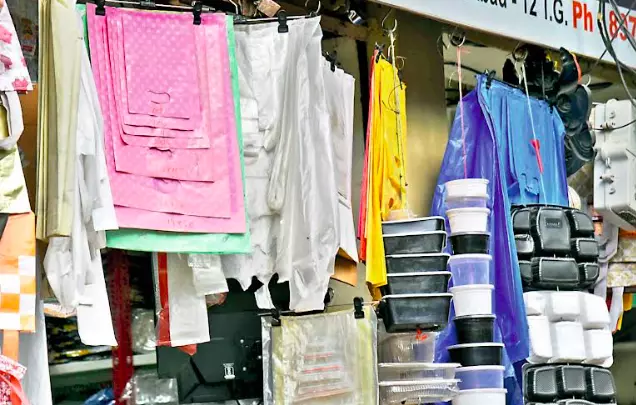
Hyderabad:Despite Telangana's ban on single-use plastics, production and supply of banned plastic items continue unabated across Hyderabad, with manufacturers openly acknowledging the practice to fulfill customer demands.
Several plastic manufacturers in Hyderabad confirmed that various types of plastic items, such as carry bags, packaging covers, polypropylene (PP) bags, and low-density (LD) covers, are still being produced and supplied.
Many manufacturers claim these bags exceed the legally mandated minimum thickness of 75 microns and thus are permissible. However, when pressed, a supplier who wished to remain anonymous admitted, “Yes, if a customer requests single-use plastic, we make and supply it against full payment.”
Manufacturers clarified that plastics below 75 microns, typically used for vegetables or groceries, are banned yet remain widely available in bulk quantities.
“For garbage covers, there’s no restriction. For carrying bags, if a customer wants, we provide them, although technically they are banned,” said one dealer.
Single-use plastic carry bags continue to be sold at varying sizes and prices, openly listed by market sources.
Prices range from `270 for 8×10 inches, `390 for 10×12, `550 for 11×14, `780 for 13×16, to `1,300 for larger 16×20 inch bags, despite the enforcement claims from authorities.
Meanwhile, the state government maintains that enforcement measures are actively in place, though visible results appear minimal. Local vendors cite convenience as a driving factor behind continued plastic usage.
“People buying vegetables while travelling usually don’t carry their own bags. They buy in kilos or half kilos, so we must provide a plastic cover. Sometimes we pre-pack them to make shopping easier,” explained a vegetable vendor on Road No. 1, Banjara Hills.
Shivani Rai, a marketing manager in a multinational company, added from a consumer perspective, “As a single working woman, I don't always carry a bag. I often buy fruits and vegetables spontaneously after work. Cotton bags at supermarkets cost ` 20, which is acceptable occasionally, but in daily life convenience often wins over environmental concerns.”
Environmental experts stress that public awareness alone is insufficient. “Everyone knows plastic is banned, but no one seems to care. There should at least be a clear colour code for allowed and banned plastics. Without practical solutions, these issues will persist, especially since vendors provide carry bags free of charge,” said Subba Rao B.V., an environmental specialist.
A senior official from the Telangana Pollution Control Board emphasised the need for stronger public cooperation.
“We’ve implemented and enforced the rules to the best of our ability. Awareness alone isn't enough; strict compliance and collective responsibility from the public are essential to curb this issue effectively.”
