NIMS Performs First AngioJet Under Aarogyasri

The procedure was performed by the Department of Vascular Surgery led by Dr Sandeep Mahapatra, with support from anaesthesiology, cath lab, nursing staff and other healthcare personnel.
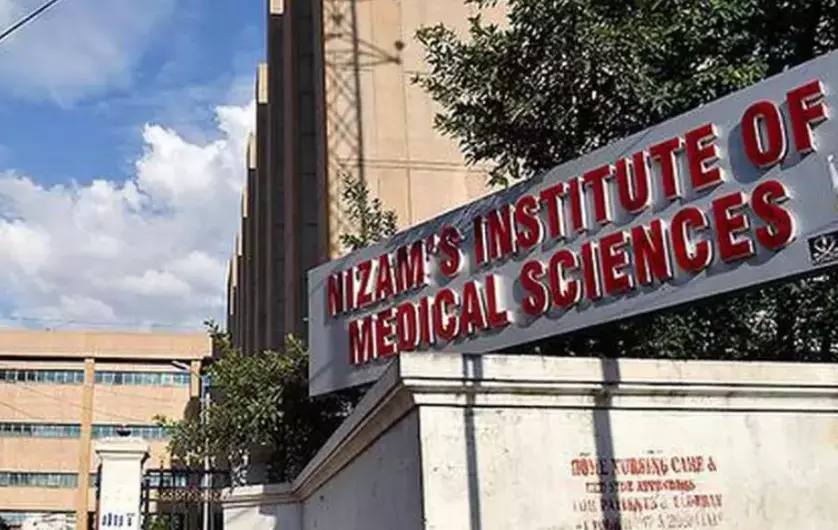
Hyderabad:Doctors at Nizam’s Institute of Medical Sciences (Nims) performed the institute’s first AngioJet Pharmaco‑Mechanical Thrombectomy to treat acute deep Vein thrombosis (DVT), providing the nearly ₹5 lakh treatment free under the Aarogyasri scheme.
The procedure was carried out on a 39‑year‑old woman from Bayyaram in Gajwel mandal, Siddipet district, who was diagnosed with acute DVT, a condition in which blood clots form in the deep veins of the legs. If untreated, the clot can travel to the lungs and cause a potentially fatal pulmonary embolism.
According to Nims, the AngioJet combines clot‑dissolving medication with a specialised device that rapidly removes the clot, restoring blood flow and improving recovery. The treatment also reduces the risk of long‑term complications such as persistent leg pain and swelling.
Nims director Prof. Rahul Devaraj said the advanced procedure, which costs around ₹5 lakh, was provided free under Aarogyasri. He said making advanced treatment accessible at no cost was a matter of pride for the institute.
The procedure was performed by the Department of Vascular Surgery led by Dr Sandeep Mahapatra, with support from anaesthesiology, cath lab, nursing staff and other healthcare personnel.
Public health expert warns on indoor air pollution
Hyderabad:Indoor air pollution, linked to one in eight deaths worldwide and more than two million deaths annually in India, requires urgent policy action and stronger collaboration rather than more scientific evidence, Hyderabad public health expert Dr Ranga Reddy Burri said at an international conference in Singapore.
Burri, president of the Infection Control Academy of India (IFCAI) and the Antimicrobial Resistance Research Society of India (AMRRSI), called for a Global South Clean Air Consortium while presenting his paper Air Quality and Public Health in the Global South at the Indoor Air 2026 conference held in Singapore from June 14 to 18.
“The science is no longer the barrier. Political will and engineering delivery are,” Burri said, urging governments, engineers, clinicians, epidemiologists and policymakers to translate decades of research into action.
According to his presentation, air pollution caused an estimated 8.1 million deaths globally in 2021, accounting for one in every eight deaths. Nearly 90 per cent of the disease burden stems from non‑communicable diseases, while air pollution also contributes to lower respiratory infections, tuberculosis, cardiovascular disease, stroke, childhood pneumonia and cognitive decline. The presentation noted that more than 570,000 newborn deaths and about 709,000 deaths among children under five are associated with air pollution globally.
Drawing attention to India, Burri cited the expansion of the Pradhan Mantri Ujjwala Yojana, under which more than 10.5 crore LPG connections have been provided, as an example of how cleaner cooking fuels can reduce household air pollution. He noted that India continues to bear an annual burden of more than two million deaths, underscoring the need for sustained interventions.
He said countries in the Global South face additional challenges including biomass fuel use, household smoke, road dust, weak monitoring systems, limited funding, poor enforcement of standards and rapid urbanisation.
“Clean air is not a luxury. It is public health infrastructure. In the Global South, delay is measured in lives,” Burri said.
Among his recommendations were phased adoption of stricter PM2.5 standards, low‑cost monitoring networks, wider use of clean cooking fuels, mandatory public display of indoor air quality in schools, hospitals and offices, inclusion of air pollution exposure in routine clinical assessments, and greater use of climate finance for clean‑air initiatives.
He also proposed demonstration projects in schools and healthcare facilities using low‑cost sensors and improved ventilation, while calling for closer integration of infection prevention and indoor air quality measures. Burri said better collaboration between public health experts and engineers could help countries build healthier public spaces and improve preparedness for future pandemics.
