NH 765 to Srisailam Gets Ready To ‘Fly’ Over Amrabad Tiger Reserve
6 Dec 2025 11:13 PM IST6 Dec 2025 11:13 PM IST
Centre, state finalise alignment for Srisailam elevated corridor through Amrabad reserve.
The point at Brahmanapally from where the proposed elevated corridor over the Amrabad tiger reserve is expected to begin.
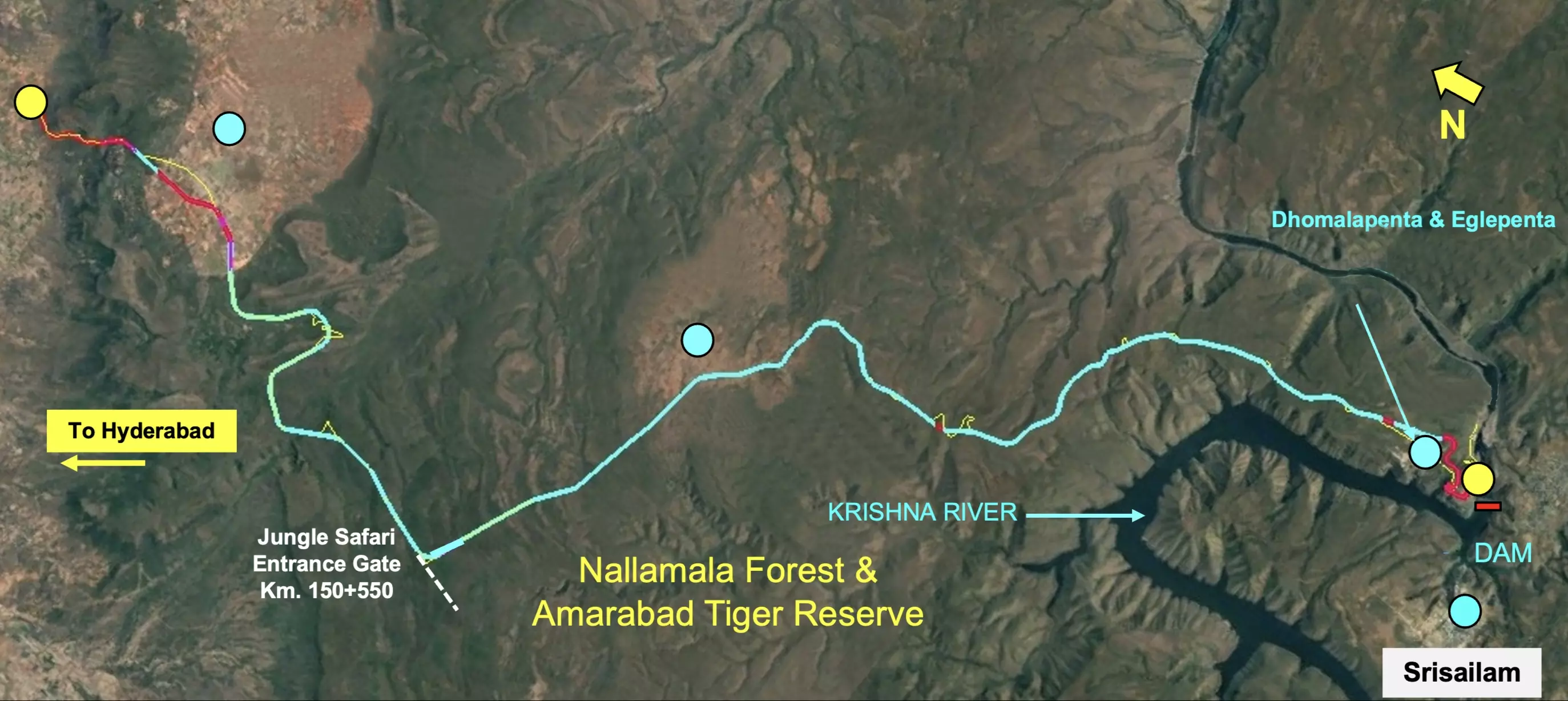
HYDERABAD: A first-of-its-kind effort in the country that will help overcome the rule barring night traffic through tiger reserves, and enable smoother access to the famous Srisailam temple for tens of thousands of pilgrims, and at the same time protect the forest that makes the Amrabad tiger reserve, has reached an important milestone.
Almost a fortnight ago, a committee of senior officials from various departments of the state and the Union ministry of road transport and
Highways (MoRT&H), has finalised the alignment of a proposed 47.82-km-long steel elevated corridor for the vehicular traffic that currently goes through the tiger reserve over a length of 55 km of National Highway 765.
This stretch of forest road is closed for all traffic from 9 pm to 6 am to allow free and safe movement of wildlife, including tigers, in the reserve.
The meeting of the “alignment committee” which agreed upon the “route map” for the elevated corridor, also considered two other options – a rope way over the forest, and a tunnel system – both dropped both as unviable and not feasible and concluded that the elevated corridor will provide the best option in terms of safety of people travelling by road to Srisailam.
“The original proposal included the possibility of a four-lane corridor, and the MoRT&H, considering the project cost of the project, along with state officials, is looking into whether a two-lane corridor will meet the traffic requirements, which could also reduce the project cost,” roads and transport special chief secretary Vikas Raj said.
Incidentally, the state, in a letter to the MoRT&H in the last week of October, also reiterated the commitment made by Chief Minister A. Revanth Reddy that the state government was willing to pick up 33 per cent of the project cost. The current estimates for the project stand at around `7,700 crore.
The elevated corridor will follow for most part the existing road through the tiger reserve with changes in alignment that will avoid hairpin bends that now exist on the ghat sections of the road. Once completed, thousands of vehicles headed to Srisailam – current average number is around 7,100 a day that rises to around 9,400 a day during festival seasons of Maha Shivaratri, Dasara and Deepavali – will not need to be halted for the night on both ends of the highway as is the current practice. The MoRT&H has estimated that by 2027, the average number of vehicles crossing the forest road will reach around 11,000 a day.
The current speed limit on the forest is 30 kmph as part of efforts to reduce or eliminate not just accidents but wildlife road kills. According to the project plans, the minimum speed on the elevated corridor would be 40 kmph in a few sections involving turns, and the maximum speed limit could be up to 80 or 100 kmph.
As per officials, the elevated corridor will not only support all types of vehicles, but will enable better regional mobility, logistics, and economic growth as it can also handle cargo, commercial and emergency services.
The basics Elevated corridor to Srisailam
Length: 45.19 Km
Height of piers: 10-52 metres
Forest land required: 129 hectares
Non-forest land required: 19 hectares
Approximate cost: 7,668 crore
Why an elevated corridor
To act as animal underpass as per ministry of forests norms.
Corridor begins at Brahmanapally, before start of the forest area.
No entry/exit ramps between Mannanur and Domalapenta at the end of the project.
No more night traffic bans, round the clock vehicle movement enabled.
To improve Hyderabad’s connectivity to key AP towns, enable economic and logistic gains.
Single check post/toll plaza at one end to avoid multiple stoppages on corridor
What changes
General traffic not to be allowed between Mannanur and Domalapenta after corridor comes into use
Forest department to develop, use area beneath the structure along the existing road.
National Highways Authority of India to have rights on existing NH for inspections and maintenance of elevated structure.
Highways (MoRT&H), has finalised the alignment of a proposed 47.82-km-long steel elevated corridor for the vehicular traffic that currently goes through the tiger reserve over a length of 55 km of National Highway 765.
This stretch of forest road is closed for all traffic from 9 pm to 6 am to allow free and safe movement of wildlife, including tigers, in the reserve.
The meeting of the “alignment committee” which agreed upon the “route map” for the elevated corridor, also considered two other options – a rope way over the forest, and a tunnel system – both dropped both as unviable and not feasible and concluded that the elevated corridor will provide the best option in terms of safety of people travelling by road to Srisailam.
“The original proposal included the possibility of a four-lane corridor, and the MoRT&H, considering the project cost of the project, along with state officials, is looking into whether a two-lane corridor will meet the traffic requirements, which could also reduce the project cost,” roads and transport special chief secretary Vikas Raj said.
Incidentally, the state, in a letter to the MoRT&H in the last week of October, also reiterated the commitment made by Chief Minister A. Revanth Reddy that the state government was willing to pick up 33 per cent of the project cost. The current estimates for the project stand at around `7,700 crore.
The elevated corridor will follow for most part the existing road through the tiger reserve with changes in alignment that will avoid hairpin bends that now exist on the ghat sections of the road. Once completed, thousands of vehicles headed to Srisailam – current average number is around 7,100 a day that rises to around 9,400 a day during festival seasons of Maha Shivaratri, Dasara and Deepavali – will not need to be halted for the night on both ends of the highway as is the current practice. The MoRT&H has estimated that by 2027, the average number of vehicles crossing the forest road will reach around 11,000 a day.
The current speed limit on the forest is 30 kmph as part of efforts to reduce or eliminate not just accidents but wildlife road kills. According to the project plans, the minimum speed on the elevated corridor would be 40 kmph in a few sections involving turns, and the maximum speed limit could be up to 80 or 100 kmph.
As per officials, the elevated corridor will not only support all types of vehicles, but will enable better regional mobility, logistics, and economic growth as it can also handle cargo, commercial and emergency services.
The basics Elevated corridor to Srisailam
Length: 45.19 Km
Height of piers: 10-52 metres
Forest land required: 129 hectares
Non-forest land required: 19 hectares
Approximate cost: 7,668 crore
Why an elevated corridor
To act as animal underpass as per ministry of forests norms.
Corridor begins at Brahmanapally, before start of the forest area.
No entry/exit ramps between Mannanur and Domalapenta at the end of the project.
No more night traffic bans, round the clock vehicle movement enabled.
To improve Hyderabad’s connectivity to key AP towns, enable economic and logistic gains.
Single check post/toll plaza at one end to avoid multiple stoppages on corridor
What changes
General traffic not to be allowed between Mannanur and Domalapenta after corridor comes into use
Forest department to develop, use area beneath the structure along the existing road.
National Highways Authority of India to have rights on existing NH for inspections and maintenance of elevated structure.
( Source : Deccan Chronicle )

Next Story