Nakkala’s Next Generation Face Identity Crisis

Kids struggle for ST status despite parents have it, putting edu, welfare far from reach
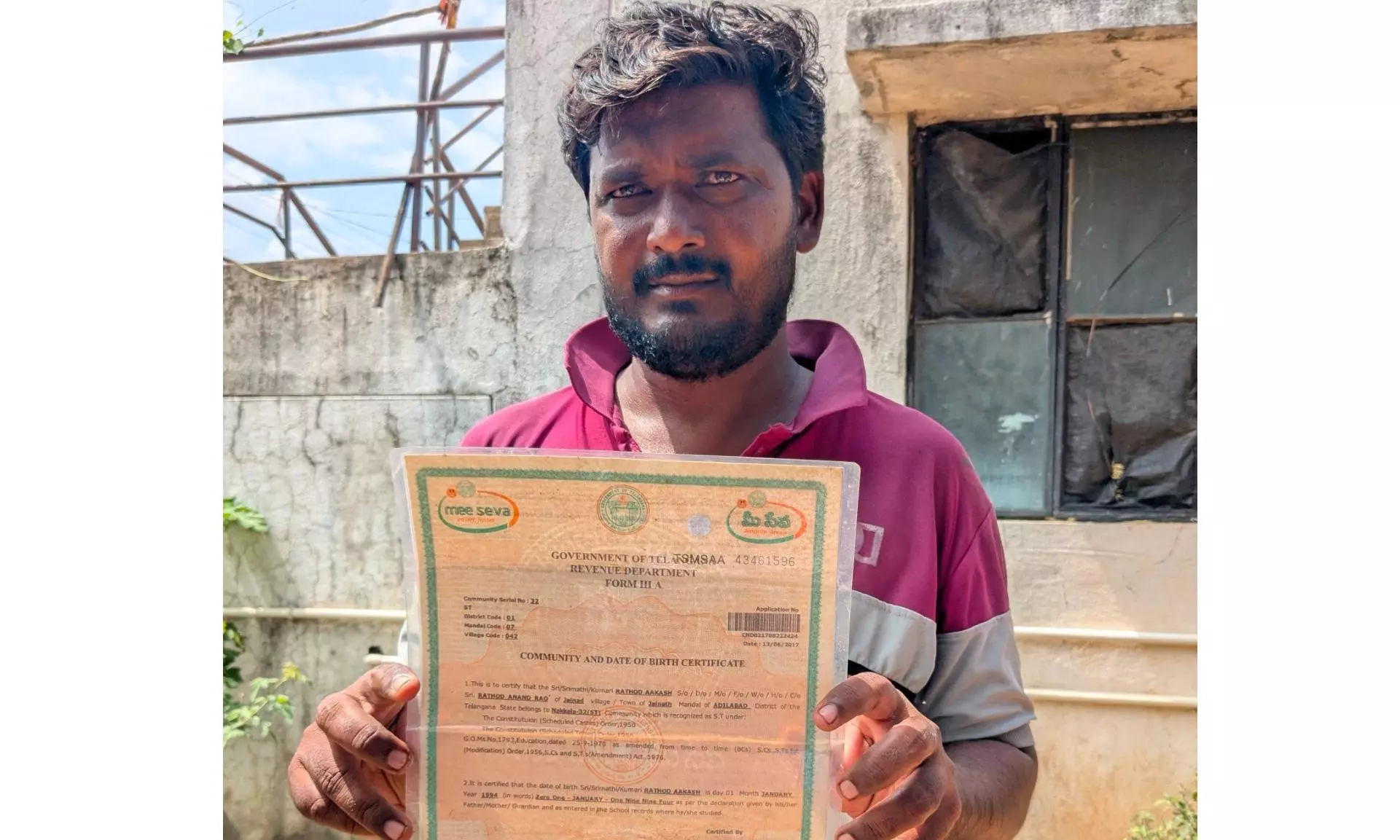
Adilabad: For the Nakkala community of the erstwhile Adilabad district, popularly known as Pittalollu, obtaining Scheduled Tribe (ST) caste certificates has become a struggle as they try to settle down and build a secure future for their children. Community members say the problem is particularly painful because revenue officials had issued ST certificates to Nakkalollu in the past, and some parents possess valid certificates, while their children are now finding it difficult to obtain the same status.
The case of brothers Rathod Akash and Rathod Deepak in Jainad highlights the issue. While Akash has an ST certificate, revenue officials rejected Deepak’s application. Their mother, Rathod Ranjana, had obtained an ST certificate under Nakkala-32 in 2015, Deepak said.
Deepak, 33, said he had submitted a photocopy of his father Rathod Anandrao’s ST certificate along with his application, but Jainad revenue officials rejected it. He said officials instead asked him to obtain a BC-A certificate under the Pardhi community, which he refused.
Deepak said he wanted to contest as a ward member in the 2026 sarpanch elections, but could not do so because he was unable to obtain the required caste certificate. He said the difficulty in obtaining ST certificates was also affecting children’s access to residential government schools and welfare schemes. “How can our children become educated and get better jobs if they cannot study in those particular schools?” he asked.
Rathod Akash, 31, who has an ST certificate, studied in Hindi medium up to Class IX at Tirpelli Government School in Adilabad town before discontinuing his education.
The children are currently getting admission to government schools based on their Aadhaar cards, with Nakkala entered as their community in school records. However, community members fear they could face difficulties later when school authorities insist on formal caste certificates.
Community members said only around 10 people living in Jainad had obtained ST certificates under Nakkala. They fear the lack of clarity over their community status could affect the next generation even as families are trying to leave behind their nomadic life.
Jainad Tahsildar Atram Narayana told Deccan Chronicle that revenue officials had issued ST certificates to Nakkala people, popularly known locally as Pittalollu or Burkalollu, in the past, but no such certificates had been issued to them during the last three years. He said he would seek clarification from the collector on issuing ST certificates if members of the Nakkala community applied for them.
The uncertainty over official identity has a historical backdrop. The British colonial government labelled the Nakkala and other nomadic and semi-nomadic communities as “criminal tribes” under the Criminal Tribes Act of 1871. The oppressive law branded entire communities as criminals by birth, subjecting them to severe surveillance, restrictions on movement and lasting social stigma. Independent India repealed the law in 1952, after which these communities came to be known as Denotified Tribes (DNTs).
In the post-Independence period, communities historically covered by such classifications have been placed under different social categories in different regions. In Andhra Pradesh and Telangana, Nakkala people have been classified under ST or BC categories for welfare measures and legal identity.
Community elder Chouhan Chandrakala said the Nakkalollu speak the Vagri language and recalled the efforts of late community leader Dhood Ram of Adilabad, who fought for ST status for the Nakkalollu.
She questioned why ST certificates issued to members of the community were not being extended to their children. Chandrakala said the Nakkalollu had finally begun settling down after generations of nomadic life and wanted their children to have access to education and a stable future.
She said the community continued to face social discrimination and mistrust despite its efforts to settle down. Recalling the difficulties faced by families living in temporary huts, she said a girl from the community died of a snakebite while sleeping in a hut three years ago.
Chandrakala appealed to Adilabad district collector Rajarshi Shah to facilitate admissions for Nakkalollu children in government hostels in Jainad.
Adivasi leader Sidam Arju Master had also fought for the rights, welfare and development of the Nakkalollu, community members said.
For the Nakkala community, the uncertainty over ST status goes beyond access to government benefits. After generations of moving from place to place, families in Jainad are trying to settle down, educate their children and secure stable livelihoods. They fear that the lack of clarity over their caste status could prevent the next generation from accessing residential education, welfare schemes and other opportunities available to eligible ST communities.
Pittalollu seeks a life beyond nomadic trail
Adilabad: “Miletho Shikari ... Naitho Bikari” (a hunter when prey is caught, alms seeker when there is none). For generations, this has summed up the uncertain life of the nomadic community Nakkala, popularly known as Pittalollu in Telangana. But now, as traditional hunting has disappeared and their seasonal forest produce trade offers little security, the community wants to settle down, secure recognition of its tribal status and give its children a chance at education and a stable livelihood.
The community members, known by different names across the state as Pittalollu, Nakkala, Nakkalollu, Burkalollu and Paradollu, and Pardhi and Passi Pardhi in northern parts of India, say they have given up their traditional hunting practices due to changing circumstances and strict forest and wildlife laws and added that some were even jailed by the forest department for hunting.
Many now depend on collecting and selling Boda Kakarakayalu (spine gourd) during the July-September season, while others work as daily-wage labourers, sell balloons and plastic toys at local functions or depend on alms for a living.
For families such as that of Sanjeev Rathod of Jainad, the seasonal trade means travelling to the forest areas of Pata, Gadchandur, Pandharkawda and Bhori in Maharashtra and Tamsi, Talamadugu and Bheempur mandals of Adilabad district to collect the vegetable. They sometimes wade through knee-deep mud and thick grass and face the risk of snake bites before returning to sell the produce in Adilabad town for around Rs 200 a kg.
For the community, however, the seasonal trade is only one part of a larger struggle to leave behind their nomadic life and secure a better future for their children.
Community members say they want the government to resolve the issue of caste certificates and ensure that eligible families are able to access education, housing and other welfare schemes.
The community has already taken some steps towards settling down. Of the 16 families, comprising 100 members, 11 families are living in double-bedroom houses at Jainad mandal headquarters, which they occupied after the houses were left incomplete. The remaining families continue to live in temporary huts. The 11 families recently received house pattas, while the community leaders claim that their families have been living in the Jainad area for nearly five decades.
There was also a colony called Pittalwada in Adilabad town where members of the community lived in the past.
Sanjeev Rathod said the community wanted to put an end to its nomadic life if the state and Central governments extended support for housing, education and livelihoods.
For some families, agriculture is seen as the way out. Elderly community member Rathod Anandrao said the families were ready to take up farming if the government provided about three acres of land to each family. He said members had earlier cultivated podu land at Laxmipur village in Jainad mandal but were evicted in 2002 without receiving pattas. He claimed that the families still possessed receipts issued by the forest department relating to their cultivation.
Anandrao appealed to Chief Minister A. Revanth Reddy to consider issuing pattas for the land they had cultivated earlier or provide alternative land to the community.
He also said the seasonal collection of spine gourd had become difficult as owners of agricultural land allegedly suspected members of the community of being thieves and did not allow them into their fields.
Swapna Rathod said the community continued to live in poor conditions, with limited educational opportunities for children. She said there was not a single government employee from the community in Adilabad district.
She also pointed to alcoholism among some men as another problem affecting families and appealed to the revenue minister, Ponguleti Srinivas Reddy, to take steps to allocate Indiramma houses to all the families of nomadic communities, saying that settling in one place could help improve their children's future.