Musi Rejuvenation: Flood-Proofing Masterplan and Godavari River Linkage Unveiled

“In 2025, Himayatsagar had only a maximum flow of nearly 30,000 cusecs. This design is being proposed for 1.53 lakh cusecs,” Narasimha Reddy said.
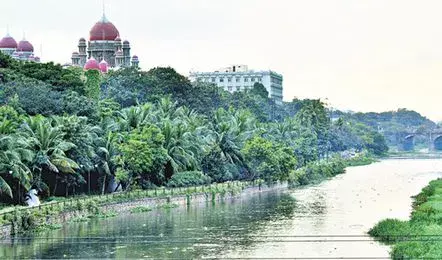
Hyderabad:The state government said on Friday that if the water flow in the Musi was not regulated, several areas would be flooded when the river was in full flow. The government presented maps showing how portions of Rajendranagar, Kismatpur, Budwel, Sun City, Upperpally, etc., could experience heavy flooding from the Himayatsagar side, and areas like Gandipet, Kokapet, Manchirevula, Bairagiguda could receive flooding from the Musi.
To allow the Musi to flow normally without affecting areas outside its boundaries, the government said it had proposed designs for the river sections for both Himayatsagar and Osmansagar stretches which could sustain ‘once in one hundred years’ flood.
E.V. Narasimha Reddy, MD of the Musi Riverfront Development Corporation (MRDCL) said that for the Himayatsagar to Gandhi Sarovar stretch, the proposed design could accommodate a flow of nearly 1.53 lakh cusecs of water, while in the Osmansagar stretch the design model could take nearly 26,300 cusecs of water.
“In 2025, Himayatsagar had only a maximum flow of nearly 30,000 cusecs. This design is being proposed for 1.53 lakh cusecs,” Narasimha Reddy said.
Narasimha Reddy said that the government had used software of the Hydrologic Engineering Centre’s (HEC) for hydrologic modelling and river analysis, both of which were developed by the United States Army Corps of Engineers to analyse hydrology for flood studies, urban drainage, and water availability, along with studying water flow in natural rivers and channels.
Officials said that the Centre’s National River Conservation Plan allowed for development of certain activities on the riverfront zones like promenades, walkways, cycling tracks, parks, seating areas, viewing decks along with essential underground utilities such as interceptor sewers and stormwater drains.
Additionally, the guidelines stated that in the buffer zone, parks, plazas, amphitheatres, approach roads, parking lots and public amenities could be developed to connect the riverfront with the city.
Narasimha Reddy also spoke about the Godavari River Linkage Project, which provides a schematic link between the Godavari and the Musi. The project, undertaken by the HMWS&SB would augment Hyderabad’s drinking water supply and support Musi river rejuvenation.
Through the project, authorities estimated that 20 tmc ft of water would be augmented, with 17.5 tmc ft of water allocated for the city’s drinking water supply and 2.5 tmc ft allocated exclusively for the Musi riverfront development.
Explaining the Musi’s hydrology, flood zone mapping and proposals of flood mitigation and river section works, Narasimha Reddy said Osmansagar and Himayatsagar had a combined total of 2,102 square kilometres of catchment area.
Narasimha Reddy stated that Osmansagar reservoir's catchment area was roughly 740 sq. km, spreading to the north-west side of the reservoir, while the Himayatsagar’s had a catchment area of about 1,362 sq. km. A total of 890 sq. km came from the downstream nalas and drainage systems from the Core Urban Region (CURE) of the city, with the streams eventually ending up in one of the reservoirs.
