Murthy Keeps Digging: Five Decades, Still on the Trowel

With half a century of experience, Murthy can determine the era of a pottery shard by touch and identify subtle characteristics that laboratories take days to confirm.
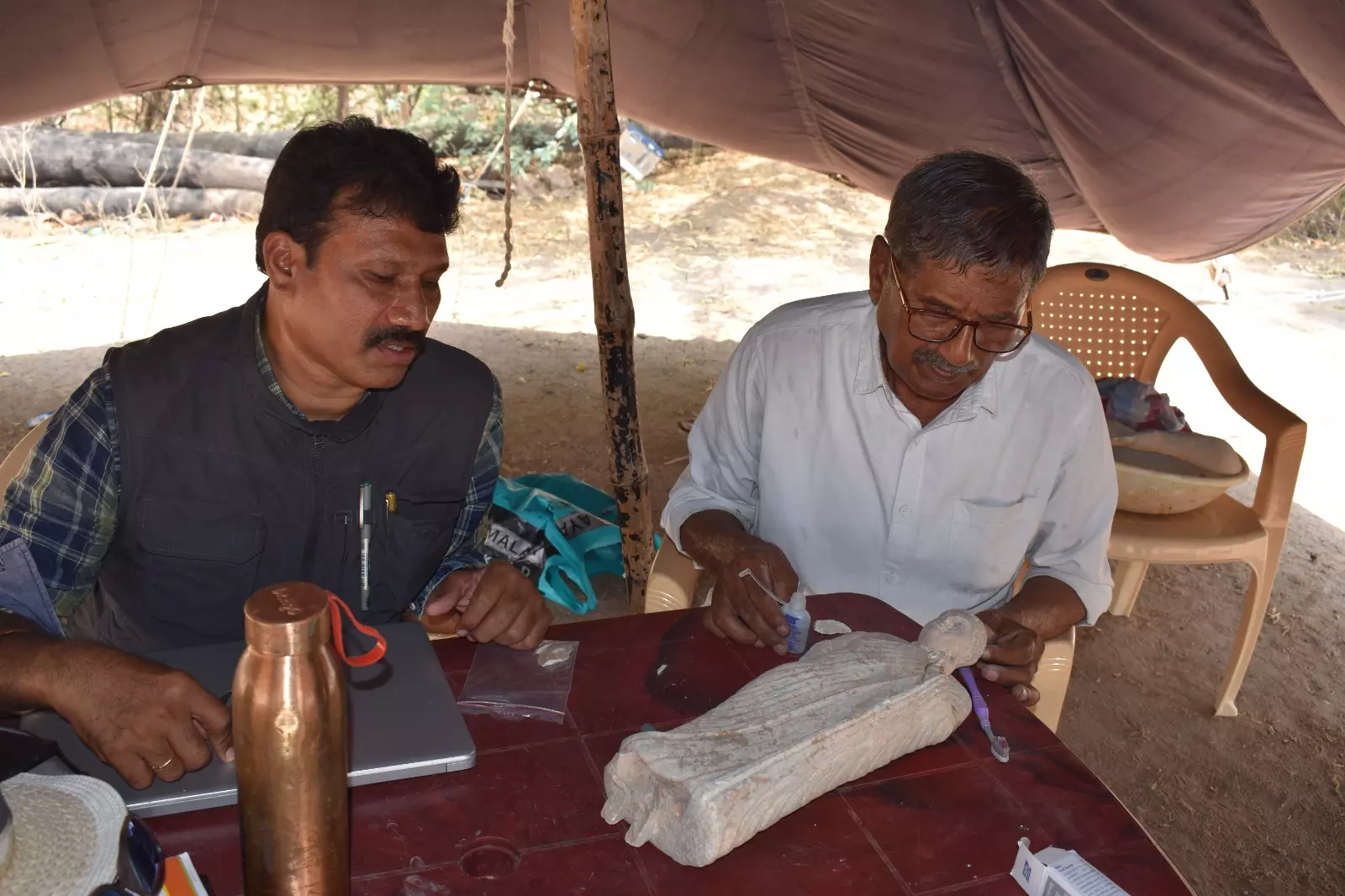
Hyderabad: Yerramraju Bhanu Murthy still trusts the intelligence buried in the soil — and his eyes — in an age where archaeology is increasingly driven by artificial intelligence and advanced imaging.
At 70, Murthy is not just a retired employee of the archaeology department but is seen as institutional memory. With over 50 years of field experience and participation in more than 100 excavations, including significant work at sites like Pajjur, he continues to take part in digs despite his superannuation in 2014.
Murthy specialises in megalithic burials, rock‑art site exploration, Buddhist site excavations and medieval‑era monument restoration projects, which demand both technical skill and historical knowledge.
With half a century of experience, Murthy can determine the era of a pottery shard by touch and identify subtle characteristics that laboratories take days to confirm.
Speaking to Deccan Chronicle, Murthy said his journey into archaeology began in 1975 through an unexpected act of help to an archaeologist, V.V. Krishna Sastry, whose scooter had broken down. Later, he worked for daily wages during excavations at Dhulikatta, a 2nd century BCE Buddhist heritage site on the Hussaini vagu banks in Peddapalli district.
Despite the advent of the latest technology at excavation sites, Murthy continues to depend on his memory. He worked in Karimnagar district until 1988, before being transferred to different districts in united Andhra Pradesh.
Passion for fieldwork and discovering new sites drove him to continue in the field to date. “Not everyone can get a chance to serve in the archaeology department,” he said.
“Although I studied up to intermediate, I learnt to write reports and identify antiquities. During excavations, we used to find a wide variety of objects and sometimes faced backlash,” said Murthy, who retired as museum caretaker.
Recalling the Phanigiri excavation — a Buddhist site that existed between the first century BCE and the fourth century CE in Suryapet district — where he unearthed numerous objects, he described the excavation as surgery on a patient, using excavation tools.
“I camped at Phanigiri for three to four months to excavate the site. Unearthing objects gave me great happiness. Initially my children struggled due to my far‑off postings, but later I shifted them to Mancherial district,” said Murthy, who now guides and teaches a new generation of archaeologists. A couple of years ago, a Roman coin bearing the bust of the emperor Augustus was recovered at the site, pointing to probable trade between Rome and Telangana.
The septuagenarian urged the government to protect the monuments by increasing security, as many are abandoned and have become grounds for anti‑social activities. “It is our responsibility to preserve the heritage,” he added.