MANUU students protest Adityanath’s ‘anti-Urdu’ remarks

Mateen Ashraf, outgoing president of the MANUU Students’ Union, spoke about Urdu’s historical role in shaping India’s cultural and political landscape
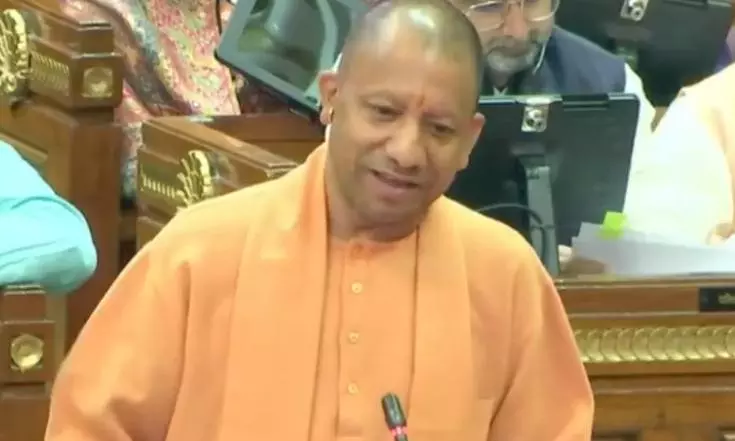
Hyderabad: Students of Maulana Azad National Urdu University (MANUU) on Wednesday staged a protest in the varsity campus against Uttar Pradesh Chief Minister Yogi Adityanath and termed his recent utterances as ‘anti-Urdu’ and ‘reflective of deeper prejudices’. The massive turnout of protestors saw them voice their concerns over what they described as an attack on Urdu’s cultural and historical significance in India.
Addressing the gathering, research scholar Talha Mannan stated that Adityanath’s comments should not be viewed in isolation but as part of a broader pattern of hostility.
“His anti-Urdu remarks are a manifestation of deep-rooted anti-Muslim hatred,” he said.
Another student said that while Urdu is an essential part of India’s linguistic and cultural heritage, it holds particular significance for Muslims due to its vast repository of religious and intellectual literature.
“Yogi’s remarks are not just about a language; they target the intellectual, political and cultural legacy of Muslims, which is deeply embedded in Urdu,” he added.
Mateen Ashraf, outgoing president of the MANUU Students’ Union, spoke about Urdu’s historical role in shaping India’s cultural and political landscape. “Urdu is the language of Mahatma Gandhi, Munshi Premchand, Chakbast, and many other luminaries. It played a crucial role in the freedom movement. Yogi’s remarks not only undermine and insult this legacy but also expose deep-seated hatred against an indigenous language,” he said.
The students stressed that the issue extended beyond political rhetoric and called upon the faculty and administration of MANUU to take a stand against such statements.
Given that it was the only central university dedicated to Urdu, they argued that it had a responsibility to safeguard the dignity and stature of the language and promote its historical contributions.
The protest reflected widespread frustration among students, who view attacks on Urdu, as attempts to marginalise a language deeply intertwined with India’s history. Praising Urdu and its legacy, they asserted that linguistic diversity is fundamental to the country’s identity and must be protected.
The students demanded a more inclusive and respectful approach toward linguistic heritage, urging educational institutions and the civil society to stand against vilification of Urdu.
