Leaders Remember Pingali Venkayya's Legacy and Service

2 Aug 2026 12:41 PM IST2 Aug 2026 12:41 PM IST
Apart from his role in the independence movement, Venkayya was a lecturer, author, geologist, educationalist, agriculturist, and a polyglot
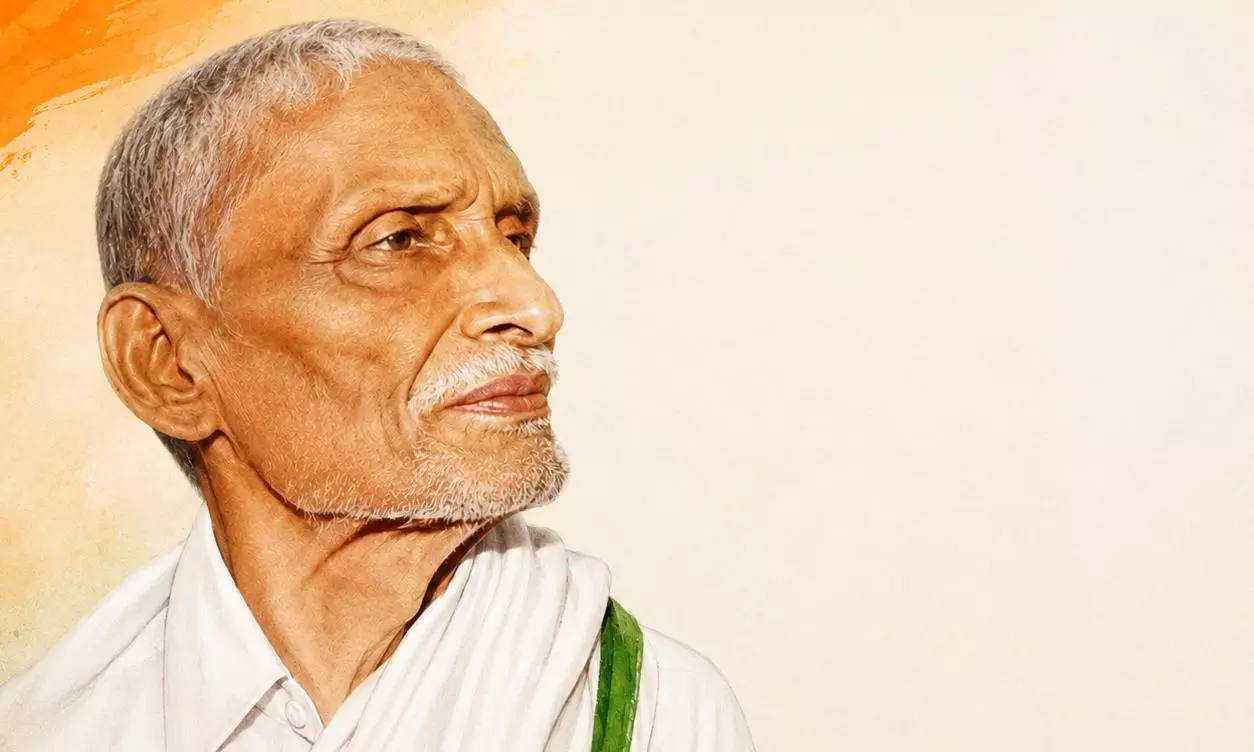
Freedom fighter Pingali Venkayya. (Photo: X)
Hyderabad: Eminent personalities recalled the services of Pingali Venkayya who was an Indian freedom fighter, known for designing Indian National Flag in connection with birth anniversary.
“Remembering Pingali Venkayya on his birth anniversary the visionary whose design laid the foundation of India's National Flag. A freedom fighter, educationist and patriot, his contribution continues to inspire generations and stands as a timeless symbol of unity, courage and national pride,” Union Coal Minister G Kishan Reddy said in a post on ‘X’.
Pingali Venkayya was an Indian freedom fighter, known for initial design of Indian National Flag. Apart from his role in the independence movement, Venkayya was a lecturer, author, geologist, educationalist, agriculturist, and a polyglot.
Venkayya joined the British Indian Army at age 19 and served in South Africa 1899 to 1902. During his service, he recognized the need for a national flag for India as Indian soldiers were required to salute the Union Jack, the British flag. Inspired by his experience and later by attending the 1906 AICC session in Calcutta, he developed a vision for a flag representing Indians, opposing the practice of hoisting the British flag at Congress meetings.
Venkayya presented his design for an Indian national flag to Mahatma Gandhi in 1921 during Gandhi's visit to Vijayawada. The flag initially consisted of red and green stripes representing Hindus and Muslims, respectively, and, on Gandhi's suggestion, a white stripe was added to represent other communities in India. This flag design was used informally at Congress meetings from 1921 and served as the foundation for the Indian national flag, which was officially adopted in its final form by the Constituent Assembly on July 22, 1947.
Venkayya was an agriculturist, as well as an educationist who set up an educational institution in Machilipatnam. Despite his contributions, he died in poverty in 1963 and remained largely unrecognized in his later years. In 2009, the Indian government issued a postage stamp in his honour.
( Source : Deccan Chronicle )

Next Story