KU Researchers Study Tornado-Like Damage Caused in Mulugu Forest

When warm, moisture-laden air rises rapidly due to atmospheric instability, it creates powerful rotating wind currents that can extensively damage forests, houses, and structures.
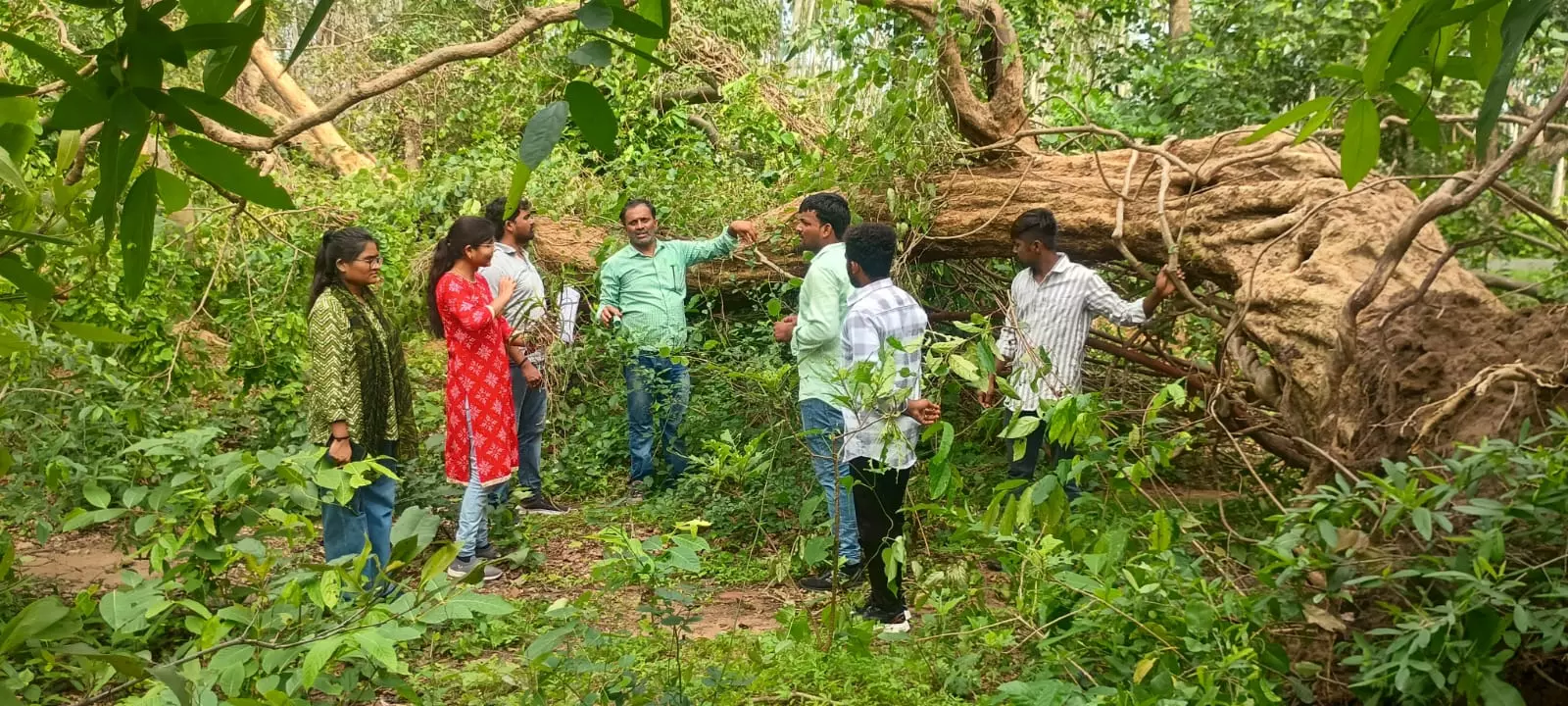
MULUGU: A team of researchers from Kakatiya University (KU) in Warangal on Sunday studied the causes for scores of trees getting uprooted when tornado-like winds struck the forest in Mangapet mandal of Mulugu district recently.
Led by environmentalist and botanist Dr. Sutari Satish, the team visited the forest area near Sandroni Ooru on the Mangapet-Komatipalli road to assess the extent of the damage.
Summing up after the inspection, Dr. Satish said that tornado-like winds had lashed the area on July 28 and uprooted more than 200 trees. He explained that trees growing in t54rn often develop shallow, surface-level root systems, instead of deep roots, making them highly vulnerable to powerful winds.
Among the species of trees affected are Tunika, Dumpena, Tanikkaya, Vishamushti, Eucalyptus, Kanuga, Juvvi, Neem, and Soapnut, many of which are ecologically and economically valuable.
The team leader said tornado-like conditions develop when warm, moisture-laden air rises rapidly due to atmospheric instability, creating powerful rotating wind currents capable of causing extensive damage to forests, houses, and other structures.
He recalled a similar incident on August 8, 2024, when about 1.5 lakh trees over nearly 800 acres of forest had been devastated in the Eturnagaram Wildlife Sanctuary near Medaram.
Dr. Satish attributed the increasing severity of such weather events to human activities, including indiscriminate felling of trees, illegal sand mining, and the destruction of natural landscapes, which disturb ecological balance and heighten the impact of extreme weather.
Researchers Vanguri Anil Kumar, Pasula Janakiramudu, Dakuri Varsha, Naitham Indu, Kathi Sandeep, and Pagadala Sai Kumar participated in the study.