Krishna, Godavari Staring at Deficit Rains in Catchment Areas

Weak rainfall in catchment areas could affect reservoirs and water supply.
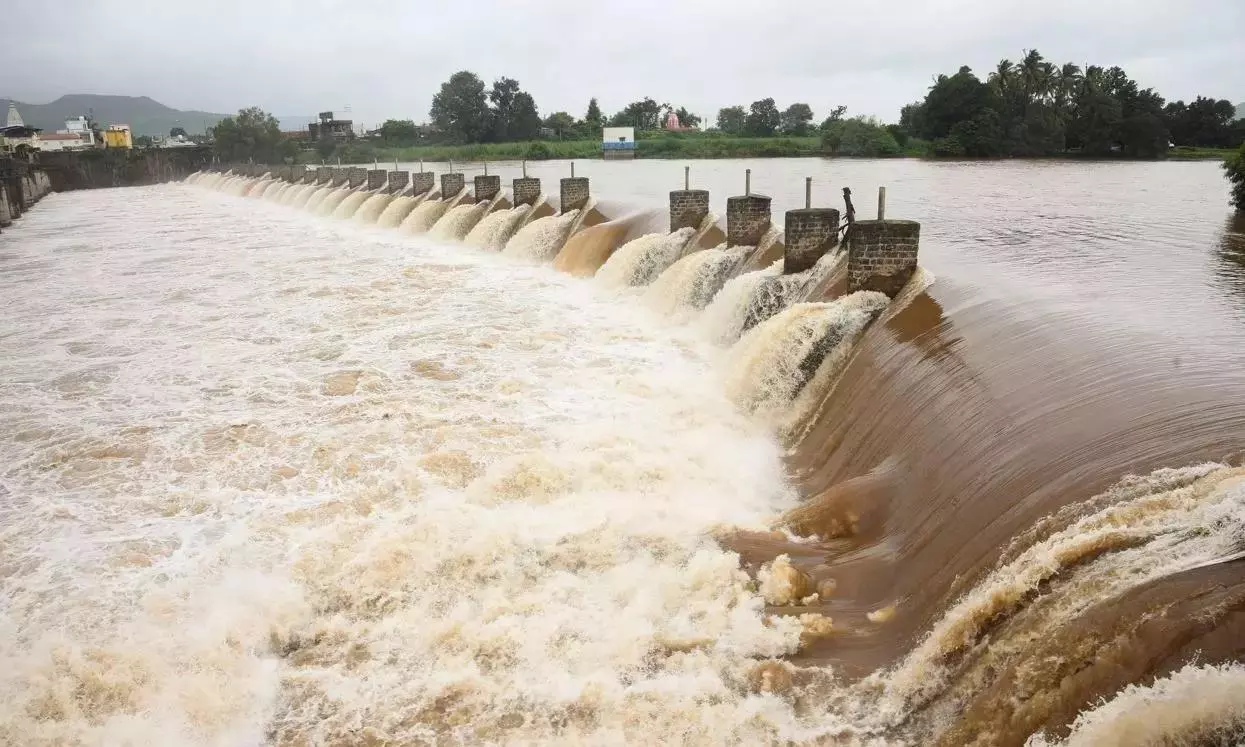
Hyderabad: Flows in the Krishna and Godavari rivers, the lifelines for Telangana, could be under jeopardy with this year’s monsoon season expected to deliver a severe deficit in rainfall in their catchment areas. While rainfall in the upper riparian states of Maharashtra and Karnataka holds the key to just how well Krishna will flow this year, for Godavari, the key states are Maharashtra and Chhattisgarh, with the former being the top contributor to the river entering Telangana.
“This year’s monsoon predictions point to a 30 to 40 per cent deficit in the catchment areas of the two rivers. If this comes true, then just how strongly the rivers will flow this year in Telangana, and if the shortfalls impact reservoir levels during and post monsoon, is a question that is up in the air,” a senior meteorologist said.
Incidentally, according to the Central Water Commission, the reservoirs in Telangana on both Krishna and Godavari have just about 40 per cent of their storage capacity after a good monsoon year.
“We are looking into all aspects related to the monsoon forecast and the possible impact on the river flows and storage,” irrigation principal secretary E. Sridhar told Deccan Chronicle.
Typically, during El Nino years, the overall rainfall in the country falls below the normal levels, and this year is not expected to be any different. For instance in 2015, the year when a strong El Nino impacted the monsoon, the Jurala dam, the first structure on Krishna in Telangana, received a total of 45 tmc during the monsoon season after Karnataka released water from its upstream Almatti and Narayanpur dams on the river.
In a good rain year, as was the case in 2005-06, the same Jurala received as much as 1,635 tmc ft of water. According to the Krishna River Management Board, the 2015 El Nino year was also the poorest with respect to the Srisailam dam, which got only 74.24 tmc ft of water for the entire year, both from Krishna and the Tungabhadra, that joins the Krishna before the latter reaches Srisailam. The Srisailam dam, when rains are plentiful, can store a total of 215.81 tmc ft of water, which was the case in 2025 despite the dam gates being opened several times due to heavy inflows.
The inflows at Srisailam are critical for Telangana as Nagarjunasagar reservoir — on which Telangana depends heavily for irrigation and drinking water needs – itself depends on releases from Srisailam.
Meanwhile, the Sriram Sagar Project (SRSP) the first storage point in Telangana on Godavari river, also delivered a shock in 2015, getting just around 2 tmc ft of water while in 2025, which was a good rain year for the country, and the river’s upper catchment areas, SRSP reached its full capacity of 80.50 tmc ft.
