Kos Minar in Old City Waiting for Restoration

Historians say that the twin Kos Minars once dotted the stretch between Golconda and Machilipatnam, but most were destroyed during modern infrastructure projects.
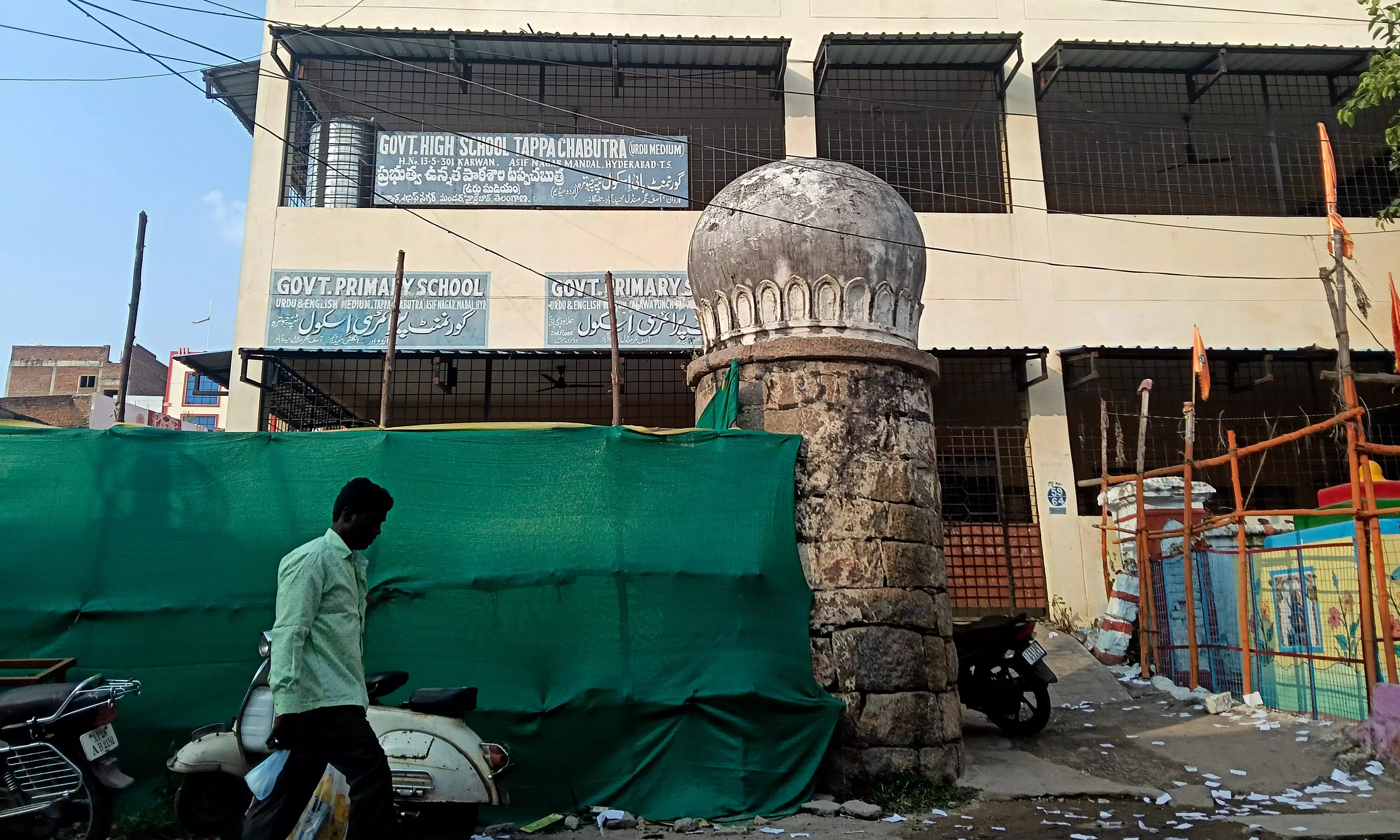
Hyderabad: The architectural legacy of the Qutb Shahi dynasty includes the historic Kos Minars—distance markers built along the Golconda–Machilipatnam route to guide traders, travellers and troops. Over the years, many of these Kos Minars have disappeared, demolished during road-widening projects. One surviving structure stands at Kulsumpura in the Old City, though it now lies neglected and in urgent need of restoration.
The Kulsumpura Kos Minar, located near the Qutb Shahi Masjid, was built during the reign of Ibrahim Qutb Shah and marks the border of the Ilaqa Qila Golconda, said heritage activist Mohammed Habeebuddin. Once part of a complex that included a Sarai for travellers, the monument today is barely recognisable as a heritage structure. “It is treated like any other pillar and even used for support. The surrounding structures have vanished due to negligence,” he said.
From the time of the dynasty’s founder, Sultan Quli Qutb Shah, routes to the east of Hyderabad were vital to the kingdom’s economy, connecting the inland fort with coastal ports that handled international trade. A Kos is an ancient unit of distance, roughly three kilometres, while Minar means pillar. Beyond marking distances, these markers symbolised administrative efficiency and connectivity, helping the movement of troops, securing trade routes and guiding travellers.
Historians say that the twin Kos Minars once dotted the stretch between Golconda and Machilipatnam, but most were destroyed during modern infrastructure projects. Sajjad Shahid, secretary of the Centre for Deccan Studies, recalled that one Kos Minar stood near or beyond Saroornagar on the old highway and another near Sultan Nagar, both lost to road expansion. “These structures are small and can easily be preserved within modern planning. But instead of protecting them, authorities prefer demolition,” he said.
Archaeologists and historians note that several Kos Minars once existed in areas such as Karwan, Hayathnagar, Almaspet and Choutuppal. Lack of awareness and planning led to their loss. Historian Dyavanpalli Satyanarayana said the Golconda–Machilipatnam route, also known as Bandar Road, served for trade and army movements, referred to locally as Dhandu Baata. “After Dhandumailaram, these minars appeared every ten miles,” he said, adding that the structures were first built in the 1520s and successive rulers added more of them over time.
