Kishan Speaks of Global Market for Telangana Weavers

The state’s renowned products, such as Pochampally Ikat, Gadwal saris, Narayanapet cotton saris, and Warangal carpets, had received the ‘geographical index’ tags and gained global recognition
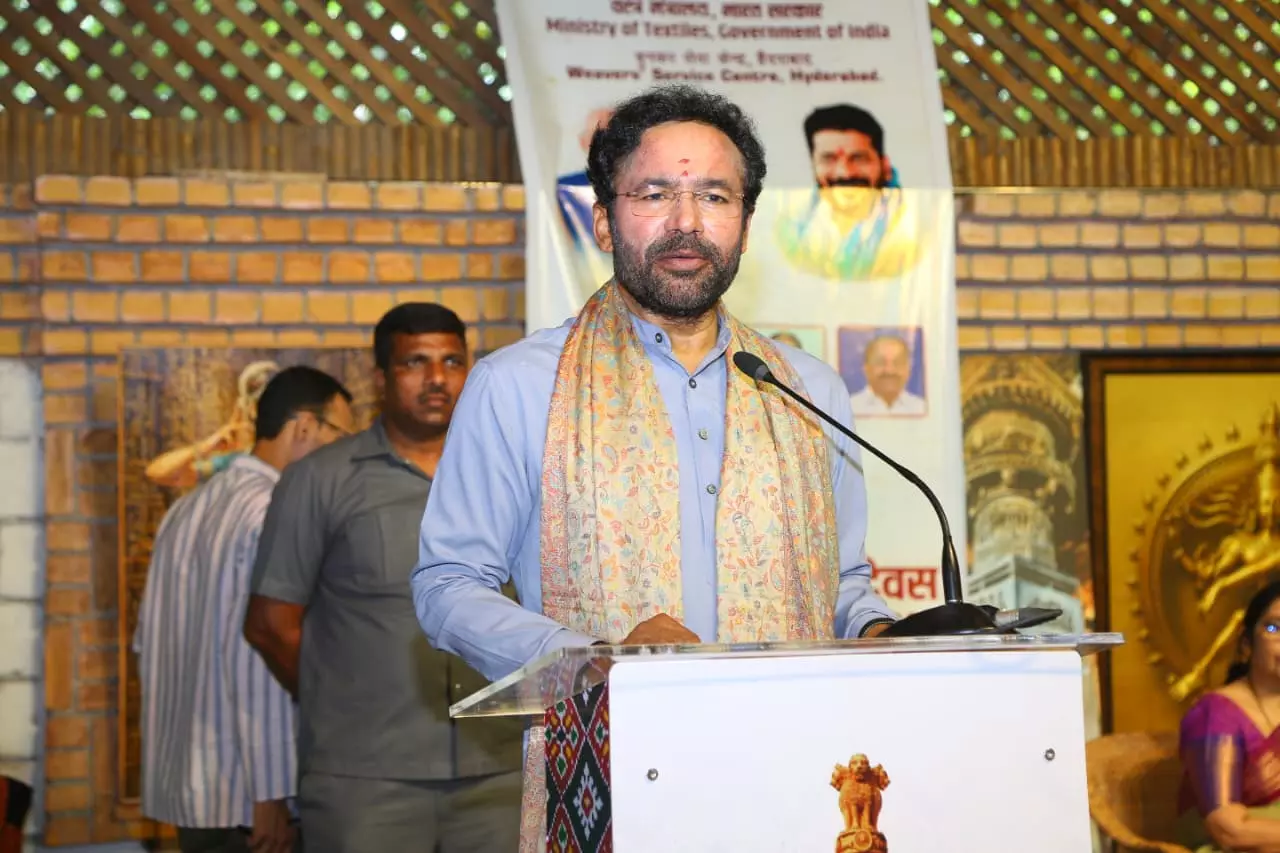
HYDERABAD: Union minister G. Kishan Reddy highlighted the status of Telangana stands as an international handloom hub,housing over 17,000 handlooms and nearly 48,000 artisans. The state’s renowned products, such as Pochampally Ikat, Gadwal saris, Narayanapet cotton saris, and Warangal carpets, had received the ‘geographical index’ tags and gained global recognition.
Speaking at an event to mark the week-long National Handloom Day celebrations starting August 7 at Shilparamam, Kishan Reddy said Telangana’s weavers had their exquisite craftsmanship at expos in Australia, Germany, Italy, and the USA and had gained valuable insights into global markets and promotional strategies. These efforts were supported by the establishment of 31 handloom producer companies and infrastructure upgrades in clusters at Siddipet, Kamalapur, Dubbak, and Warangal.
One of the flagship initiatives is the Kakatiya Mega Textile Park in Warangal, a Rs 10,000 crore investment project expected to generate employment for 2 lakh people. Under Prime Minister Modi’s leadership, Kishan Reddy said, Telangana had been selected to host one of seven prestigious PM-Mitra parks to accelerate integrated textile manufacturing. The distribution of 100 Jacquard looms and skill development programmes training over 900 weavers were revitalising traditional crafts with modern techniques. Additionally, with Rs 70 crore in microcredit aid, the government was empowering weavers to expand production and sustain their livelihoods.
Kishan Reddy called on all stakeholders to unite in supporting the handloom sector. He underscored the critical role of the handloom and textile sector in India’s economy and highlighted the transformational support extended by Prime Minister Modi’s government.
He emphasised that after agriculture, the handloom industry was the largest employment generator, directly and indirectly supporting nearly 50 million livelihoods. The sector contributes 2.3 per ent to India’s GDP, 13 per cent to industrial output, and accounted for 12 per cent of national exports.
With consistent growth over the past 11 years, driven by the Centre’s Make in India initiative and the comprehensive 5F strategy — Farm to Fiber, Fabric, Fashion, Foreign Markets, and Vision — the handloom industry was emerging as a major global player, he said. India was the sixth-largest exporter of handloom and textile products worldwide.
In 2023-24, the sector achieved exports worth Rs 3 lakh crore, with an ambitious target to triple this to Rs 9 lakh crore by 2030. Support mechanisms like the Production Linked Incentive (PLI) scheme and the National Handloom Development Project (NHDP) provide weavers with marketing infrastructure, concessional loans, and modernization assistance, Kishan Reddy pointed out.
