Jayesh Ranjan Asks Officials to Conserve Water, Electricity amid El Niño Threat

The State government had appointed 10 senior officers as special officers for the 10 erstwhile undivided districts and had initiated measures to tackle El Niño conditions: Jayesh Ranjan
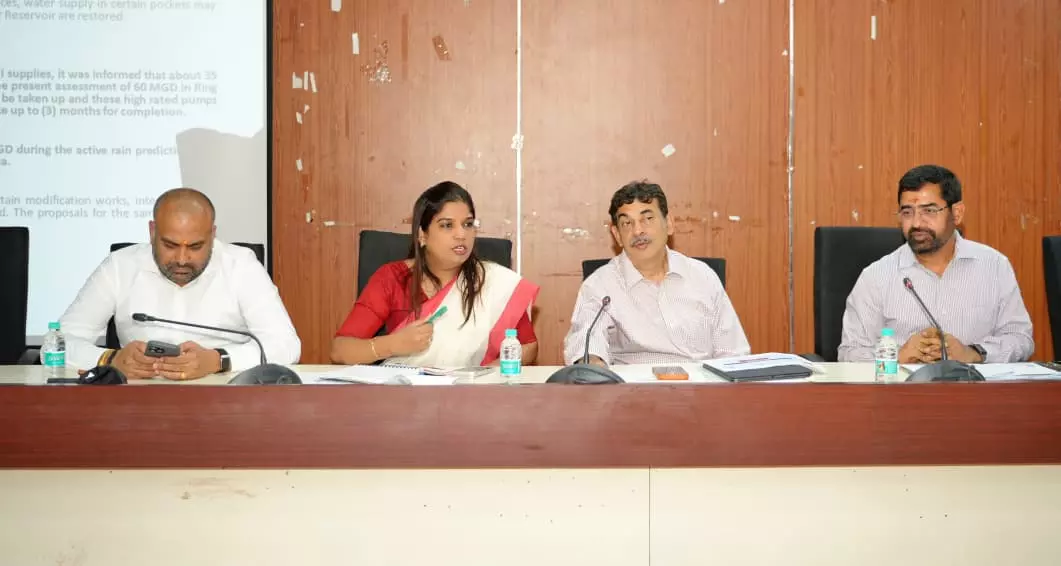
Hyderabad: Government Special Chief Secretary Jayesh Ranjan on Friday asked officials to take precautionary measures for water conservation, protection of groundwater and electricity conservation in view of the impact of El Niño and adverse weather conditions in the district.
He conducted a review meeting on the precautionary measures to be taken at the Hyderabad Collectorate conference hall in Lakdikapul, along with District Collector Dr. Priyanka Ala, Hyderabad Metropolitan Water Supply and Sewerage Board (HMWSSB) Managing Director K Ashok Reddy, TGSPDCL Managing Director Jitesh Patil, GHMC Commissioner R.V. Karnan and officials of the concerned departments.
He stated that the State government had appointed 10 senior officers as special officers for the 10 erstwhile undivided districts and had initiated measures to tackle El Niño conditions.
He observed that Hyderabad is an urban area with high drinking water requirements and electricity consumption, and stressed the need to take measures through advance planning to prevent any difficulties in the coming months.
He stated that extensive awareness programmes would be conducted through various media to ensure that every household reduces its water consumption by at least 20 per cent. He made it clear that those illegally installing motors on HMWSSB pipelines to draw water would be identified and the motors removed, with fines and penalties imposed wherever necessary.
He also stated that HYDRAA services would be utilised to identify violations, including illegal extraction of water and misuse of resources, and take action against them.
He stated that measures would soon be taken to use treated sewage water discharged into the Musi River for purposes that do not require drinking water, such as industrial use, data centres, gardening, landscaping and maintenance of central medians.
For this purpose, filling stations would be established at sewage treatment plants (STPs) to make treated water available.
Ashok Reddy stated that bookings for water tankers had increased due to reduced rainfall and declining groundwater levels. Normally, around 3,500 tanker bookings are recorded during this month, whereas approximately 7,000 bookings are currently being recorded, he observed.
He explained that groundwater levels had declined by more than five metres compared to the previous year.
He stated that, as there had been no inflows into the Manjeera and Singur reservoirs this year, the water currently available would be sufficient only until December.
Plans were being prepared to supply water through alternative sources. He said that, in addition to making extra water available through the Godavari Drinking Water Scheme, the possibility of drawing additional water from Krishna waters and establishing additional filter beds at Himayat Sagar and Osman Sagar was also being examined.
He stated that, of the 13 treated water filling stations identified under the HMWSSB jurisdiction, three to four were currently operational. The target was to make all 13 stations operational by November 1. Another 20 filling stations would be established over the next 15 days.
He stated that measures would be taken to ensure that 90 per cent of the water required for construction activities was sourced from treated water available in nearby areas. Steps would also be taken to make the use of treated water mandatory for landscaping in all areas, including government institutions.
He stated that a mobile application, ‘Dial a Green Tanker’, would be introduced to enable online booking of treated water through tankers. He explained that 22,000 groundwater recharge structures had been taken up this year and that a plan was being formulated to provide groundwater recharge facilities to every household over the next five years.
TGSPDCL Managing Director Jitesh Patil appealed to the public to conserve electricity along with water. He stated that electricity demand in the State had reached 20,018 MW, registering a new peak. He noted that electricity demand was likely to increase further during the coming summer months, particularly in March and April.
He stated that government offices should set an example for society by maintaining air conditioner temperatures at 25 degrees Celsius and reducing electricity consumption during evening hours.
He advised people to inspect electrical wiring in their homes and exercise due caution when using appliances such as electric cookers, induction stoves and air conditioners simultaneously. He urged people to remain alert to prevent electrical accidents and fires and to use electricity only as required.
He also stated that the installation of rooftop solar power systems was being encouraged and advised people to plan their electricity consumption in accordance with the availability of solar power during the daytime.
He appealed to the public to reduce electricity consumption between 5 pm and 10 pm. He stated that TGSPDCL personnel were available round the clock to resolve electricity supply-related issues and that a 1912 control room had also been established.
Karnan stated that instructions had already been issued to the Urban Biodiversity Department with the objective of restricting the use of drinking water to essential requirements. He made it clear that drinking water would not be used for gardening, landscaping and maintenance of central medians.
He stated that the Municipal Administration Department would extend full cooperation to the Government's water and electricity conservation measures being undertaken to tackle El Niño conditions.
India Meteorological Department scientist Sravani stated that night-time temperatures, along with daytime temperatures, were increasing and the onset of winter was being delayed. She also noted that rainfall during the withdrawal phase of the northeast monsoon was likely to be below normal.
She expressed hope that rainfall could occur in November due to cyclone-related weather systems. Deputy Director of the Ground Water Department Harish stated that rainfall and groundwater levels were being continuously monitored through 33 piezometers established across the district's 16 mandals.
He explained that only three mandals had received normal rainfall so far, while the remaining 13 mandals were experiencing a rainfall deficit. He stated that the average groundwater level, which was at a depth of 3.55 metres below ground level last year, had now declined to 10 metres.
District Collector Dr. Priyanka Ala stated that special officers would be appointed to monitor the situation at the field level across all 16 mandals of the district. She directed Ground Water department officials not to issue permissions for new borewells in order to prevent the misuse of groundwater. She stated that necessary instructions would be issued to monitor water and electricity consumption and ensure coordinated action among departments, along with undertaking extensive public awareness programmes.
She said that the next review meeting would be held after 15 days to assess the situation and review progress in implementing the measures.