India prospered when science thrived, says Rajnath

Rajnath said India has faced great hurdles for betterment of our society and economy, moving from perpetual scarcity to building competence in raw material for machines and heavy equipment, pharmaceuticals, textiles, cement, steel and other industries
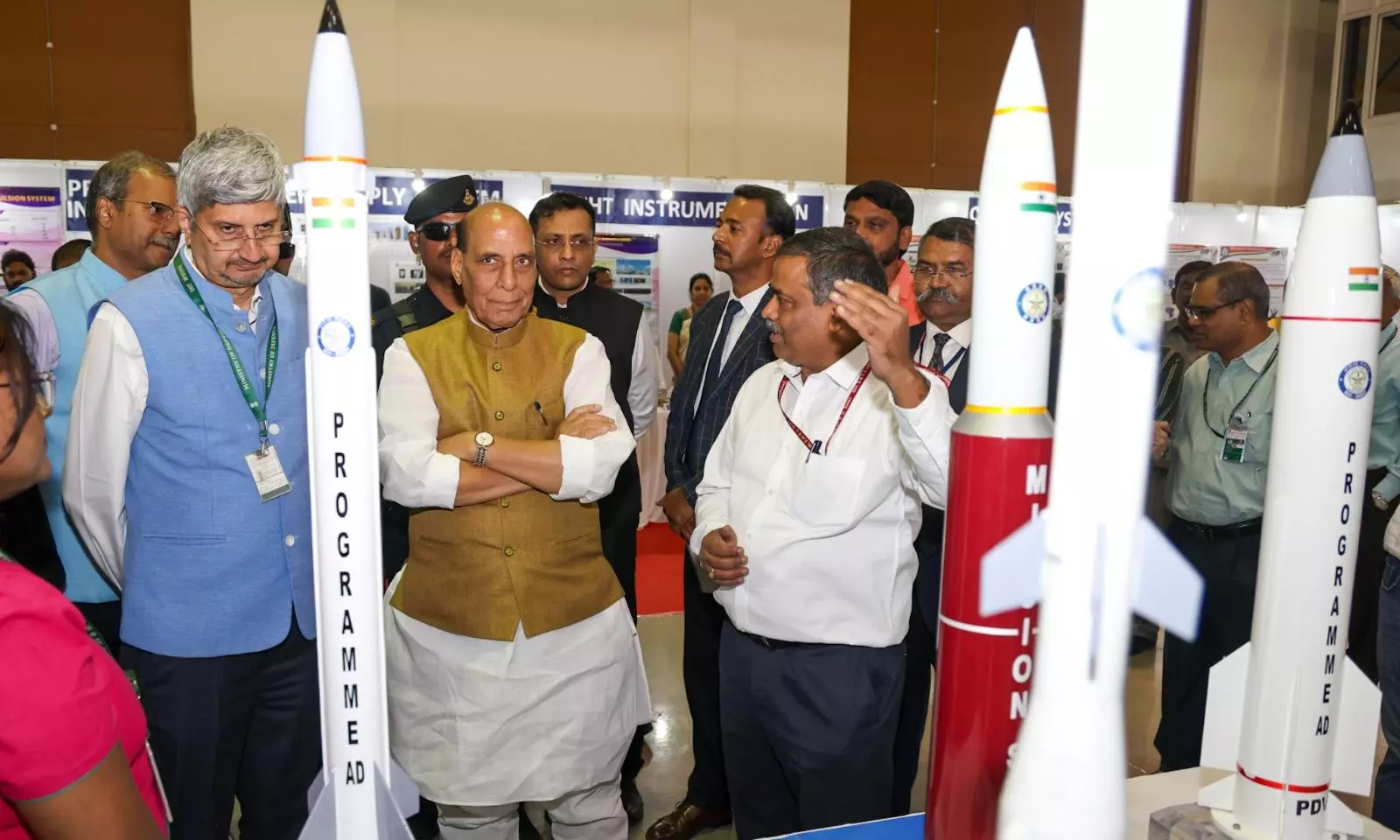
Hyderabad: Recalling the significant contributions of India to science from ancient age to modern period, defence minister Rajnath Singh urged youth to develop a scientific temper and enable India's leadership on the global platform on the occasion of National Science Day.
Addressing students and scientists at an event organised by DRDO at Gachibowli Stadium in Hyderabad on Friday, he said the heliocentric model of the solar system, the value of pi, and the decimal system were some of the contributions made by India in the field of science and some of the greatest Indian minds such as Aryabhatta and Bhaskaracharya making this knowledge available to the humankind even before Westerners such as Copernicus and Galileo.
"When India prospered in science, its economy prospered too. At the time of Independence, while we excelled in science, economic growth remained low. After Independence, the first economic transformation brought by science was in the field of agriculture, in what came to be known as the Green Revolution," Singh said. This led to self-sufficiency of food in India and proved the victory of science over hunger.
He said India has faced great hurdles for betterment of our society and economy, moving from perpetual scarcity to building competence in raw material for machines and heavy equipment, pharmaceuticals, textiles, cement, steel and other industries.
"Modern progress cannot be thought of without consistent scientific evolution and scientific society interface. Science has proved to be the biggest chapter in human welfare. Our progress is also based on science. When we send a satellite in space, our weather forecasting gets better, our farmers get timely information and fishermen get early warnings of sea activities, our communication gets extended and our students get classes online," the minister said.
Singh urged students to take lead roles in harnessing the power of existing infrastructure. "War is increasingly moving from hardware to software. New technological breakthroughs are on the horizon and we have to take a lead in transformative technologies such as Artificial Intelligence, Quantum Computing, Machine Learning and Clean-tech. India can remain strong and secure in adverse situations if it has solutions to critical technological challenges," he said.
Stating that the New Education Policy, 2020, "aims to transform scientific education by inculcating creativity, critical thinking and innovation," Singh said "it is the joint responsibility of the Centre and the state to ensure that the future generations get the best possible education," since education is a concurrent subject as per the Constitution.
"This day is celebrated to honour Sir C.V. Raman, whose discovery of the Raman Effect in 1928 won him the Nobel Prize in 1930 and the day has been celebrated as the National Science Day since 1986. I have a personal affinity with the subject, being a student of science and having served as a lecturer of physics, before entering public life. Curiosity has always driven me and I want the youth of today to imbibe the same attitude," the defence minister said.
