IIT-H Hackathon Showcases Fintech Innovation

The two-day event saw 72 shortlisted teams present their prototypes, with 18 making it to the final round
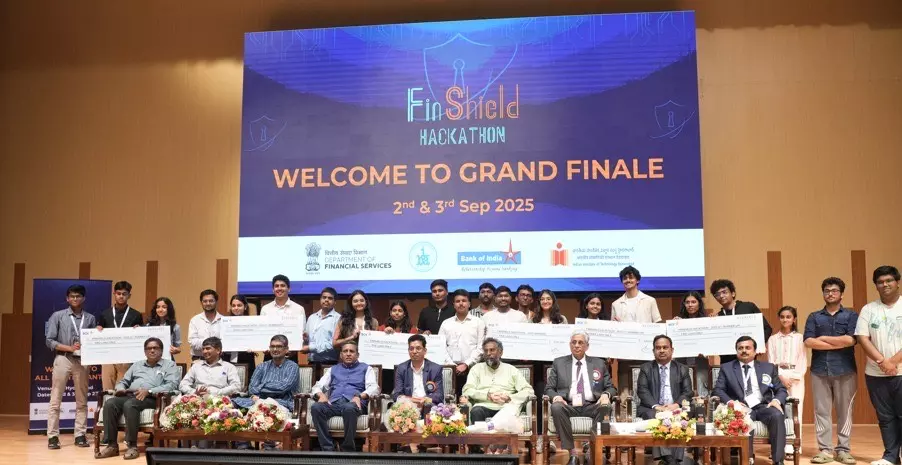
Hyderabad: From predicting loan defaults through unconventional data to building password-less logins that stop fraudsters in their tracks, students from across India demonstrated how artificial intelligence can reshape banking at the FinShield Hackathon 2025 finale in IIT Hyderabad.
The two-day event saw 72 shortlisted teams present their prototypes, with 18 making it to the final round. Their task was clear: design a smarter credit risk model and create secure authentication systems to tackle impersonation and online banking fraud. For the young participants, the challenge was not just about winning but about testing whether their solutions could stand up before industry experts.
Among the winners was Team Jigyasa from IIIT Kottayam, which took first prize in the fraud detection problem. Their app used a support vector machine to monitor every swipe and touch of a user’s phone, turning it into a unique behavioural fingerprint. “We built an app that can detect SIM hijacking or impersonation attacks because everyone has a distinct way of using their device. If someone else tries to access it, the system flags it immediately,” explained Lavanya Rajan.
Her teammate, Vipal Srivastav, reflected on the team’s journey: “We initially tried neural networks but realised they wouldn’t be practical in real-world banking systems. Moving to support vector machines taught us how different research is from actual implementation. That experience was more valuable than the prize.”
Other winning teams came from the Indian Institute of Petroleum and Energy in Andhra Pradesh, Gautam Buddha University in Delhi, Manipal Institute of Technology in Karnataka and Amrita Vishwa Vidyapeetham in Kerala. Their innovations ranged from AI-powered credit risk prediction to user-friendly authentication designs that banks could realistically adopt.
Students said the hackathon demanded quick iteration and critical choices under pressure. One participant described it as “two months of trial, error and discovery squeezed into a single stage.” For many, the biggest gain was exposure to real problems faced by banks and the opportunity to present solutions directly to decision-makers.
While dignitaries from the ministry of finance, the Indian Banks’ Association and Bank of India were present, the real focus of the event was the fresh perspective students brought. Officials acknowledged that some of the solutions had immediate potential for scalability. IIT Hyderabad’s director Prof. B.S. Murty summed it up: “Events like this show how student innovation can move straight from classrooms to the financial system.”
