IIITH Scholar’s Dance Education Tool Bags Patent

25 July 2025 11:16 PM IST25 July 2025 11:16 PM IST
IIITH scholar codifies classical dances, bags patent
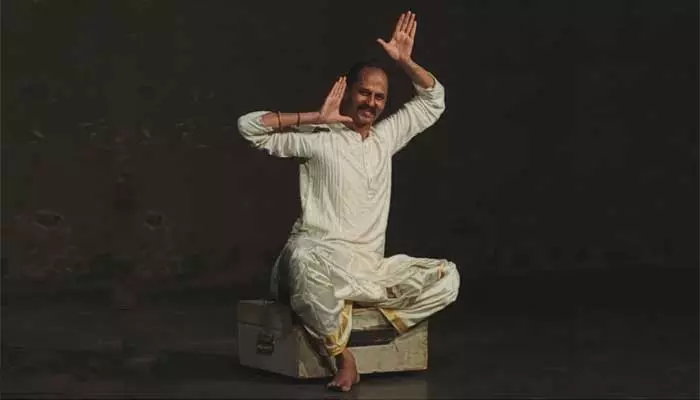
Jayachandran Surendran, a senior researcher at IIIT Hyderabad, has developed Atam, a patented cross-style classical dance pedagogy system rooted in Tandava theory, combining tradition with technology (Image:DC)
Hyderabad: An engineer-turned-dancer and doctoral researcher at IIIT Hyderabad has developed one of the country’s rarest patented tools in the arts domain, a form-neutral, style-neutral pedagogy system for classical dance.
Jayachandran Surendran, a senior research scholar and lecturer at the institute’s Center for Exact Humanities, recently defended his PhD based on Atam, the patented tool he built to formalise fundamental dance movements and support cross-style training.
“I realised that many classical dance forms in India, though diverse, share universal principles of movement. Atam bridges tradition with cognition,” Jayachandran said. The tool, which analyses Indian dance theory across styles through the lens of Tandava, also draws on ethnographic work in temple rituals, Shaiva philosophy and performance practice.
Originally an electronics engineer from Salem, Jayachandran left behind a rising corporate career at Wipro to join Kalakshetra, South India’s leading classical dance institute, for nearly a decade. He later joined IIITH in 2014 after receiving mentorship under iconic gurus, including Leela Samson, C. V. Chandrashekhar and Bragha Bessell.
At IIITH, his work spans temple architecture, Indian aesthetics and computational analysis of Abhinaya (expression). “This institution gave me the academic freedom to collaborate across cognitive science, computer vision and performance studies. It’s rare for arts and sciences to converge like this,” he explained.
Jayachandran’s research is based on fieldwork with Kondi Devadasi practitioners, archives of Kalakshetra and Shaiva texts. He has taught foundational movement theory to engineering undergraduates for several years at IIITH and has conducted gesture workshops internationally.
His patent for Atam comes at a time when there is growing interest in integrating traditional Indian knowledge systems into higher education frameworks. “If Tandava is the source of movement, we must be able to teach it across disciplines, not just to dancers but also architects, animators and AI researchers,” he noted.
While traditional performers often rely on oral knowledge, Jayachandran’s work attempts to codify and preserve movement systems, a shift many scholars view as crucial for future-proofing India’s intangible heritage. “The banyan tree has been my metaphor, Kalakshetra had one, and so does IIIT-H. They nurtured me, and now I seek the next.”
( Source : Deccan Chronicle )

Next Story