The institute’s iHub-Data, drawing on prior research from the Centre for Visual Information Technology, has deployed an artificial intelligence-based system called Vahan Eye to monitor sand transport vehicles for the Telangana Mineral Development Corporation.
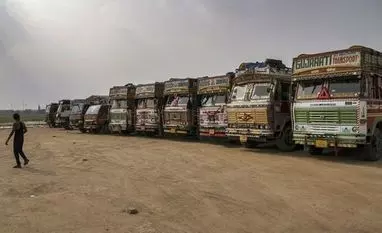
HYDERABAD: When standard number plate recognition systems failed to read India’s hand-painted truck plates, researchers at the International Institute of Information Technology Hyderabad (IIIT-H) developed a solution tailored for Indian highways.
The institute’s iHub-Data, drawing on prior research from the Centre for Visual Information Technology, has deployed an artificial intelligence-based system called Vahan Eye to monitor sand transport vehicles for the Telangana Mineral Development Corporation. The aim is to track authorised trucks and curb illegal sand mining.
“Typical licence plates are actually easy to detect,” said Dr Veera Ganesh Yalla, CEO of iHub-Data and Adjunct Faculty at IIIT-H. “But in India, especially with trucks, plates are often hand-painted, inconsistent and highly variable. From vehicle to vehicle, the design and style are unique.”
Commercial automatic number plate recognition systems, designed for uniform plates, proved ineffective and costly. The IIIT-H team adapted a lab prototype, rebuilt the handwritten character recognition module, and integrated it as a plug-in into an open-source platform. “If anybody wants to plug in our licence plate technology into their platform, they can do it without rewriting everything,” Dr Yalla said.
The system was piloted at Chityal on the Vijayawada–Hyderabad highway. It tracks incoming trucks and cross-checks them against a whitelist of nearly 40,000 approved vehicles. Running since September, it has continued to improve with live data despite low light conditions and visual obstructions such as decorative garlands.
Built by a small team of fewer than five engineers using deep learning models such as YOLO and RF-Detr, Vahan Eye is now being customised for traffic violation detection. “Our IP is that we figured out how to solve this handwritten licence plate problem,” Dr Yalla said, adding that the goal is to make such public-interest technology affordable and scalable for government use.