IIIT-H Wins Award, Showcases Robotics Research at IROS

Hyderabad researchers showcase AI-powered innovations in robot navigation, drone operations and glass detection at IROS in Pittsburgh.
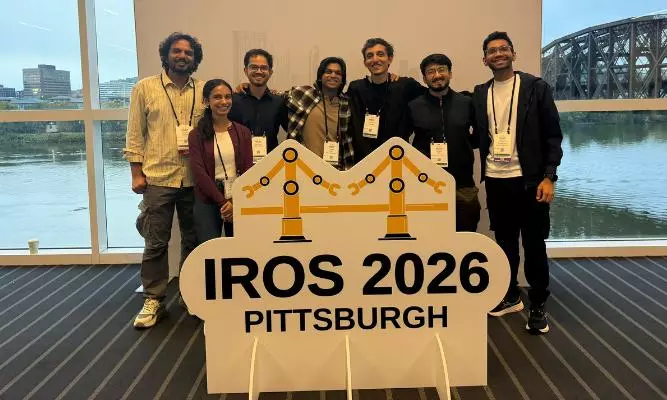
Hyderabad: From helping robots map unfamiliar spaces and detect glass walls to enabling drones to pick up objects and navigate safely, researchers from the International Institute of Information Technology, Hyderabad (IIIT‑H), presented a wide range of work at the International Conference on Intelligent Robots and Systems (IROS) in Pittsburgh, US. The institute also won a Best Paper Award.
The award‑winning paper Beyond Frontiers: Scene‑Anomaly Guided Autonomous Exploration, authored by Akash Kumbar and Abhinav Raundhal under Prof. K. Madhava Krishna, introduces SCAGE, a framework that helps robots identify gaps in 3D maps and reposition to capture areas not properly understood. “Exploration should be driven not just by where the robot has not been, but by what it has not understood,” Akash said. The award carried a $500 prize sponsored by Field AI.
Other papers explored ways to make aerial robots safer and more adaptable. AERMANI‑VLM, developed by Sarthak Mishra and colleagues under Profs. Wei Pan and Spandan Roy, allows drones with robotic arms to follow natural‑language instructions, separating AI decision‑making from actual movement to prevent unsafe commands. AeroGrab helps drones identify objects in cluttered spaces and choose collision‑free grasps, while AeroPlace‑Flow enables placement of objects using everyday language. Another AI‑based control system helps aerial robots adapt to changing loads and external forces.
Detecting transparent surfaces remains a challenge. IIIT‑H addressed this through GlassFormer, which combines camera images with millimetre‑wave radar. In low‑light tests, it scored 0.59 in detecting glass, compared with 0.49 for a vision‑only model. SILICA, another system, uses text‑to‑image AI knowledge to identify glass and estimate depth, improving 3D mapping without requiring labelled images.
Other innovations included NoContactNoWorries, which detects physical contact using cameras and robot movement data instead of touch sensors, and PixelLoop, which creates shortcuts in visual maps to improve navigation. In simulated tests, PixelLoop improved success and efficiency by over 35 percentage points compared with image‑level mapping.
A study on multi‑drone inspection missions proposed calculating spare fleet sizes to account for simultaneous replacements, achieving 99.8 per cent mission success across five scenarios versus 69.9 per cent with existing methods. At a workshop on long‑term perception, researchers also presented Radar‑Dot, which combines radar and camera images to help autonomous vehicles estimate movement and identify moving objects.
IIIT‑H students chaired two sessions on robot learning and vision‑language agents. Prof. K. Madhava Krishna, head of the Robotics Research Centre, said the institute’s papers had a 100 per cent acceptance rate at IROS, against an overall rate of less than 37 per cent.
IROS, co‑sponsored by the IEEE Robotics and Automation Society and the Robotics Society of Japan, is one of the two major annual international robotics conferences, alongside ICRA.
