Hyderabad’s Unwritten Traffic Rules Keep Chaos Moving

A raised eyebrow, a palm lifted briefly in permission or protest — these gestures may not follow any rulebook, but they work most of the time
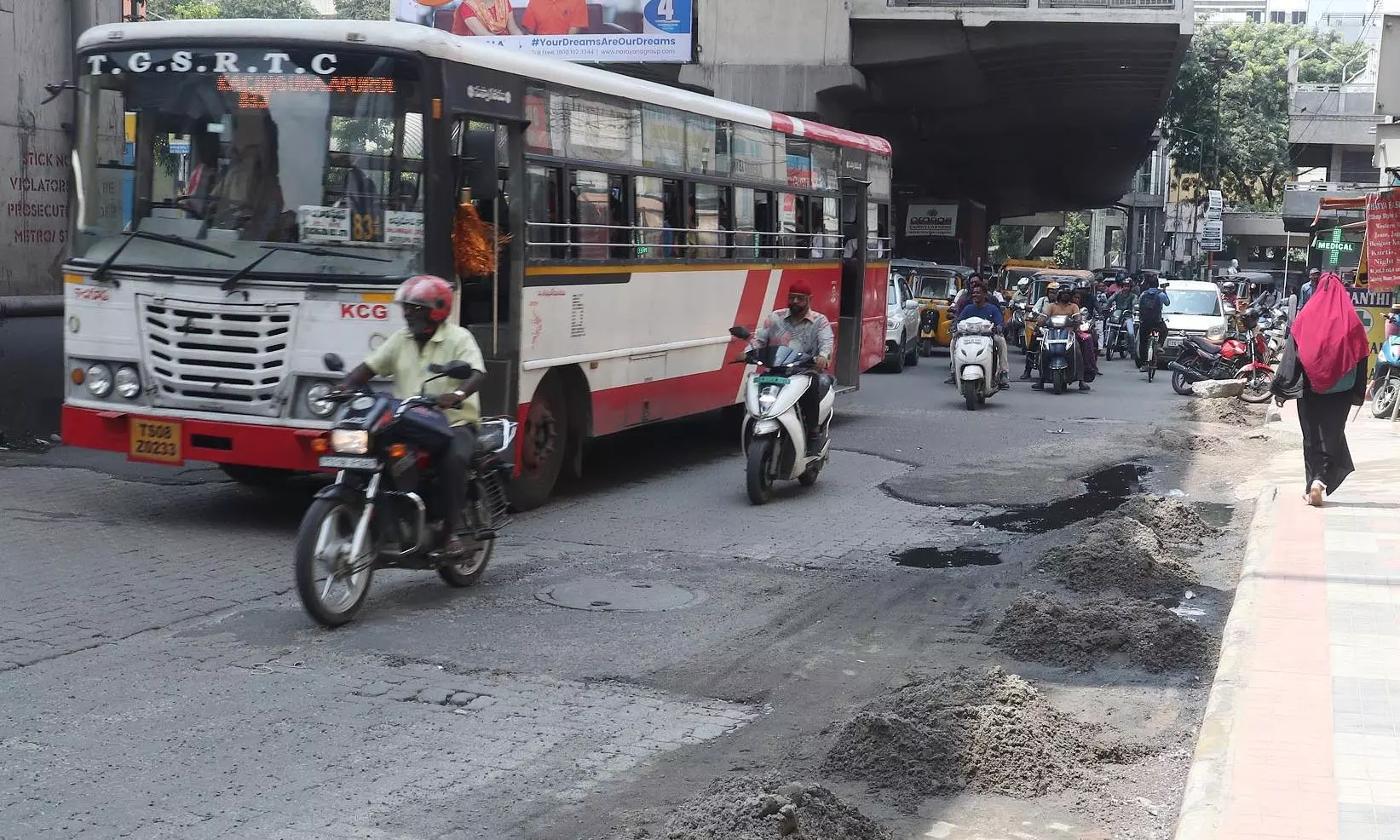
Hyderabad: Amid blaring horns, unpredictable traffic signals and pedestrians weaving through chaos, a silent yet surprisingly effective form of communication thrives on the city’s roads.
It’s not taught in driving schools, nor does it feature in traffic manuals — but eye contact, nods and subtle gestures have become an unwritten etiquette for many drivers and pedestrians. Though inconsistent, this informal language often provides just enough confidence to navigate Hyderabad’s bustling roads.
A bus traveller, Neelam Singh, who commutes daily to a jewellery shop in Panjagutta, recalled one such moment. “Sometimes it’s funny and sometimes it’s dead serious,” she said. “Punjagutta signal has traffic from all four sides. Catching the bus is my priority, and once the signal turned green, I found myself standing in the middle of the road. The driver was gentle, and we both hesitated, unsure who should go first.
Then he nodded — just once — and let me pass. He was a saviour.”
Whether at congested U-turns, roads with thick traffic or relatively quieter stretches, this unspoken language plays out daily. A raised eyebrow, a palm lifted briefly in permission or protest — these gestures may not follow any rulebook, but they work most of the time.
“There is no formal rule saying you should use hand gestures along with indicators,” said Ch. Bagyaraj, a social media manager. “Even before I started driving a four-wheeler, I used those gestures. And even after switching, a nod or a glance still makes sense. Jaywalkers and two-wheelers especially rely on it. Sometimes it turns funny — like when nobody decides to go. There are also funny hand gestures. I once saw a biker making a snake-like gesture with his hand while turning right, despite having an indicator. It looked odd, but it made sense.”
Be it bikers, autorickshaw drivers, car drivers or lorry drivers— many seem to agree on these informal signals. Yet, the system isn’t without its flaws. A traffic officer pointed out that these unspoken exchanges sometimes result in confusion. “There was an instance where two drivers assumed the other would stop — but neither did. They ended up colliding. Thankfully, it wasn’t serious, just a few bruises.”
Samuel M., a biker who travels long stretches for work, said his toughest moments are with three-wheeler goods carriers. “Half of my unpleasant experiences are with them,” he said. “People have created their own language outside the law to communicate. But with cargo vehicles, it’s tricky. There was an instance. Once, the truck driver was on the left side and I was slowly taking the right. He was using his hand, stating that he was taking a right turn, and that was not even visible. After I fell, the driver then claimed he was showing a sign. His indicator wasn’t working either, and I ended up falling.”
The traffic officer added, “While unspoken signs are helpful, indicators and signal lights are essential and must be maintained. The unspoken may fill the gaps — but the lights still speak the clearest.”
